If you open a standard history textbook today, you will likely read that the Rig Veda was composed around 1500 BCE, and that the great Indian epics—the Ramayana and the Mahabharata—are magnificent, but entirely fictional, mythological poems.
But as an engineer looking at these texts, a glaring contradiction emerges. If these were mere fairy tales starting with “once upon a time,” why did the authors embed hundreds of highly specific, complex astronomical observations into the verses?
The answer is simple, yet profound: the ancient sages of India were using the sky as a giant, unforgeable clock to timestamp their history. Today, through the science of archaeo-astronomy, modern technology is finally catching up to ancient wisdom, proving that India’s civilizational timeline is far older than we were taught.
The Colonial Compression of History
To understand how the date of 1500 BCE became the global standard, we have to look at the 19th-century European scholars who first translated these texts, most notably Max Müller.
These early Indologists approached Indian history through a specific, Eurocentric lens, heavily influenced by the Biblical timeline accepted at the time. According to this 19th-century worldview, the Earth was created around 4004 BCE, and the Great Flood occurred around 2400 BCE. Therefore, in their minds, no civilization could possibly predate these events.
Based entirely on linguistic guesswork—and zero archaeological or astronomical data—Müller arbitrarily assigned 1200–1500 BCE as the date for the Rig Veda. Even though Müller himself later admitted that these dates were purely speculative, the 1500 BCE timeline was cemented into global academia. Thousands of years of meticulously recorded Indian history were compressed to fit a pre-existing 19th-century framework.
The Paradigm Shift: Archaeo-Astronomy
Ancient Indian astronomers did not track time merely by days and years; they tracked it by the slow, predictable mechanics of the cosmos. They observed the precession of the equinoxes, the exact positions of planets (Grahas), and solar and lunar eclipses.
Because the Earth wobbles on its axis over a 26,000-year cycle (the precession of the equinoxes), the night sky changes steadily over millennia. A specific arrangement of planets, stars, and equinoxes is like a celestial fingerprint—it only happens once in thousands of years.
Modern Planetarium Software Meets Ancient Texts
Today, researchers do not have to guess. Using advanced planetarium software—the same mathematical modeling used by NASA and modern astronomers—we can wind the night sky backward to see exactly what the stars looked like thousands of years ago.
Pioneering researchers like Nilesh Nilkanth Oak and Rupa Bhaty have taken the hundreds of specific astronomical observations recorded by Maharishi Valmiki (in the Ramayana) and Maharishi Vyasa (in the Mahabharata) and plugged them into this software. The results are shattering the colonial timeline:
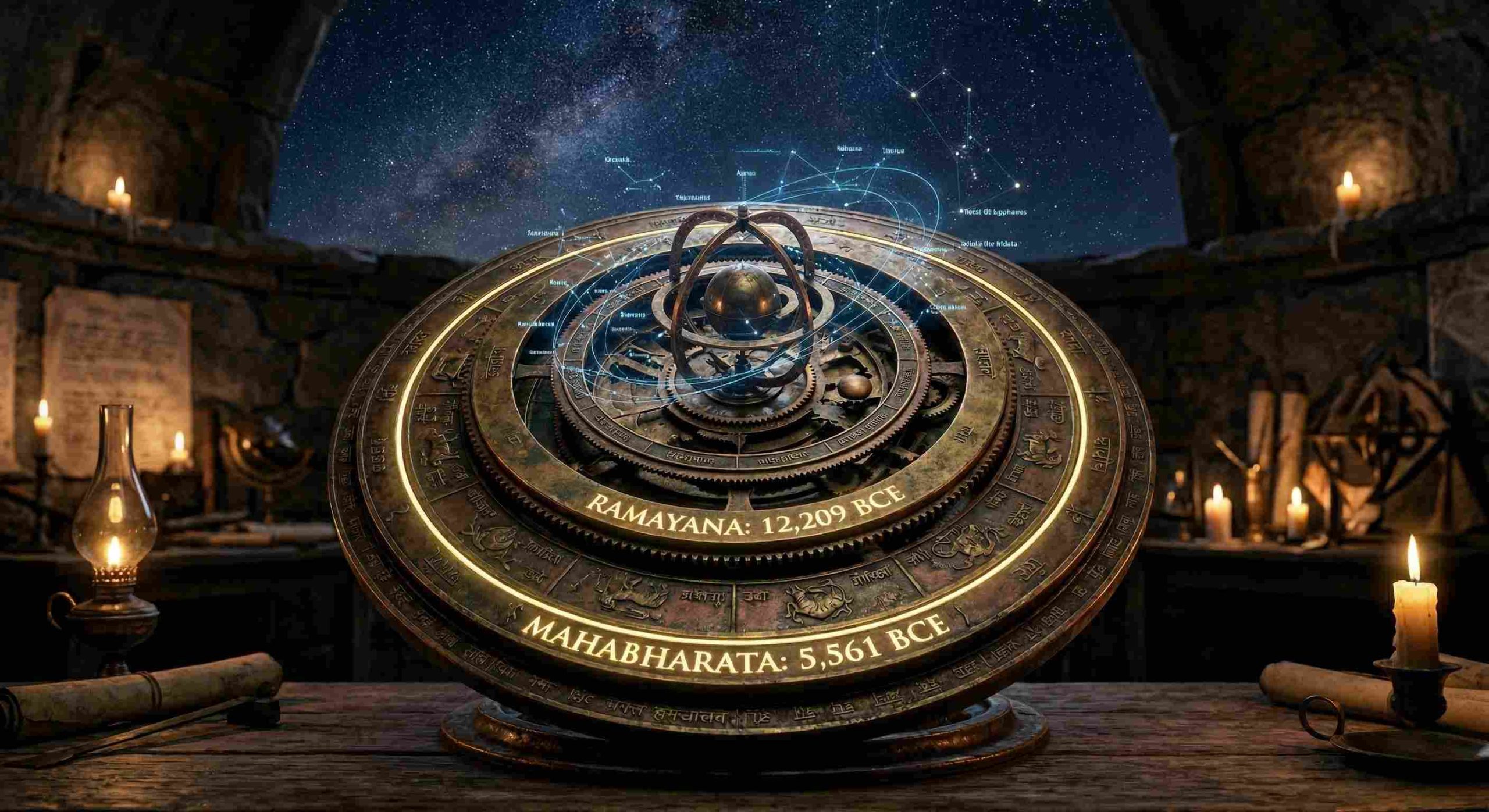
- Dating the Mahabharata (5,561 BCE): Vyasa recorded over 300 specific astronomical observations surrounding the Kurukshetra War. One of the most famous is his observation of the binary star system Arundhati and Vashistha (Alcor and Mizar). Vyasa noted that Arundhati was walking ahead of Vashistha—an astronomical anomaly that only occurred during a specific window of time between 11000 BCE and 4500 BCE. When testing all 300 planetary conditions, Nilesh Oak’s research pinpoints the exact year of the Mahabharata War to 5,561 BCE.
- Dating the Ramayana (12,209 BCE): Valmiki was equally precise. He recorded the exact planetary positions at the time of Sri Rama’s birth, the season and sky conditions during his exile, and the specific eclipses that occurred during the war in Lanka. By triangulating these celestial fingerprints using modern software, researchers have pushed the timeline of the Ramayana back to an astonishing 12,209 BCE.
History, Not Mythology
When we strip away the biases of the 19th century and apply modern scientific rigor to these ancient texts, a new reality emerges. The Ramayana and Mahabharata are not mythologies; they are Itihasa—which translates literally to “thus it happened.”
By recognizing the sky as the ultimate clock, we are not just reclaiming the true timeline of Sanatana Dharma. We are acknowledging that the ancient Indians possessed a level of observational science, mathematics, and record-keeping that remained unmatched for millennia.