The Concept
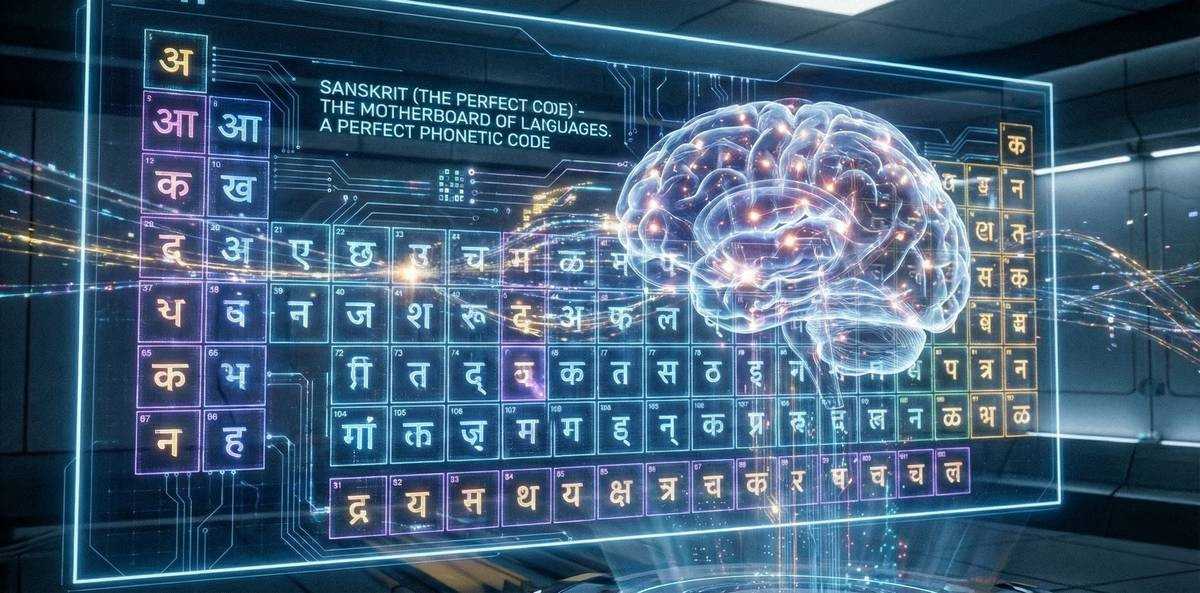
Sanskrit (Samskrita) translates as ‘refined’ or ‘perfected.’ Sanskrit, unlike languages that evolved by happenstance (such as English, where ‘A’ sounds different in ‘Apple’ and ‘Car’), was carefully engineered. The alphabet, or Varnamala, is a scientifically arranged map of how the human voice functions. The script follows the rules of sound, proceeding logically from the back of the mouth to the front: Gutturals begin deep in the throat (Ka, Kha); Palatals and Cerebrals move to the roof of the mouth; Dentals and Labials strike the teeth and halt at the lips (Pa, Ma) . This order corresponds to how you breathe, so there is no confusion: you type exactly what you say.
The “Motherboard” of Languages
Sanskrit is the linguistic ancestor of the Indo-European family.
-
Matr (Sanskrit) → Mater (Latin) → Mother (English).
-
Pitr (Sanskrit) → Pater (Latin) → Father (English).
-
Nama (Sanskrit) → Nomen (Latin) → Name (English).
The First Algorithm
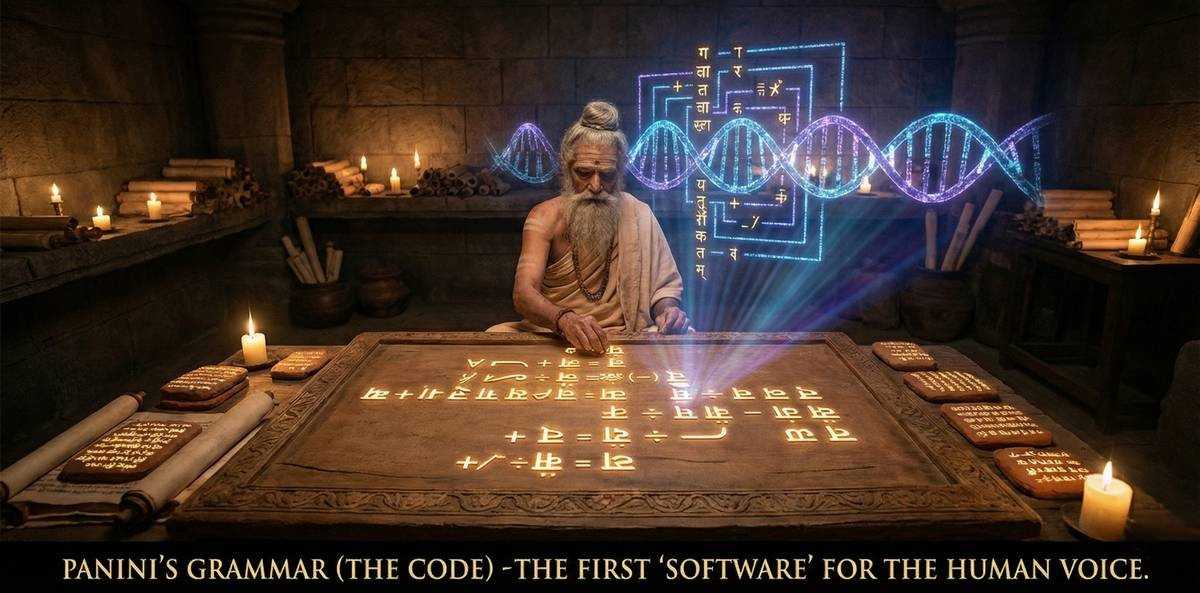
The grammarian Panini wrote the Ashtadhyayi approximately 2,000 BCE. From a modern perspective, this was code. He created approximately 2,012 root sounds and a ‘machine’ with more than 4,000 algebraic rules. You can create an endless number of words by incorporating roots into these guidelines.
The “Impossible” Literary Engineering
The Rishis considered language to be a form of mathematics. Viloma Kavya (Bidirectional Poetry) is the final proof. The Raghavayadaviya, a 17th-century masterpiece, tells the story of Lord Rama when read forward. However, when the exact same letters are read backward, they tell the story of Lord Krishna. This is a narrative miracle that no modern supercomputer has been able to replicate in another language.
Ancient “Checksum” Algorithms
Rishis created ‘Oral Hard Drives’ to preserve the Vedas for over 10,000 years without allowing the paper to decay. They devised strategies to chant arithmetic problems, such as Ghanapatha (Density Recitation). Syllables are pronounced in a braided manner (1-2, 2-1, 1-2-3). If a student missed even one syllable, the mathematical pattern broke, acting as an error-correction algorithm to ensure 100% data fidelity over millennia.
The Sanskrit Effect
Recent MRI experiments conducted by neuroscientist James Hartzell show that extensive Sanskrit memorisation significantly increases grey matter density and cortical thickness in the hippocampus, the region connected with memory. Learning Sanskrit is a great way to strengthen your brain.
Recent Post
The Concept Language normally evolves in a chaotic manner. However, [...]