
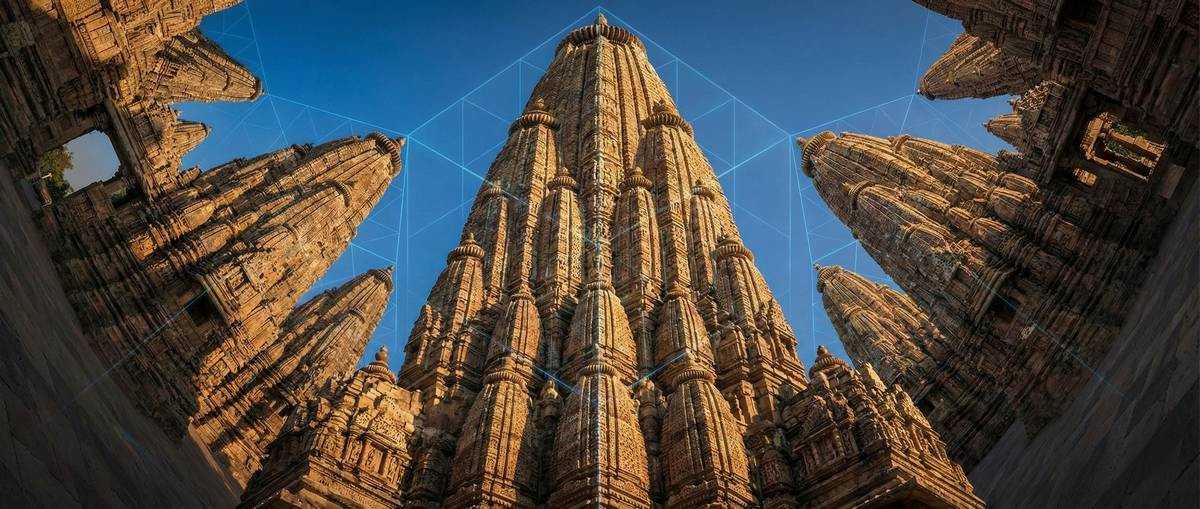
The Concept
A fractal is a pattern that repeats itself on smaller and smaller scales; it is ‘Self-Similar’. Nature uses it (trees, lungs, ferns), but it is difficult to build .
The Story
When you look at a Hindu temple like Kandariya Mahadeva, you aren’t just looking at a building; you are looking at a mathematical algorithm . Centuries before Benoit Mandelbrot defined “fractals” in 1975, Indian architects were using nature’s own geometry—self-similar patterns that repeat at every scale. The main tower is made of smaller towers, which are made of even smaller towers, creating a recursive structure that is both beautiful and structurally indestructible. They realized that the universe itself was built on these repeating patterns, and they built their temples to be a mirror of that infinite complexity.
The Timeline
| Milestone | Details |
| Western Reference | 1975 CE (Benoit Mandelbrot coins ‘Fractal’) |
| Indian Source | 1000 CE (Khajuraho Temples); 3,000 BCE (Vastu Shastra) |
| Chron. Gap | Over 900 Years |
The Original Text
The Vastu Vidya formally establishes the principles of this recursive design geometry.
Related Innovations
Recursive Geometry: Using algorithms where the output of one step becomes the input for the next to create infinite complexity (Vastu Shastras). Structural Damping: The fractal spikes help break wind flow, making tall towers resistant to storms (Shilpa Shastras).
Fun Fact
When you look at a Hindu temple from a distance, it appears to be a mountain, but as you go closer, you realise it is made up of mini-mountains, which is what a fractal is.
The Modern Legacy
Fractal geometry is used to design antennas, compress digital images, and study chaos theory.
Recent Post

The Concept A bridge that swings from cables rather than [...]
The Concept A lathe rotates a workpiece while a stationary [...]