
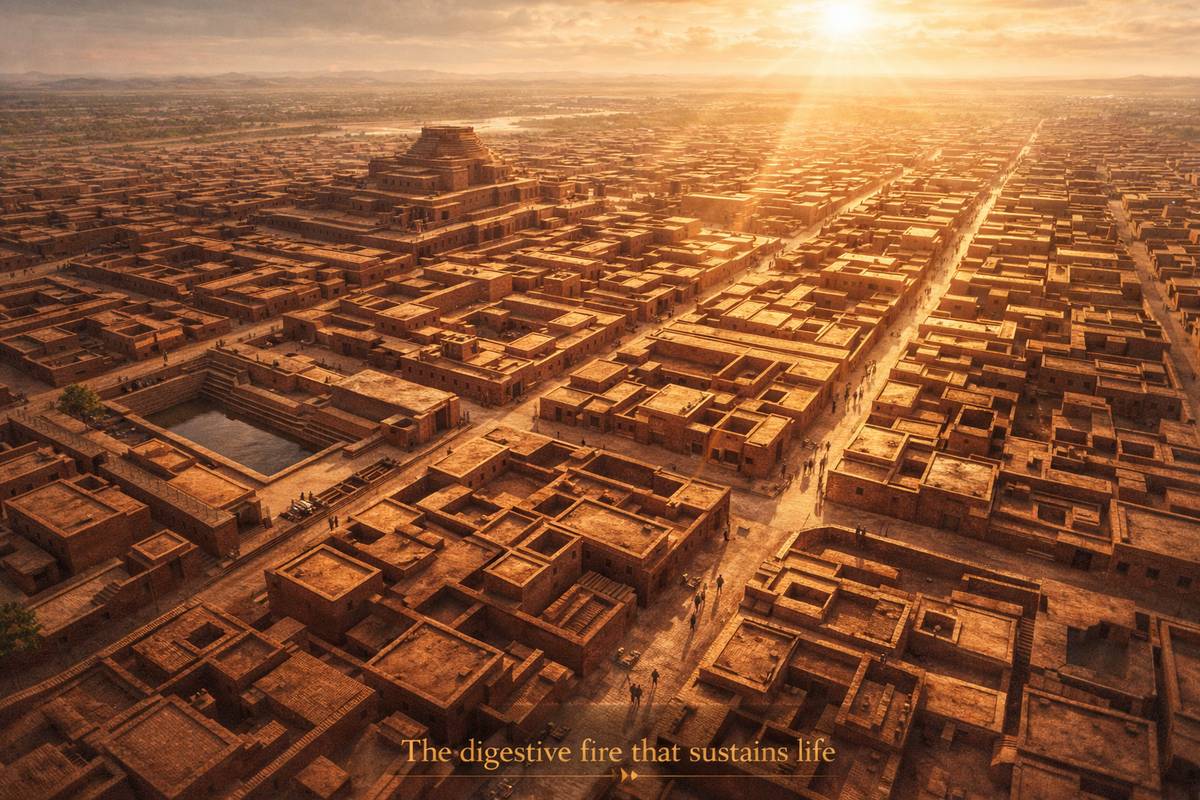
The Concept
A city should not be a maze. A planned city uses a ‘Grid Iron’ system where streets cut each other at right angles, oriented to the cardinal directions (North-South, East-West). This maximizes airflow and sunlight while making navigation easy.
The Story
While the “Father of Town Planning” was yet to be born in Greece, the architects of Harappa and Mohenjo-Daro were already building the world’s first “Smart Cities”. They rejected the chaotic mazes of other civilizations in favor of a perfect “Grid Iron” system. Every street intersected at a right angle, perfectly aligned with the cardinal directions to catch the cooling breeze. Their engineering was so precise that their bricks followed a standard 1:2:4 ratio across thousands of miles, and their covered sewage systems were more advanced than those of London in the 1700s. It was an ancient blueprint for efficiency that modern cities like New York still follow today.
The Timeline
| Milestone | Details |
| Western Ref. |
450 BCE (Hippodamus of Miletus) |
| Indian Source |
Prior to 2600 BCE – Sindhu Saraswati Civilization (IVC) |
| Chron. Gap |
Over 2,000 Years |
The Original Text
Sanskrit Shloka: त्रयः प्राचीना राजमार्गास्त्रय उदीचीना इति वास्तुविभागः । …अष्टशतानि ग्राम्याणां मार्गाः ॥
Transliteration: Trayaḥ prācīnā rājamārgāstraya udīcīnā iti vāstuvibhāgaḥ | …Aṣṭaśatāni grāmyāṇāṃ mārgāḥ || Vastu Shastra (Texts describing the layout of the Vastu Purusha Mandala) .
Meaning: “Three Royal Roads should run from west to east, and three from south to north. This is the division of the Vastu… The village roads shall be 8 dandas (approx 32-48 ft) wide.”
Related Innovations
Underground Drainage: IVC built covered sewage systems with inspection manholes, a sanitation standard higher than 18th-century London (Mohenjo-daro Excavations, c. 2600 BCE). Soak Pits: Ceramic jars placed in the ground to filter waste water, preventing groundwater contamination.
Fun Fact
Did you know? The bricks used in these cities were so well-made that a brick from Harappa would fit perfectly into a wall in Mohenjo-Daro, 400 miles away.
The Modern Legacy
This old paradigm of efficiency is still employed in modern city zoning and grid layouts, such as New York City.
Recent Post

The Concept A bridge that swings from cables rather than [...]
The Concept A lathe rotates a workpiece while a stationary [...]