
The Concept
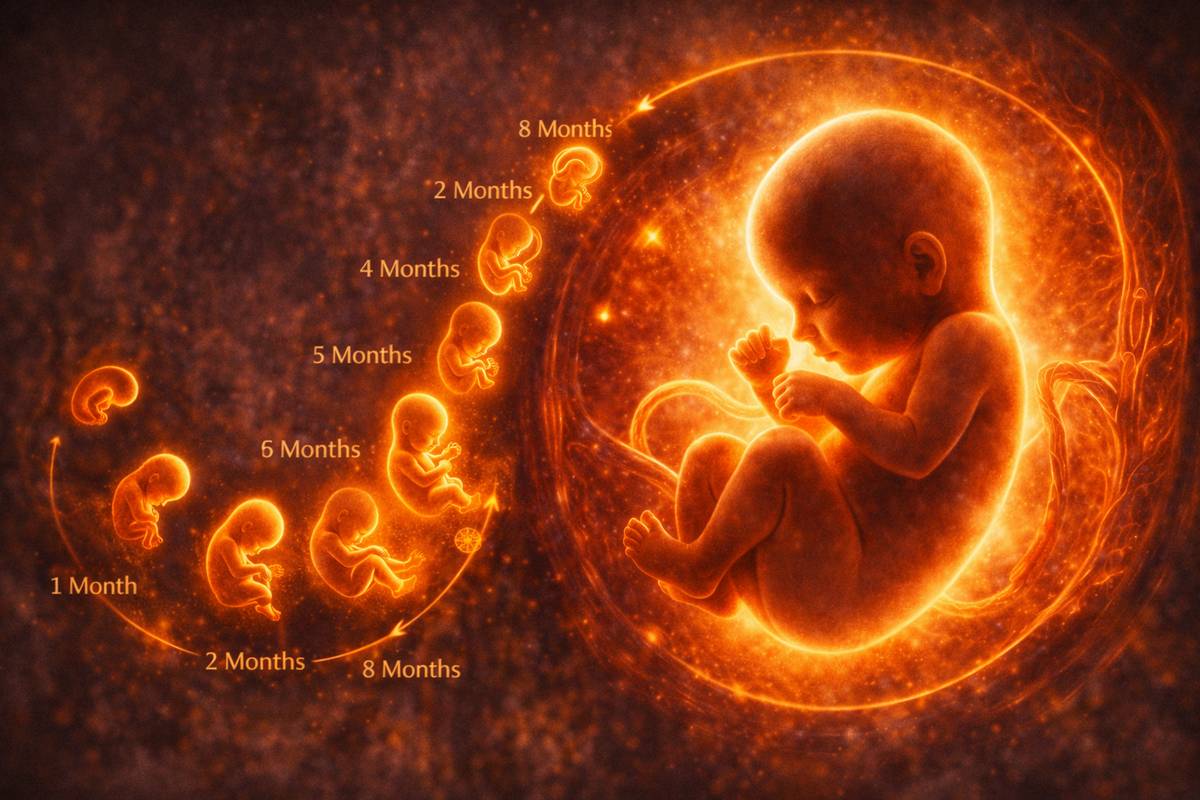
Human life begins in the womb and develops in stages. It begins as a single cell and grows into a foetus with limbs.
The Story
Long before the first ultrasound machine was ever turned on, the Garbha Upanishad provided a window into the womb. While the Western world was still centuries away from understanding human development, ancient Indian texts were already documenting the month-by-month growth of a fetus. They described the first night as a “nodule,” the formation of the head in the second month, and the development of limbs in the third. Most remarkably, they understood that the sex of the child was determined by the “seed” (sperm), a fact that modern genetics wouldn’t confirm until the discovery of chromosomes. It was a developmental schedule so accurate that it predicted the fetus’s ability to perceive pain in the seventh month, centuries before modern neurology.
The Timeline
| Milestone | Details |
| Western Ref. |
1600s CE (Microscopes reveal development) |
| Indian Source |
Prior to 1400 BCE (Garbha Upanishad) |
| Chron. Gap |
Over 3,000 Years |
The Original Text
The Garbha Upanishad (Verse 2-3) lays out a highly detailed, chronological timeline of fetal growth.
Related Innovations
Sex Determination: The belief that the male seed (Shukra) decides the sex (Sushruta Samhita), rather than the idea that the female is completely responsible. Teratology: Identifying the reasons for birth deformities, such as poor diet or heredity (Charaka Samhita), rather than blaming curses.
Fun Fact
The book correctly indicates that the foetus becomes aware and capable of experiencing pain in the seventh month, aligning with modern neurological findings.
The Modern Legacy
Obstetricians and prenatal care workers use this developmental schedule to ensure that babies are born healthy.
Recent Post

The Concept Yoga demonstrates that the autonomic nervous system may [...]

The Concept The body functions as an engine, burning fuel [...]