
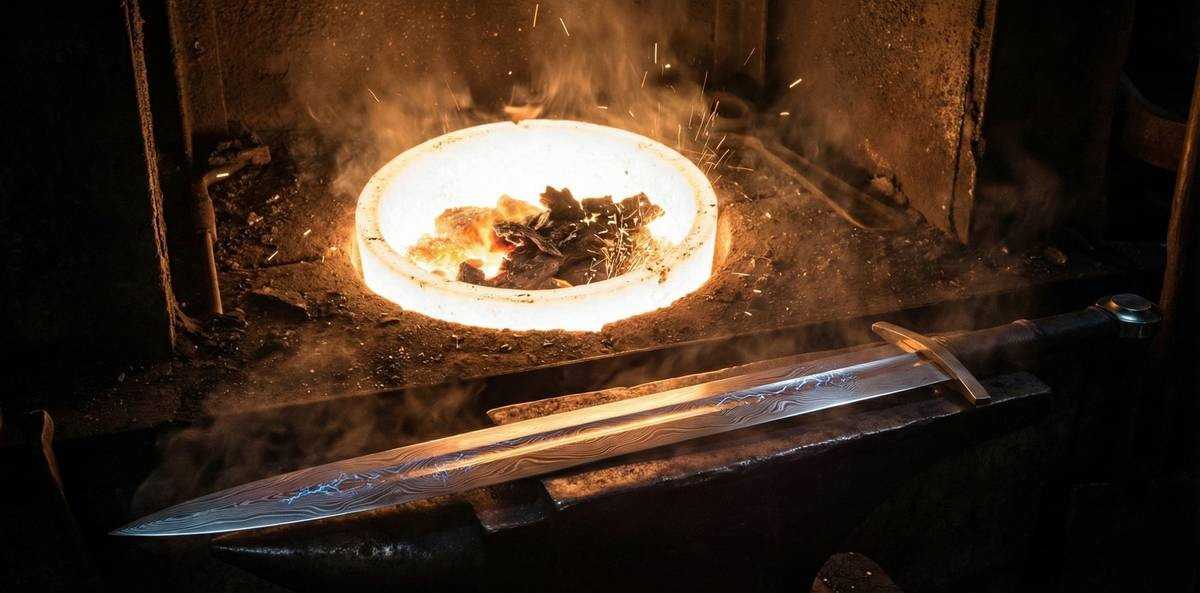
The Concept Steel is iron with a small amount of carbon added. If there is insufficient carbon, it is soft; if there is too much, it is brittle . ‘Wootz’ (a misreading of the Kannada word for ‘ukku’) was the first high-carbon crucible steel in history. It had a banding pattern known as ‘Damascus Steel’ that was both superplastic and sharp.
The Story In the ancient world, if you wanted the world’s best sword, you looked to India for Wootz steel. Indian smiths achieved something “impossible”: they heated iron in sealed clay crucibles with carbon-rich leaves to create a metal so tough it could cut through a falling silk scarf. Modern microscopy has revealed the secret—ancient Wootz steel actually contained “carbon nanotubes,” making it a forerunner of modern nanotechnology. This “legendary metal” was so superior that it remained the gold standard for global weaponry for over two thousand years.
The Timeline
| Milestone | Details |
| Western Ref. |
1740 CE (Benjamin) |
| Indian Source |
Prior to 400 BCE (South Indian Excavations) |
| Chron. Gap |
Over 2,000 Years |
The Original Text
Sanskrit Shloka: शस्त्रं क्षारेण पयसा वा पायितं नराश्वद्विरददीप्तिकरम् । गोक्षीरेण च मेध्यं वदन्ति ब्राह्मण्यसिद्ध्यर्थम् ॥
Transliteration: Śastraṃ kṣāreṇa payasā vā pāyitaṃ narāśvadviradadīptikaram | Gokṣīreṇa ca medhyaṃ vadanti brāhmaṇyasiddhyartham | Brihat Samhita (Chapter 50) (Describes the hardening of swords), Sushruta Samhita (Surgical Instruments)
Meaning: “A weapon quenched in a solution of alkali/ash (Kshara) or water… or in cow’s milk is considered pure…” (Describing different quenching media for different properties).
Related Innovations Modern microscopy of Wootz Steel (c. 300 BCE) reveals that it included self-forming carbon nanotubes, making it extremely robust. The Brihat Samhita (about 550 CE) discussed the art of Nirvana (quenching), which required cooling the metal in various baths to make it less rigid and more flexible.
Fun Fact Did you realise that the nanotubes in ancient Wootz steel are similar to the ones we use today?. This makes it more durable than anything current metallurgists can devise.
The Modern Legacy High-carbon steel serves as the foundation for modern science, being utilised to construct everything from girders to surgical scalpels.
Recent Post
The Concept Different metals burn in different hues. For example, [...]
The Concept Iron rusts. Iron degrades when it comes in [...]