
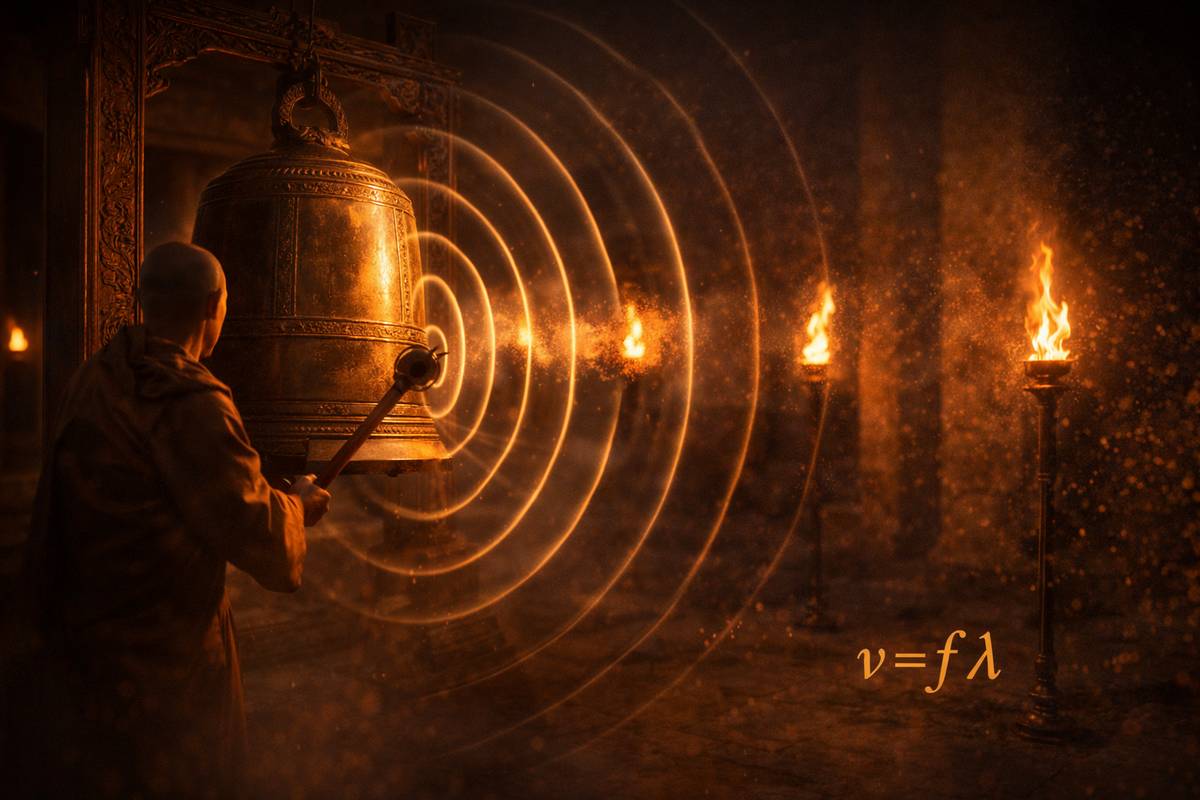
The Concept Sound travels through a medium (such as air or water) as a wave. It is not a physical object but a disturbance that propagates.
The Story How does a voice travel from one person to another?. While some ancient cultures thought sound was a physical “thing” that flew through the air, the Indian Mimamsa scholars used a brilliant analogy: Vici-Taranga-Nyaya, or the Logic of the Ripple. They compared sound to a stone thrown into a pond—the water itself doesn’t move across the pool, but the disturbance spreads in circles. They realized sound was a wave-like disturbance moving through a medium. This ancient insight into wave mechanics is the reason we can today enjoy everything from music on a radio to the clarity of an ultrasound.
The Timeline
| Milestone | Details |
| Western Ref. |
1600s CE (Modern Acoustics), 1st Century BCE (Vitruvius – weak theory) |
| Indian Source |
Prior to 200 CE (Sabara Bhashya on Mimamsa) |
| Chron. Gap |
Over 1,500 Years |
The Original Text
Sanskrit Shloka: संयोगविभागान्नैरन्तर्येण क्रियमाणान् शब्दः । वीचीतरङ्गन्ययेन श्रोत्रप्रदेशम् आविशति ॥
Transliteration: Saṃyogavibhāgānnairantaryeṇa kriyamāṇān śabdaḥ | Vīcītaraṅganyayena śrotrapradeśam āviśati || Sabara Bhashya on Mimamsa Sutras (Discusses Vici-Taranga-Nyaya – Ripple Logic).
Meaning: “Sound is produced by constant conjunction and disjunction (vibration)… and it enters the ear following the Logic of Ripples and Waves (Vici-Taranga-Nyaya).”
Related Innovations The Vaisheshika Sutras described Pratidhvani as sound bouncing off surfaces like a mirror image. Sangita Ratnakara (c. 13th century CE) investigated Anuranana (resonance) to explain how vibrations maintain and generate sympathetic tones in musical acoustics.
Fun Fact They recognised that sound reflected (echo); thus, they named it Pratidhvani, which means ‘counter-sound’.
The Modern Legacy Understanding wave mechanics is essential for ultrasonic imaging, sonar, and noise-cancelling headphones.
Recent Post

The Concept Stone columns can be tuned to vibrate at [...]
The Concept Old European science considered heat to be a [...]