
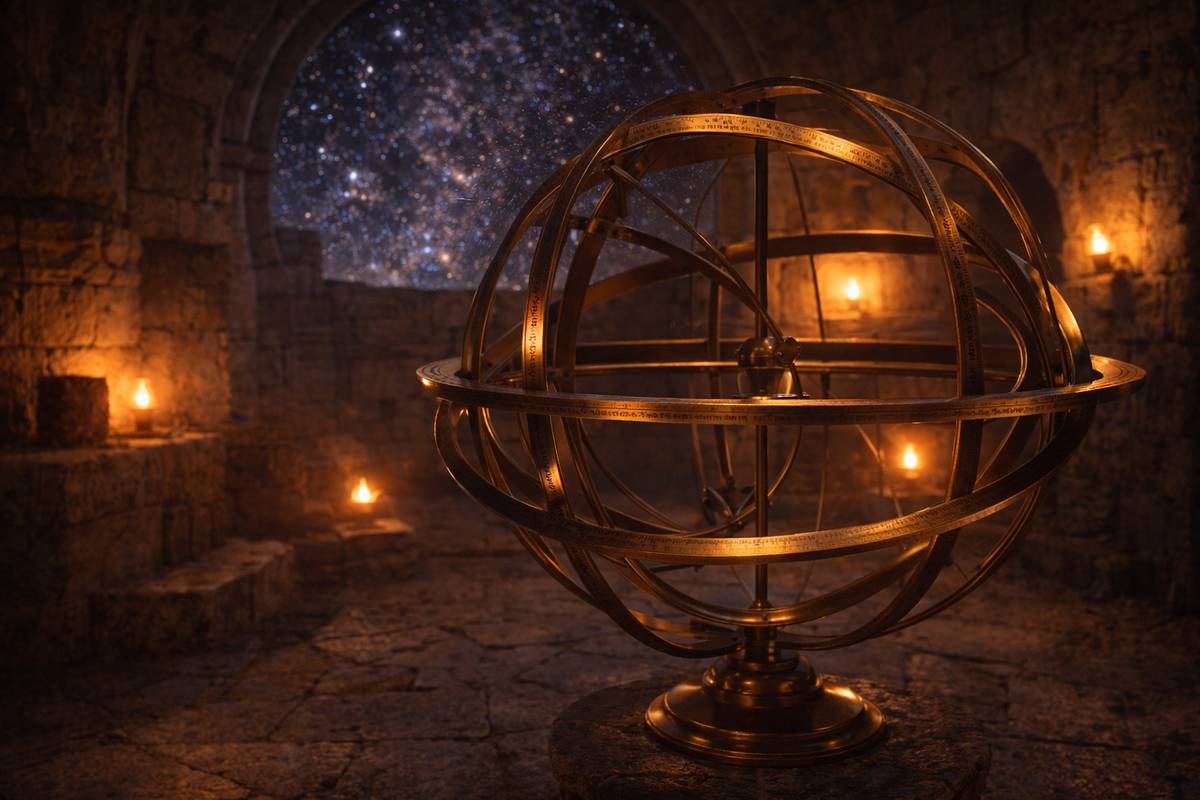
The Concept An armillary sphere is a mechanical representation of the universe. The skeleton is made up of rings that represent the celestial equator, the ecliptic, and various meridians. In the centre lies a miniature Earth. It is similar to a planetarium or a 3D desktop globe, which were previously used to teach astronomy.
The Story Imagine a 3D mechanical model of the universe made of wooden rings, showing the equator, the horizon, and the paths of the planets. The Surya Siddhanta gives step-by-step instructions for building the Gola Yantra—a complex armillary sphere used for teaching astronomy. But the real magic was its power source: they used a water-drive mechanism to make the entire sphere rotate automatically. It was the world’s first “Automatic Tracking Device,” a miniature rotating universe that moved in real-time with the stars themselves.
The Timeline
| Milestone | Details |
| Western Ref. |
255 BCE |
| Indian Source |
Surya Siddhanta (c. 10,000 BCE) |
| Chron. Gap |
Over 10,000 Years |
The Original Text
Sanskrit Shloka: काष्ठमयं समवृत्तं समान्तलगुं च गोलकं कृत्वा । सूचीव्यधं प्रकुर्याद् गोलदण्डं ततः परम् ॥ Transliteration: Kāṣṭhamayaṃ samavṛttaṃ samāntalaguṃ ca golakaṃ kṛtvā | Sūcīvyadhaṃ prakuryād goladaṇḍaṃ tataḥ param || Surya Siddhanta (13.3) Meaning: “Construct a wooden sphere (Golaka), perfectly round and uniform in weight. Pierce it with a rod (Suci) to form the axis.”
Related Innovations The text describes using a water-drive mechanism (fluid dynamics) to make the sphere rotate automatically, mimicking the real-time movement of the heavens.
Fun Fact This was perhaps the first ‘Automatic Tracking Device’ in the world. It was designed to turn with the same speed as the Earth.
The Modern Legacy Celestial Mechanics and coordinate systems used in satellite tracking.
Recent Post

The Concept A bridge that swings from cables rather than [...]

The Concept Engineers face difficulties when building a dam on [...]