
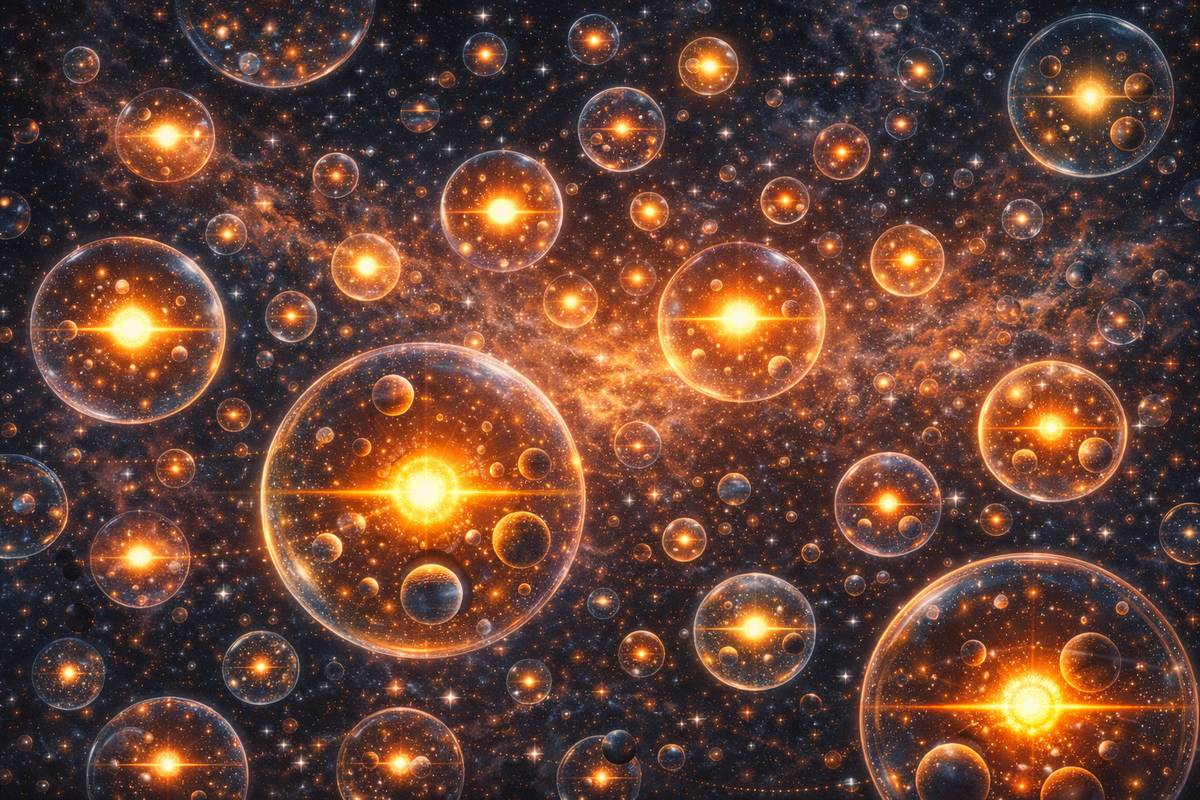
The Concept There are other stars, such as our Sun. Other stars in the cosmos are Suns and may have their own planets.
The Story In 1600 CE, the Italian scholar Giordano Bruno was burned at the stake for the “heresy” of claiming that other stars were actually distant suns. But in India, this idea was common knowledge. The Bhagavata Purana spoke of Ananta-koti Brahmanda—limitless billions of universes floating like dust particles in a beam of light. They understood that our Sun was just one of many, and that the cosmos was a recursive, holographic structure of infinite worlds. It was exoplanet science and the “Multiverse” theory, recorded as ancient spiritual poetry.
The Timeline
| Milestone | Details |
| Western Ref. |
1600 CE (Giordano Bruno) |
| Indian Source |
Prior to 5000 BCE (Bhagavata Purana) |
| Chron. Gap |
Over 6,000 Years |
The Original Text
The Bhagavata Purana (6.16.37) distinctly mentions countless universes floating like dust particles in space.
Related Innovations Ancient Puranic texts implicitly described the ‘Goldilocks Zone’ by distinguishing habitable Lokas from hellish planes. They also discussed ‘Exobiology’ in which beings have bodies (Sharira) that are uniquely fitted to the environment of various planetary spheres.
Fun Fact The book compares universes to dust particles in a light beam, a scale that modern astronomy is only beginning to fathom.
The Modern Legacy Exoplanet research (the discovery of planets orbiting other stars).
Recent Post
The Concept The Milky Way is our galaxy. It is [...]
The Concept The zodiac consists of a 360-degree circle rather [...]