
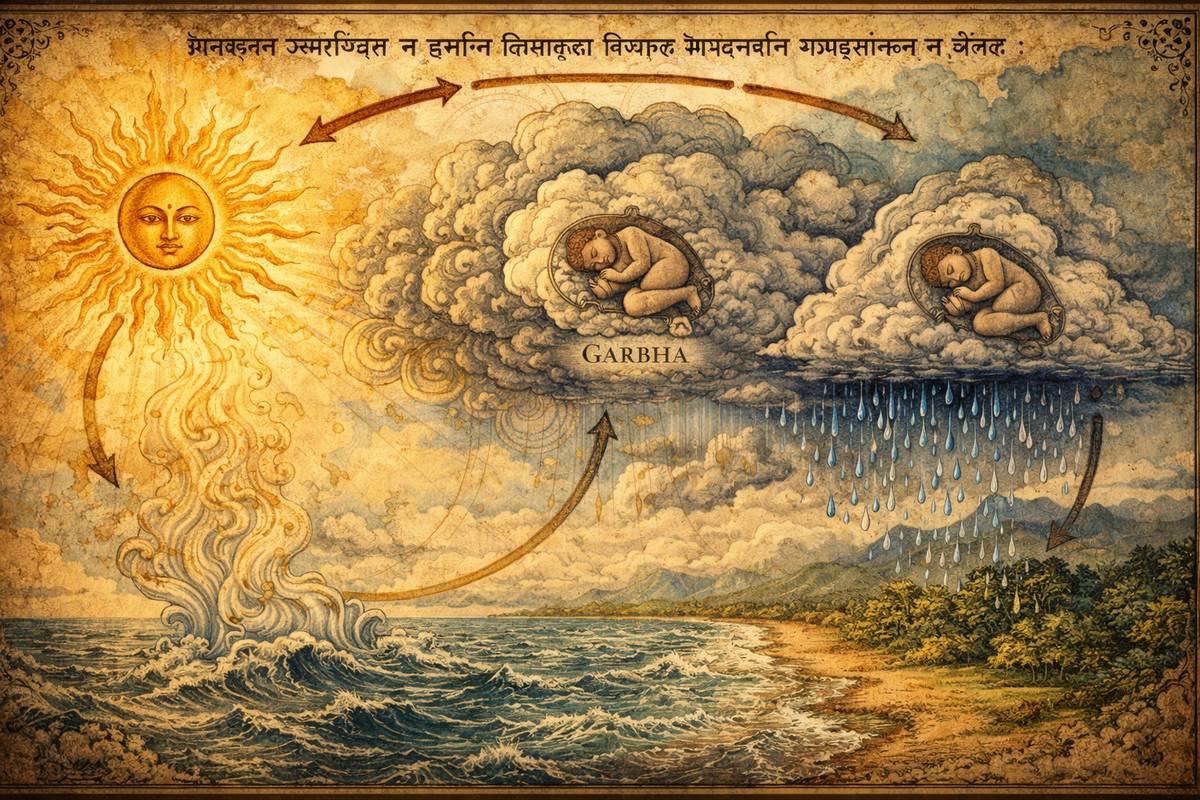
The Concept There are layers in the atmosphere, and clouds are made up of heat and water vapour. It is a constantly changing fluid system.
The Story While ancient poets in other lands sang of “airy spirits,” Indian scientists were measuring the weight of the wind. The Brihat Samhita describes a sophisticated “Cloud Pregnancy” (Garbha Lakshana) theory, where scholars tracked the humidity and heat of the air to predict rainfall six months in advance. They realized that the Sun’s heat “conceived” the rain by drawing water from the oceans, which the wind then transported across the land. They even invented the world’s first rain gauges to quantify the monsoon, turning the unpredictable weather into a measurable science of survival.
The Timeline
| Milestone | Details |
| Western Ref. |
1802 CE (Luke Howard classifies clouds) |
| Indian Source |
500 CE (Varahamihira); Prior to 10,000 BCE (Vedas) |
| Chron. Gap |
Over 1,200 Years |
The Original Text
Sanskrit Shloka: लक्षणं तु गर्भस्य शिशिरशिशिरयोः । पौषशुक्लपक्षस्य प्रतिपत्प्रभृतिक्षपाः ॥
Transliteration: Lakṣaṇaṃ tu garbhasya śiśiraśiśirayoḥ | Pauṣaśuklapakṣasya pratipatprabhṛtikṣapāḥ || Brihat Samhita (Chapter 21)
Meaning: “The symptoms of the conception of clouds should be observed during the first half of the winter season, starting from the nights of the bright half of the month of Pausha.”
Related Innovations The Arthashastra (c. 300 BCE) was the first book to use regular rain gauges to predict how much food would be grown, and the Brihat Samhita (c. 550 CE) was the first book to explain how to locate groundwater aquifers using biological indicators such as termite mounds.
Fun Fact Ancient scholars tracked the humidity and heat of the air to accurately predict rainfall up to six months in advance.
The Modern Legacy Meteorology, the science of predicting weather that saves thousands of lives each year, was founded on this concept.
Recent Post

The Concept Steel is iron with a small amount of [...]

The Concept Stars are Suns that are located far away. [...]