
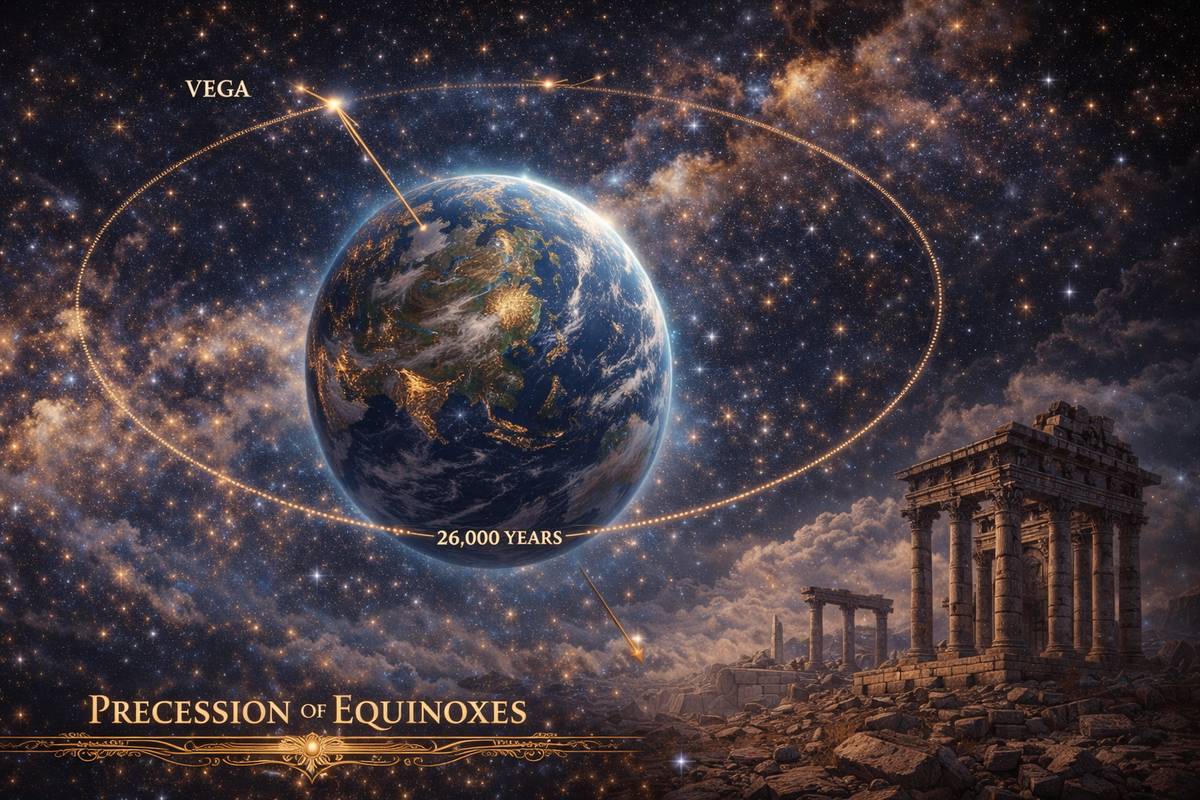
The Concept The Earth wobbles on its axis, similar to a spinning top. As a result, location of stars vary very slowly over thousands of years (about one degree every 72 years).
The Story The Earth does not just spin; it wobbles like a slowing top. This movement, called the Precession of the Equinoxes, is so slow it takes 25,800 years to complete one circle. While Hipparchus is often credited with “discovering” this in 127 BCE, ancient Indian texts had been tracking this “wobble” (Ayanamsa) for ages to keep their star-charts accurate. They realized that the “North Star” isn’t a permanent title, but a position that changes over thousands of years. Because of this precision, we can now “time-stamp” ancient Indian events based on the exact position of the stars described in the texts.
The Timeline
| Milestone | Details |
| Western Ref. |
127 BCE (Hipparchus) |
| Indian Source |
Prior to 10,000 BCE (Surya Siddhanta) |
| Chron. Gap |
Over 10,000 Years |
The Original Text
The Surya Siddhanta (3.9-12) documents the mathematical models describing the oscillation of the equinoxes.
Related Innovations The Surya Siddhanta calculated the rate of axial precession, indicating a ‘Great Year’ of approximately 25,800 years. Texts such as the Vedanga Jyotisha (1,400 BCE) recorded equinoctial sites, allowing ‘Star Dating’ to determine their precise historical age.
Fun Fact Because of this wobble, the ‘North Star’ during the Ramayana was most likely Vega rather than Polaris. This is what antique star charts depict.
The Modern Legacy Understanding precession is critical for predicting long-term climate cycles (Milankovitch cycles) and for successfully navigating deep space.
Recent Post
The Concept A water clock, for example, calculates time based [...]
The Concept Old European science considered heat to be a [...]