

The Concept What causes planets farther out to travel more slowly? The Surya Siddhanta states that all planets move at the same average linear speed. Outer planets take longer to complete a lap due to their larger orbits (Kaksha). This means that while linear speed remains constant, angular speed decreases with distance. This allowed ancient humans to calculate the relative distances between planets with great accuracy.
The Story Why does Saturn crawl across the sky while the Moon races? In 1619, Johannes Kepler struggled to explain the relationship between a planet’s distance and its speed. Thousands of years earlier, the Surya Siddhanta had already solved the puzzle with a simple, elegant theory: all planets move at the same linear speed, but those farther out have a much longer “track” to run. They described the force keeping them in line as “cords of wind” tied to the Pole Star—a mechanical metaphor for the gravitational balance that keeps the solar system from flying apart.
The Timeline
| Milestone | Details |
| Western Ref. |
1619 CE (Johannes Kepler) |
| Indian Source |
Vedic Period (Surya Siddhanta) |
| Chron. Gap |
Over 11,000 Years |
The Original Text
The mathematical principles defining this constant linear velocity are established in the Surya Siddhanta (12.73) with the rule: ‘Madhyamaani tu tulyaani…’.
Related Innovations Retrograde Motion explains why objects appear to move backward when their speeds mismatch. Source: Surya Siddhanta.
Fun Fact The book refers to the force that drives the planets as ‘cords of wind’ tied to the Pole Star, a mechanical term for gravity.
The Modern Legacy This is the first step towards Celestial Mechanics, which explains how the size of an orbit influences its period.
Recent Post
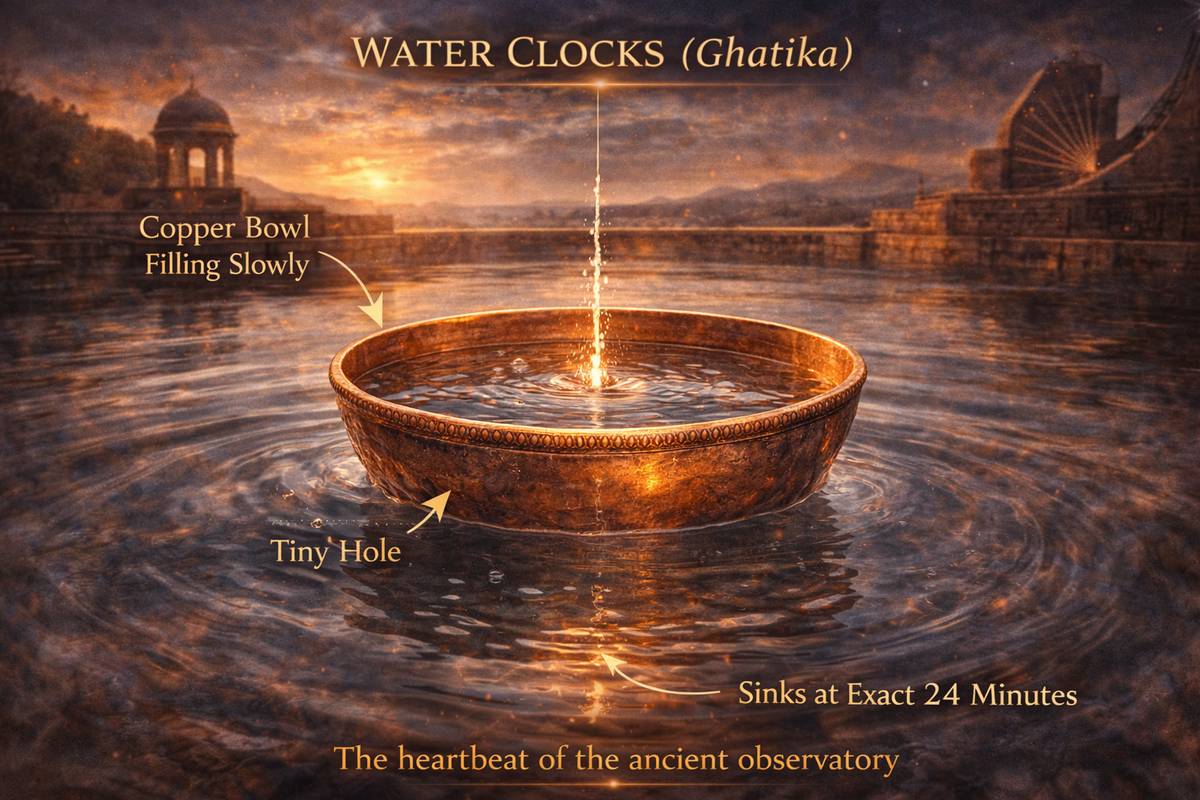
The Concept A water clock, for example, calculates time based [...]
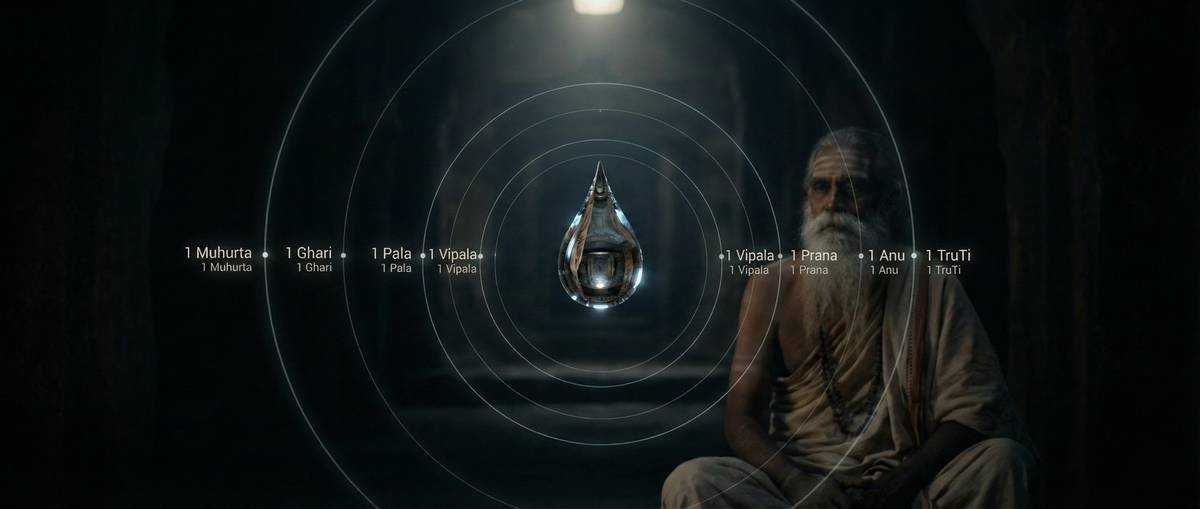
The Concept You may break time down into smaller and [...]