
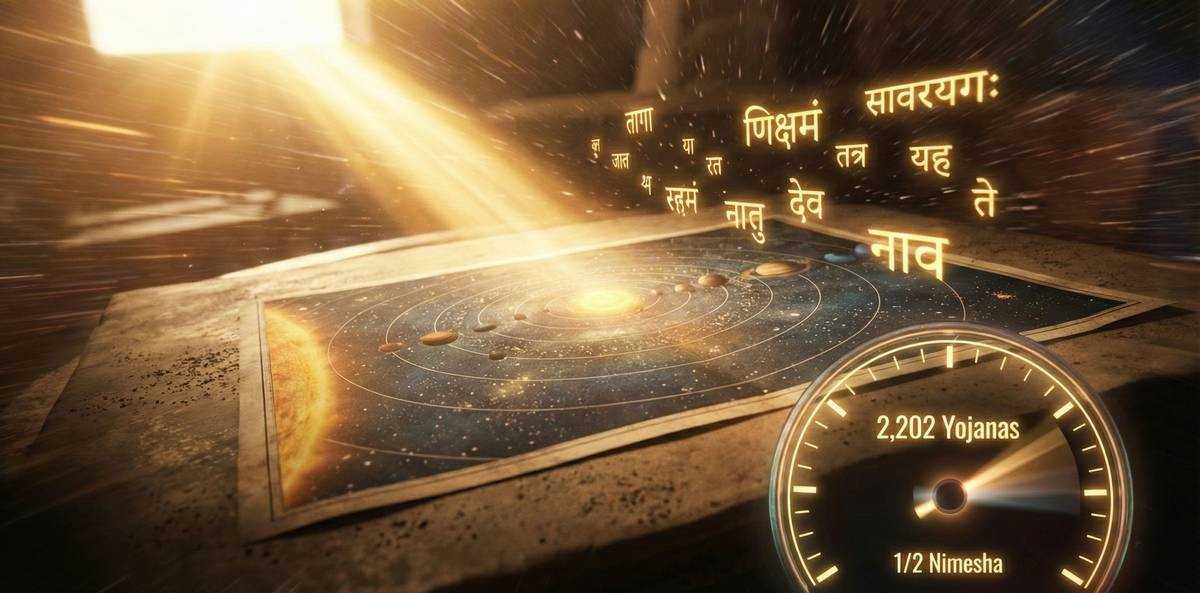
The Concept Light does not travel instantly; it moves at a specific rate, which is approximately 186,000 miles per second. This speed limit is a fundamental constant of the universe.
The Story In 1676, the Danish astronomer Ole Romer shocked the world by suggesting light had a speed limit. But tucked away in a 14th-century commentary on the Rig Veda, the scholar Sayana had already written down a number that would make a modern physicist double-take. He described light traveling 2,202 Yojanas in half a Nimesha (a split second). When converted, his calculation hits remarkably close to the 186,282 miles per second we know today. While the West viewed light as an instantaneous act of God, India had already timed it as the fastest traveller in the universe.
The Timeline
| Milestone | Details |
| Western Ref. |
1676 CE (Ole Romer) |
| Indian Source |
1300s CE (Sayana’s commentary on Rig Veda) |
| Chron. Gap |
Over 300 Years |
The Original Text
Sanskrit Shloka: तथा च स्मर्यते । योजनानां सहस्रे द्वे द्वे शते द्वे च योजने । एकेन निमिषार्धेन क्रममाण नमोऽस्तु ते ॥ Transliteration: Tathā ca smaryate | Yojanānāṃ sahasre dve dve śate dve ca yojane | Ekena nimiṣārdhena kramamāṇa namo’stu te || Sayana (14th Century) on Rig Veda 1.50.4 Meaning: “It is remembered thus: [O Sun,] who traverses 2,202 Yojanas in half a Nimesha (blink of an eye), salutations to you.”
Related Innovations The Surya Siddhanta defines Nimesha as a method of measuring fractions of a second, which is required for high-speed calculations. At the same time, the Vaisheshika Sutra said that light is composed of individual energy packets known as Tejas, which is akin to the corpuscular concept of photons.
Fun Fact Sayana’s number comes to around 186,413 miles per second. The current scientific value is 186,282 miles per second.
The Modern Legacy The speed of light (c) is the ‘c’ in Einstein’s equation $E=mc^2$ and is crucial for fibre-optic internet.
Recent Post

The Concept Science pursues Truth, regardless of discomfort, and requires [...]
The Concept Old European science considered heat to be a [...]