
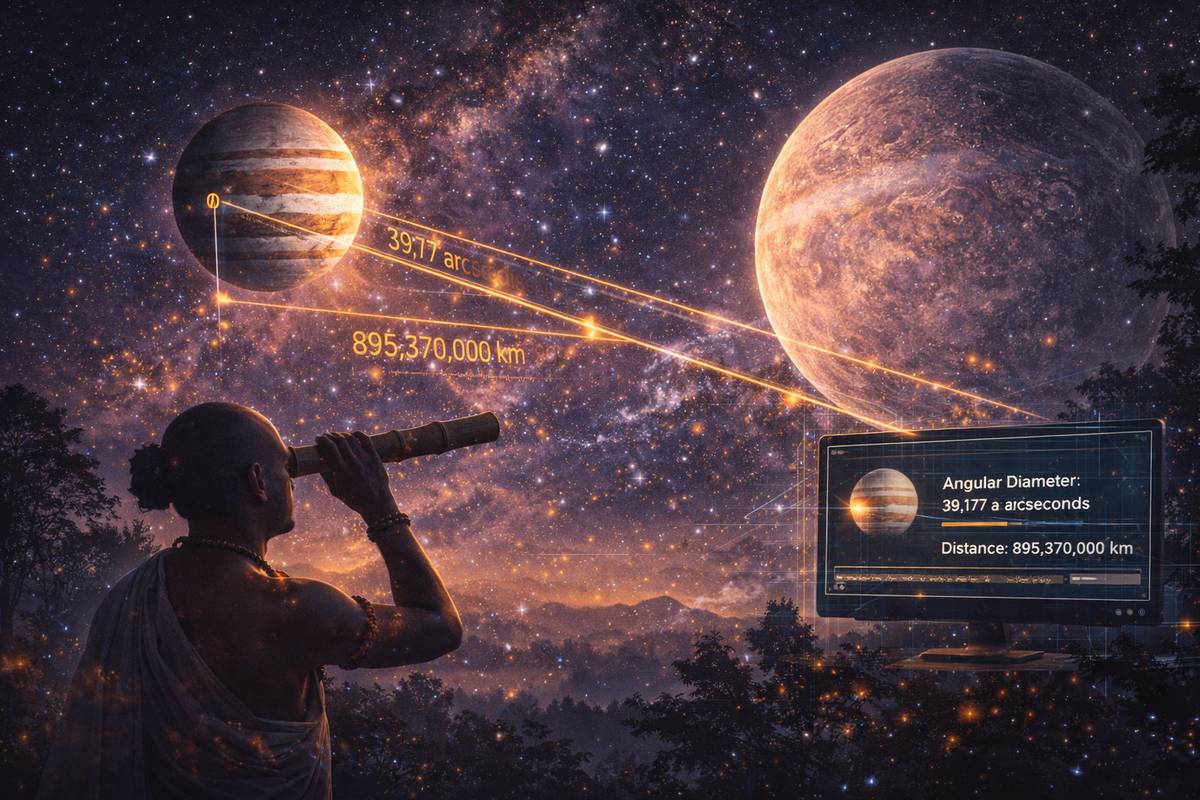
The Concept How can you measure a planet without a telescope? The Surya Siddhanta determines the planet’s angular diameter (how large it appears) and then utilises it to calculate its orbit. It accurately states that the physical size remains constant, while the visual size varies with distance. It uses trigonometry to calculate the diameters of Mars, Saturn, and Mercury in yojanas by setting the Moon’s angular size to approximately 32 arcminutes, which is consistent with modern figures.
The Story How do you measure a world you cannot touch? Without the aid of a single glass lens, the authors of the Surya Siddhanta looked at the wandering lights in the sky and saw them as physical spheres. While European science wouldn’t accurately measure a planet’s diameter until the 17th century, ancient Indian astronomers were using the Moon’s angular size as a “cosmic ruler”. By applying complex trigonometry, they calculated the diameters of Mercury, Mars, and Saturn with stunning precision. They even managed to distinguish between the solid globe of Saturn and its mysterious rings—all through the power of pure, naked-eye mathematics.
The Timeline
| Milestone | Details |
| Western Ref. |
1660s CE (Giovanni Cassini) |
| Indian Source |
Vedic Period (Surya Siddhanta) |
| Chron. Gap |
Over 11,000 Years |
The Original Text
Sanskrit Shloka: योजनानि शतान्यष्टौ भूकर्णो द्विगुणानि तु । त्रिंशद्भिरधिकान्याहुरर्केन्द्वोर्मिथुनं विना ॥
Transliteration: Yojanāni śatānyaṣṭau bhūkarṇo dviguṇāni tu | Triṃśadbhiradhikānyāhurarkendvormithunaṃ vinā || (Surya Siddhanta 1.59 / 7.13 varies by recension)
Meaning: “The diameter of the Earth is 800 Yojanas. (In Chapter 7, verse 13, it specifies the angular diameters of Mars, Saturn, Mercury, Jupiter, and Venus at the Moon’s distance).”
Related Innovations Variable Size: The apparent diameter changes depending on where the object is in its orbit (apogee/perigee). Source: Surya Siddhanta.
Fun Fact
Surya Siddhanta correctly identifies Mercury as smaller than Mars, despite being difficult to see due to the Sun’s glare.
The Modern Legacy This is the foundation of modern science and astrophysics, both of which rely on observational data to determine physical attributes.
Recent Post
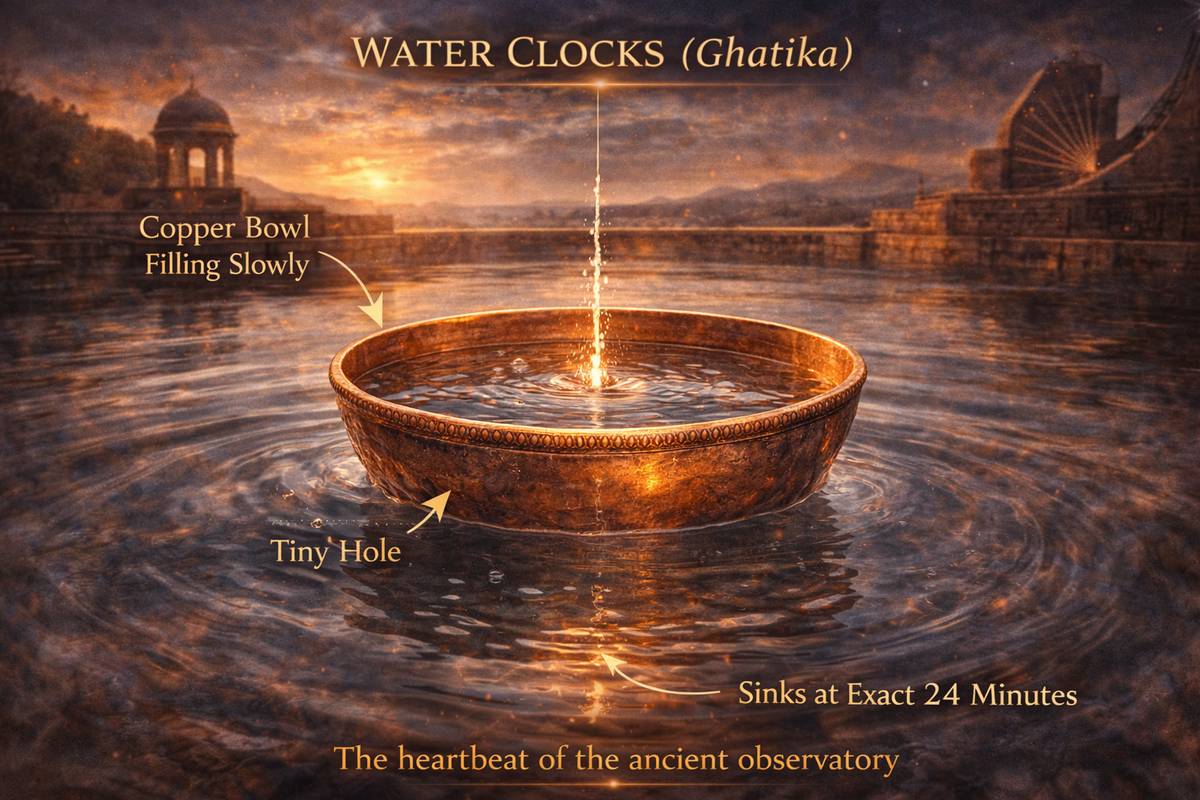
The Concept A water clock, for example, calculates time based [...]
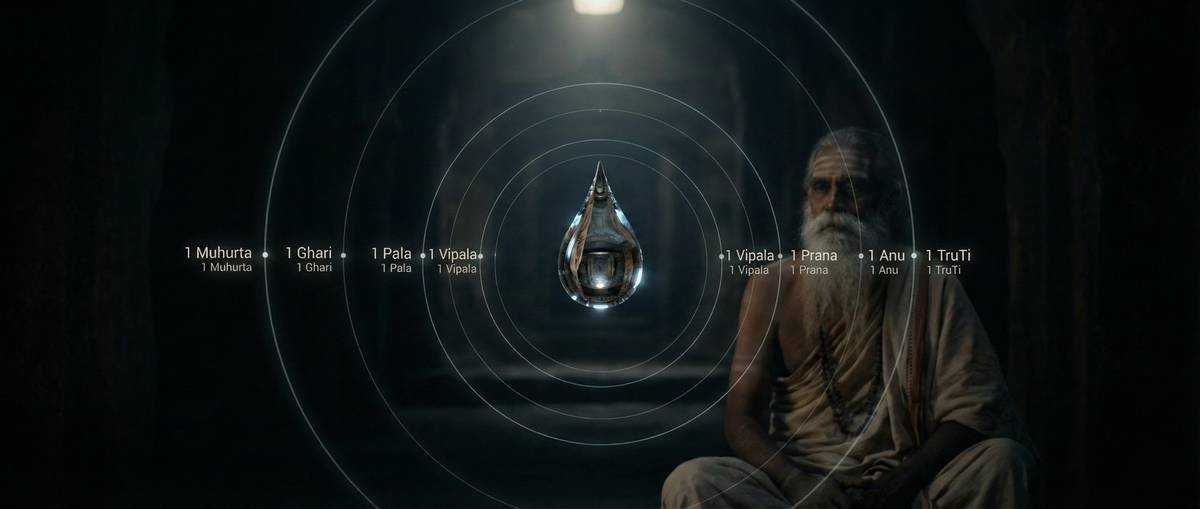
The Concept You may break time down into smaller and [...]