The Concept ‘Kuttaka’ implies breaking or smashing something into small pieces. It is a method for solving linear indeterminate equations such as ax + c = by in mathematics. It requires breaking down numbers into smaller remainders until a solution is reached.
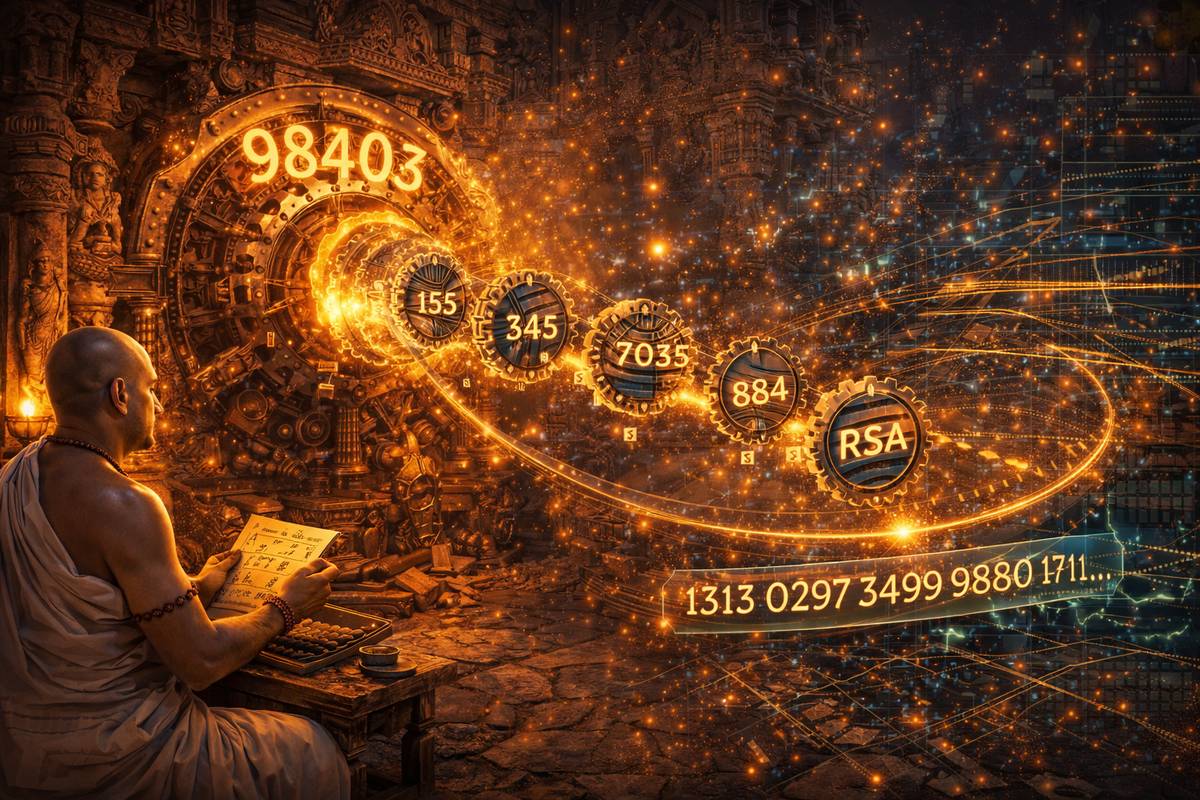
The Story Indian astronomers had a problem: how do you calculate the exact moment when the planets will align after millions of years? To solve it, Aryabhata invented the Kuttaka, or “The Pulverizer”. He treated math like a grain mill, “grinding” large, messy numbers into smaller and smaller remainders until he found the perfect integer solution. This was the birth of modular arithmetic—the “clock math” that keeps our modern world running. Today, every time you use a secure online banking password, you are using the descendant of Aryabhata’s pulverizer to protect your data.
The Timeline
| Milestone | Details |
| Western Ref. |
1624 CE (Bachet de Méziriac)
|
| Indian Source |
499 CE (Aryabhata)
|
| Chron. Gap |
Over 1,100 Years
|
The Original Text
The Aryabhatiya (Ganita 32-33) details the step-by-step process of mutual division used to execute this pulverization.
Related Innovations The Kuttaka algorithm was the first time modular arithmetic was applied. The method is frequently referred to as clock and remainder maths. This method was developed to determine how the planets align and how many days have transpired since the commencement of the Kali Yuga.
Fun Fact The approach is termed ‘pulveriser’ because it breaks down the coefficients into smaller and smaller quantities, similar to how grain is ground into flour.
The Modern Legacy This approach is the foundation of the current encryption (RSA algorithm) used to protect online banking.