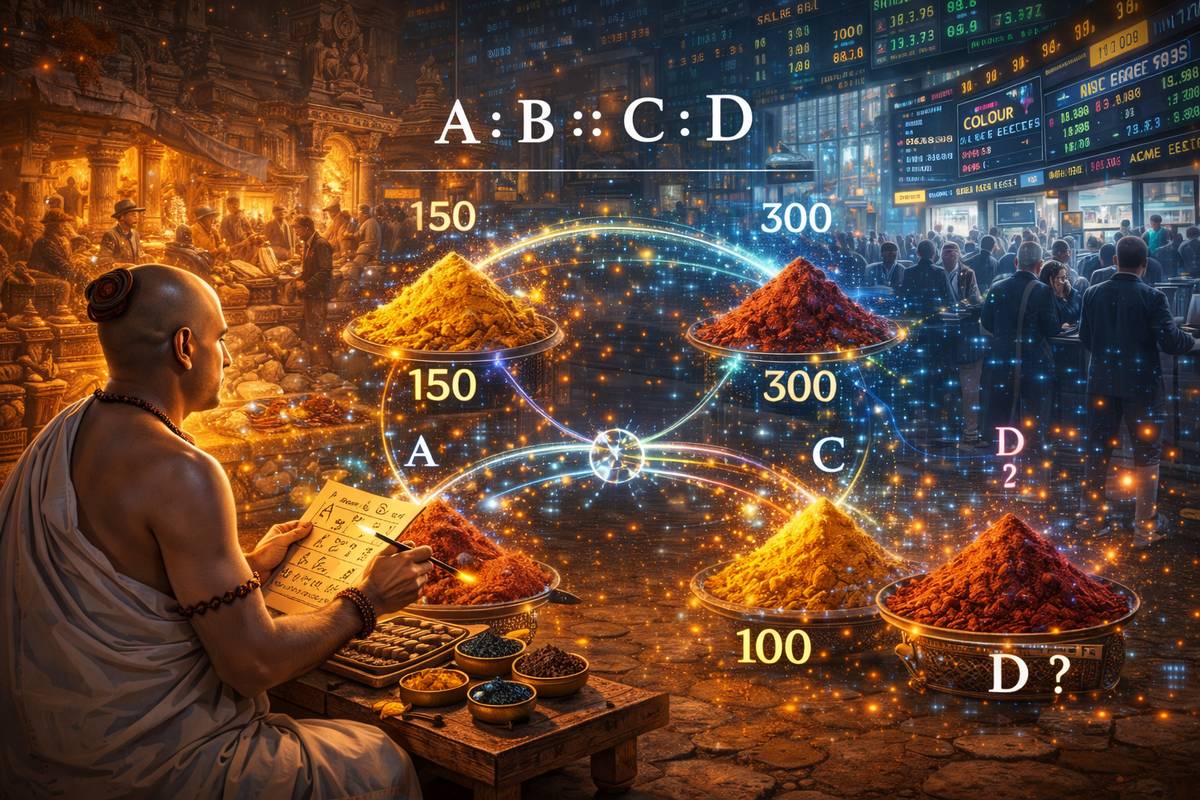
The Concept The ‘Rule of Three’ is the most common technique to practise maths in everyday life. It addresses proportional questions, such as ‘If 3 apples cost 5 rupees, how much do 10 apples cost?’. There are three knowns and one unknown.
The Story In the bustling ancient marketplaces of India, merchants needed a way to calculate prices, weights, and ratios instantly—what we now call the “Rule of Three”. Recorded in the ancient Bakhshali Manuscript, this logic was known as Trairashika. It was so efficient that when it finally reached Europe via the Arab world, it was hailed as “The Golden Rule” because it solved every commercial problem imaginable. While modern students learn it as cross-multiplication, it was originally an Indian survival tool for traders, allowing them to scale everything from spices to temple dimensions with a simple, three-step logic.
The Timeline
| Milestone | Details |
| Western Ref. |
1600s CE (Taught in Merchant Schools)
|
| Indian Source |
200 CE (Bakhshali Manuscript); 499 CE (Aryabhata)
|
| Chron. Gap |
Over 1,400 Years
|
The Original Text
Sanskrit Reference: Aryabhatiya (Ganita 26) details the rule: ‘Trairashike phalarashi…’ (In the rule of three, multiply the fruit by the requisition…).
Related Innovations Indian scriptures expanded the traditional Rule of Three into the ‘Rule of Five’ or ‘Seven’ to help solve difficult issues with several variables. They also developed Vyasta-Trairashika (inverse proportion) for circumstances in which one amount increases while the other decreases, such as speed vs time.
Fun Fact Did you realise that Aryabhata’s formula (A/B = C/D) is identical to the cross-multiplication method that every sixth-grade teacher utilises today?
The Modern Legacy This logic is the bedrock of commercial mathematics. It governs the ratios and scales essential to modern engineering and global trade.