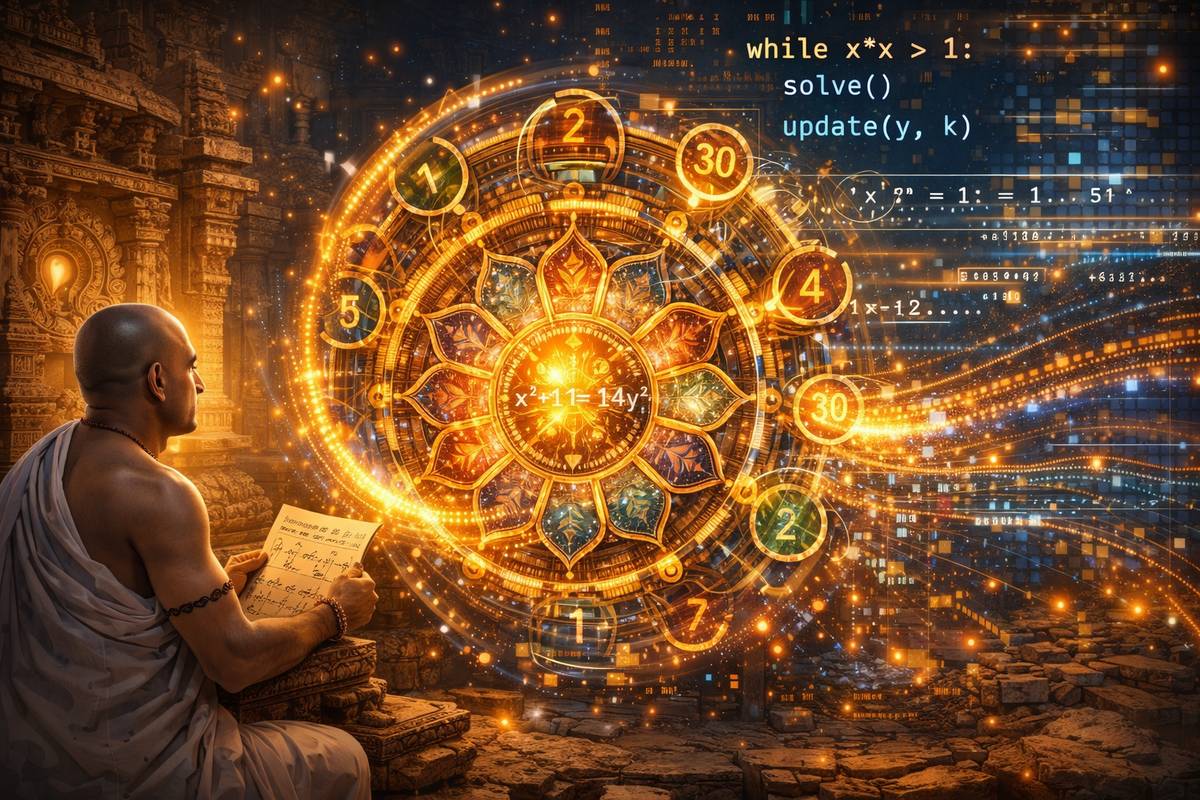
The Concept The Chakravala approach is used to solve indeterminate quadratic equations, such as $Nx^2 + 1 = y^2$. These problems are extremely difficult and typically have integer solutions that entail large integers.
The Story In 1657, the French mathematician Pierre de Fermat issued a challenge to the world to solve a “monstrous” equation: $61x^2 + 1 = y^2$. He thought he had found a problem that would stump everyone. He had no idea that 500 years earlier, an Indian astronomer named Bhaskara II had already solved it using the Chakravala, or “Cyclic Method”. By “pulverizing” large numbers into smaller remainders and looping them back through a cycle, Indian mathematicians could find integer solutions that involved massive digits—numbers so large they made European geometry look like child’s play. It remains, quite simply, the most elegant piece of algebra in the ancient world.
The Timeline
| Milestone | Details |
| Western Ref. |
1657 CE (Fermat’s challenge); 1768 CE (Lagrange proves it)
|
| Indian Source |
1150 CE (Bhaskara II); 628 CE (Brahmagupta)
|
| Chron. Gap |
Over 500 Years
|
The Original Text
Bijaganita (Verse 75) gives the detailed mathematical description of the cyclic process used to break down these equations.
Related Innovations The Bhavana principle established a method for combining things in such a way that you can create an infinite number of new solutions from old ones. Indian mathematicians solved ‘Pell’s Equation’ ($x^2 – Dy^2 = 1$) years before it was defined in the West.
The Modern Legacy These algorithms are the great-great-great-grandparents of the computer loops that programmers use today to solve complex problems.