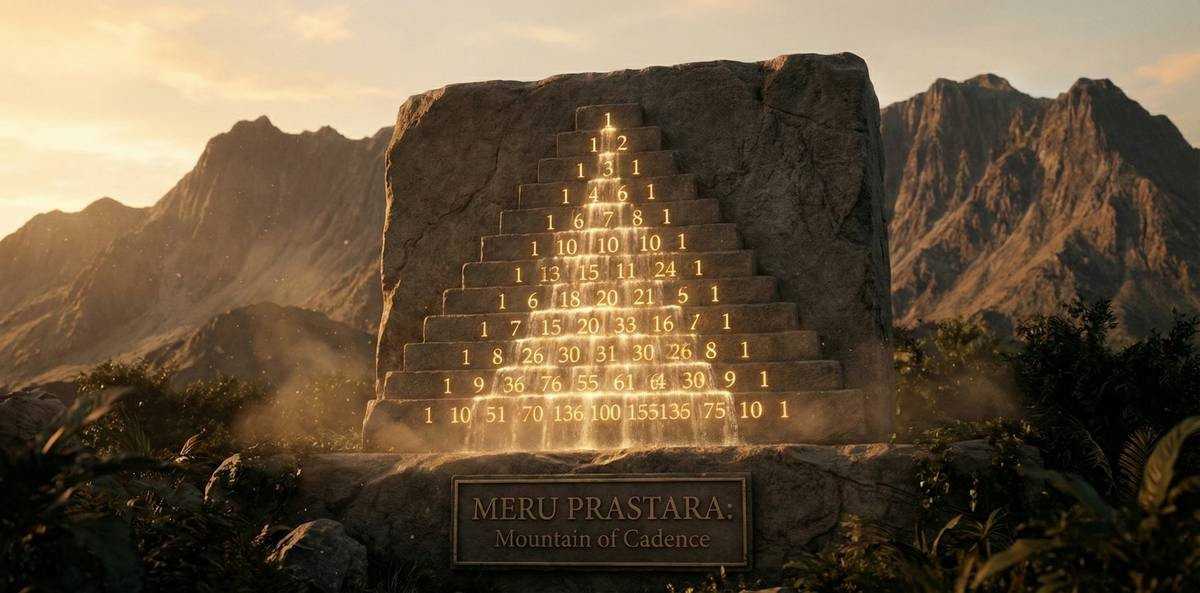
The Concept In this triangular array of integers, each number is the sum of the two directly above it. It is used to calculate binomial coefficients (combinations) and probabilities.
The Story Long before Blaise Pascal sat down in 17th-century France to map out his famous triangle, Indian poets were using the exact same structure to build a “Staircase of Mount Meru” (Meru Prastara). In 3000 BCE, the sage Pingala realized that if you wanted to know every possible way to combine short and long syllables in a poem, you needed a pyramid of numbers. Each row was born from the sum of the two numbers above it. While the West eventually used this triangle for probability and gambling, India used it to ensure that the rhythm of sacred chants was mathematically perfect. It wasn’t just a triangle; it was the world’s first combinatorial map.
The Timeline
| Milestone | Details |
| Western Ref. |
1653 CE (Blaise Pascal)
|
| Indian Source |
Prior to 2,000 BCE (Pingala); 10th Century CE (Halayudha commentary)
|
| Chron. Gap |
Over 3,500 Years
|
The Evidence
Sanskrit Shloka: परे पूर्णम् । परे पूर्णम् । उपरिष्टादेकम् । द्वयोः कोष्ठयोः समाहारः ॥ Transliteration: Pare pūrṇam. Pare pūrṇam. Upariṣṭādekam. Dvayoḥ koṣṭhayoḥ samāhāraḥ. (Halayudha’s Commentary) Meaning: Pingala: “In the succeeding [row], fill the squares.” Halayudha (explaining): “Place one on top. The sum of the two squares above determines the value of the square below.” (This describes exactly how to generate Pascal’s Triangle).
Related Innovations Halayudha used the triangle to calculate the binomial expansion coefficients for $(a+b)^n$ and to solve problems where you had to pick ‘k’ items from a list of ‘n’.
Fun Fact Did you realise that the ‘stairs’ of the Meru Prastara are the coefficients of $(a+b)^n$, a highly important formula in algebra?
The Modern Legacy This pattern is the foundation for modern genetics, statistics, and probability theory.