
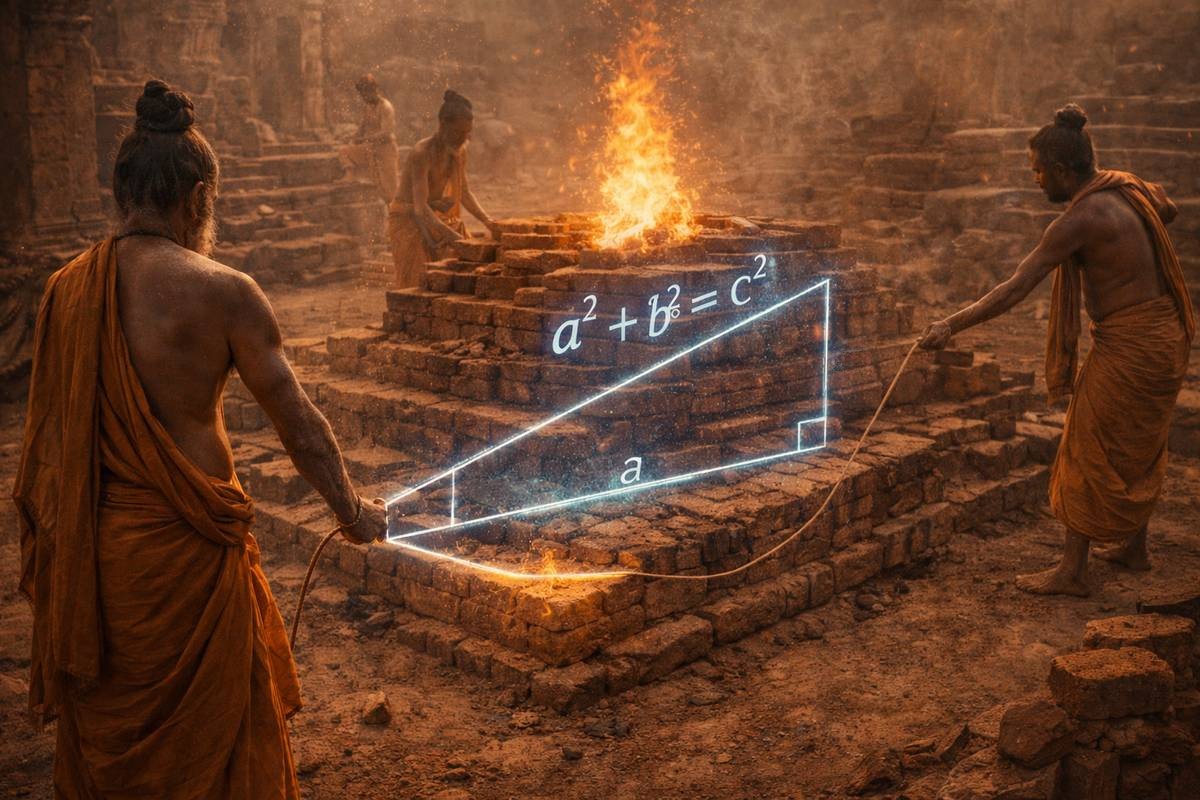
The Concept In a right-angled triangle, the square of the hypotenuse equals the sum of the squares of the other two sides ($a^2 + b^2 = c^2$). This rule helps you find the shortest distance between two points.
The Story We all know the name Pythagoras, but the secret of the right-angled triangle was actually a sacred architectural requirement in India long before he was born. Vedic architects were the ultimate perfectionists; they believed a fire altar had to be mathematically perfect for a ritual to succeed. In the Baudhayana Sulba Sutra, they recorded the rule: the diagonal of a rectangle produces an area equal to the sum of its sides. They even used ‘Pythagorean Triples’ (like 3-4-5) as a shortcut for construction. Pythagoras may have the name, but the Indian Rishis had the blueprint 4,000 years earlier.
The Timeline
| Milestone | Details |
| Western Ref. |
500 BCE (Pythagoras)
|
| Indian Source |
Prior to 5,000 BCE (Baudhayana Sulba Sutra)
|
| Chron. Gap |
Over 4,000 Years
|
The Evidence
Sanskrit Shloka: दीर्घस्याक्ष्णया रज्जुः पार्श्वमानी तिर्यग्मानी चयत्पृथग्भूते कुरुतस्तदुभयं करोति ॥ Transliteration: Dīrghacaturasrasyākṣṇayā rajjuḥ pārśvamānī tiryaṅmānī ca yat pṛthagbhūte kurutastadubhayaṃ karoti. Meaning: ‘The diagonal of a rectangle produces the areas which the two sides produce separately.’ (Baudhayana — Sulba Sutra -1.48)
Related Innovations The Sutras used Pythagorean triples such as (5, 12, 13) to calculate accurate angles on the ground and discovered the square root of 2 to four decimal places (1.4142) for diagonal precision.
The Modern Legacy Central to modern science, this theorem anchors architecture, navigation, and trigonometry—the essential rule that keeps our buildings standing straight.