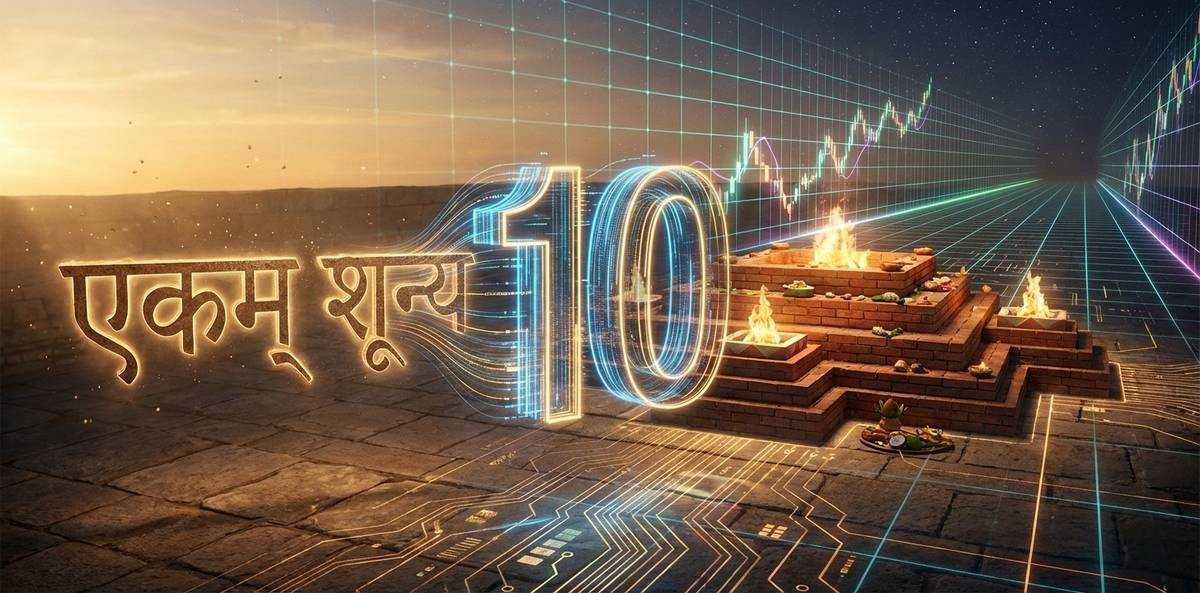
The Concept We can write any number, no matter how large, using only ten symbols (0-9) in the ‘Base-10’ format. ‘Place value’ is the magic word. The value of a number varies depending on its location. The ‘5’ in 500 is ten times larger than the ‘5’ in 50, for example, which makes difficult math much easier.
The Story Imagine trying to run a global business using only the letters I, V, X, and L. To the ancient Romans, a simple division problem like ‘MCMLXXXVIII divided by XII’ was a mathematical nightmare that could take hours.
While the West was struggling with these clumsy symbols, Indian mathematicians were playing with ‘Place Value’ magic. They realized that the number ‘5’ could be ten times larger just by moving its seat. This ‘Base-10’ secret was so powerful it allowed the authors of the Yajur Veda to name numbers up to a trillion—at a time when the Greeks didn’t even have a word for anything over ten thousand. This ‘Hindu Art’ (called Hindsat by the Arabs) eventually liberated Europe from its counting chains, becoming the heartbeat of the modern economy.
The Timeline
| Milestone | Details |
| Western Reference |
1200 CE (Europe adopts Hindu-Arabic numerals) |
| Indian Source |
Prior to 10,000 BCE (Vedic Period texts naming powers of 10) |
| Chronological Gap |
Over 11,000 Years |
The Evidence
Sanskrit Shloka: एकं च दश च शतं च सहस्रं च अयुतं च नियुतं च प्रयुतम् ॥
Transliteration: Eka ṁ ca daśa ca śata ṁ ca sahasra ṁ ca Ayuta ṁ ca niyuta ṁ ca prayutam.
Meaning: “One, ten, hundred, thousand, ten thousand, hundred thousand, and million.” (Yajur Veda -17.2). This demonstrates the systematic naming of powers of ten.
Fun Fact Did you know that the Yajur Veda lists the numbers up to parardha (a trillion)?. The ancient Greeks had no name for numbers greater than 10,000 (a myriad).
The Modern Legacy Due to its superior efficiency in processing data, the decimal system remains the bedrock of modern science, complex engineering, and the world economy.
“The ingenious method of expressing every possible number using a set of ten symbols… emerged in India. The idea seems so simple nowadays that its significance and profound importance is no longer appreciated.” — Pierre Simon de Laplace