
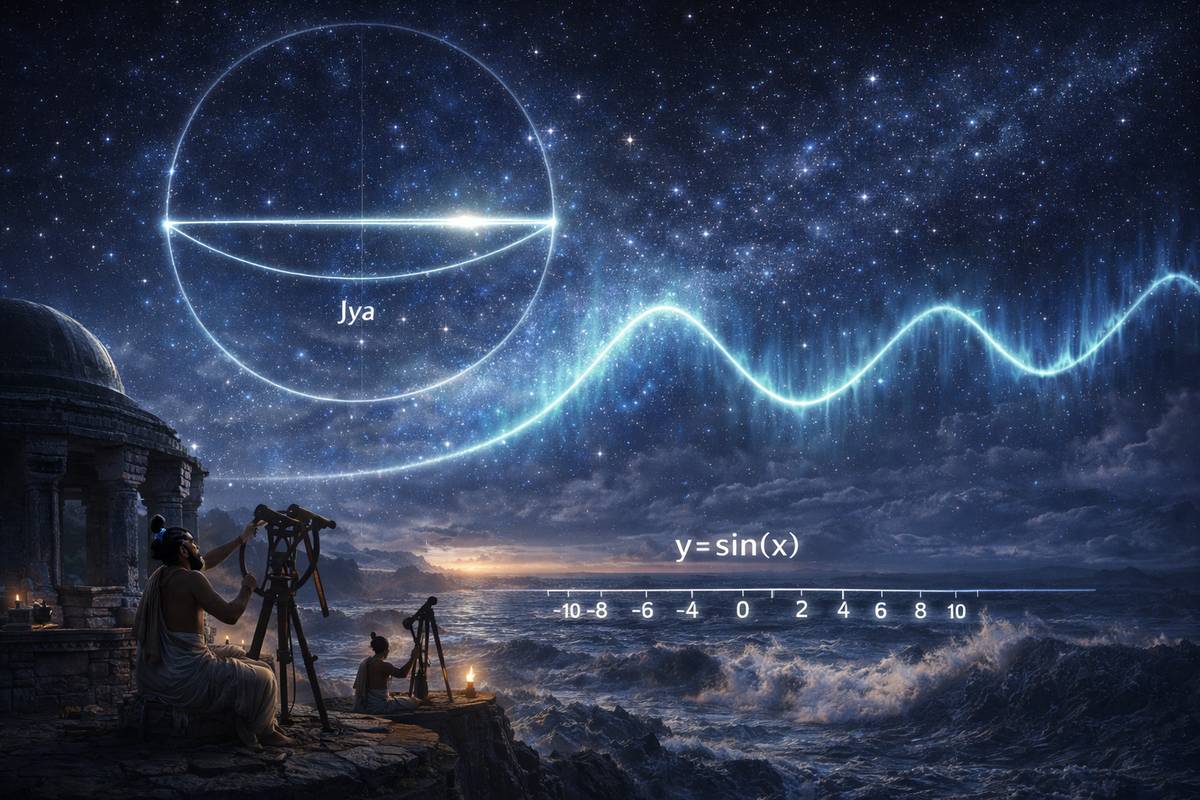
The Concept Trigonometry is the study of the relationships between triangle sides and angles. We can use the ‘Sine’ function to calculate distances that cannot be measured, such as the distance to a star or the height of a mountain.
The Story The word ‘Sine’ is actually a thousand-year-old linguistic accident. Ancient Indian astronomers like those who wrote the Surya Siddhanta used the Jya (half-chord) to measure the distance to the stars. When this knowledge reached the Arab world, they called it Jiba. But when Latin translators saw the word, they mistook it for the Arabic Jaib, which means a ‘pocket’ or ‘fold’ of a garment. They translated it into the Latin Sinus, and the name stuck. Every time a modern student uses a sine function in a GPS app, they are using a piece of Indian star-mapping that was literally ‘lost in translation’.
The Timeline
| Milestone | Details |
| Western Ref. |
1500s CE (Modern Trigonometry in Europe)
|
| Indian Source |
Prior to 10,000 BCE (Surya Siddhanta) & 499 CE (Arabhata)
|
| Chron. Gap |
Over 11,000 Years
|
The Evidence
Sanskrit Shloka: ज्यार्धं मौर्विका जीवा सर्वा वक्रेषु कथ्यते । तस्माज्ज्यार्धगुणाः कार्या भवन्ति कोटिजीवाः ॥ Transliteration: Jyārdhaṃ maurvikā jīvā sarvā vakreṣu kathyate | Tasmājjyārdhaguṇāḥ kāryā bhavanti koṭijīvāḥ || Surya Siddhanta (2.57) Meaning: ‘The half of the chord is called the Jya (Sine) or Jiva. From that half-chord, the Kotijya (Cosine, literally the sine of the complement) is derived.’
Related Innovations Ancient Indian texts such as the Surya Siddhanta and Aryabhatiya employed Koti-Jya (cosine) to calculate horizontal distances and Utkrama-Jya (versine, 1-cos(x)) to locate planets.
The Modern Legacy Trigonometry is useful in GPS technology, building structures, and researching waves (sound, light, and radio).