
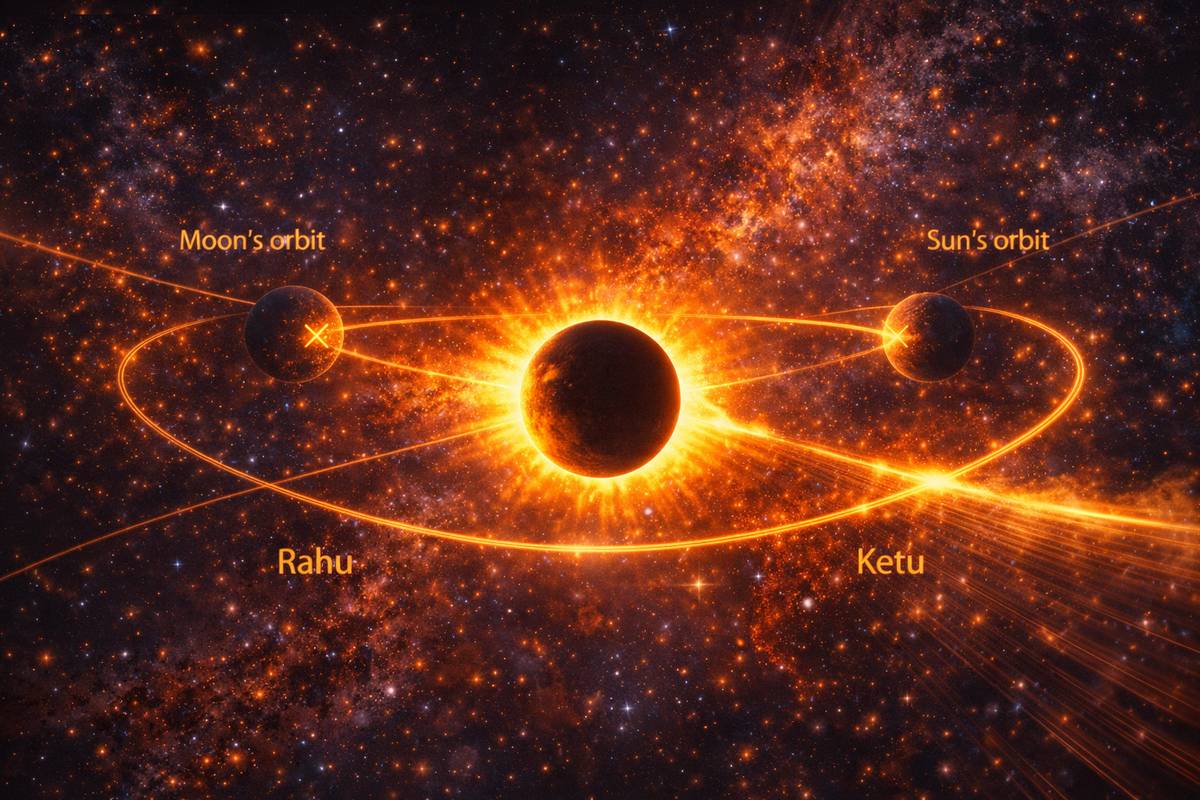
The Concept Rahu and Ketu are not evil demons but rather the ascending and descending nodes. These are the mathematical points at which the Moon’s tilted orbit intersects the Earth’s path (the Ecliptic). A lunar eclipse requires the Moon to be close to these nodes. The Surya Siddhanta calculates their retrograde motion to the minute, allowing it to predict precisely when and how much of the Sun or Moon will be covered.
The Story To the ancient world, eclipses were terrifying moments where a celestial dragon swallowed the Sun. But Indian astronomers saw past the myth to the math. They realized that Rahu and Ketu weren’t monsters, but invisible “nodes”—mathematical points where the Moon’s tilted path crosses the Earth’s orbit. By creating a 3D model of these intersecting planes, the Surya Siddhanta could predict exactly when and where a shadow would fall. This “Nodal Astronomy” was so accurate it is still used in traditional Indian Panchangs to this day to track the heartbeat of the sky.
The Timeline
| Milestone | Details |
| Western Ref. |
17th Century CE (Kepler/Newton) |
| Indian Source |
Prior to 10,000 BCE (Surya Siddhanta) |
| Chron. Gap |
Over 11,000 Years |
The Original Text
Sanskrit Shloka: वक्रानुवक्रगमनान् मण्डलान्तगौ ध्रुवौ । क्षेपस्तेभ्योऽपमण्डले सिद्धयत्यर्कग्रहाग्रतः ॥
Transliteration: Vakrānuvakragamanān maṇḍalāntagau dhruvau | Kṣepastebhyo’pamaṇḍale siddhyatyarkagrahāgrataḥ || Surya Siddhanta (2.6)
Meaning: “From the retrograde and somewhat retrograde motion, the nodes (Dhruva points) move to the end of the circle. Their latitude (deviation) in the ecliptic is established from the position of the Sun and planets.”
Related Innovations Eclipse Colour: Using the depth of the shadow to predict whether the Moon will be red or black. Source: Surya Siddhanta.
Fun Fact The Western astronomical symbols for the North (Omega) and South (mho) Nodes are derived from the Indian Dragon Head (Rahu) and Tail (Ketu).
The Modern Legacy Orbital mechanics is the foundation of modern science. It is required for determining satellite routes and crossing of orbital planes.
Recent Post
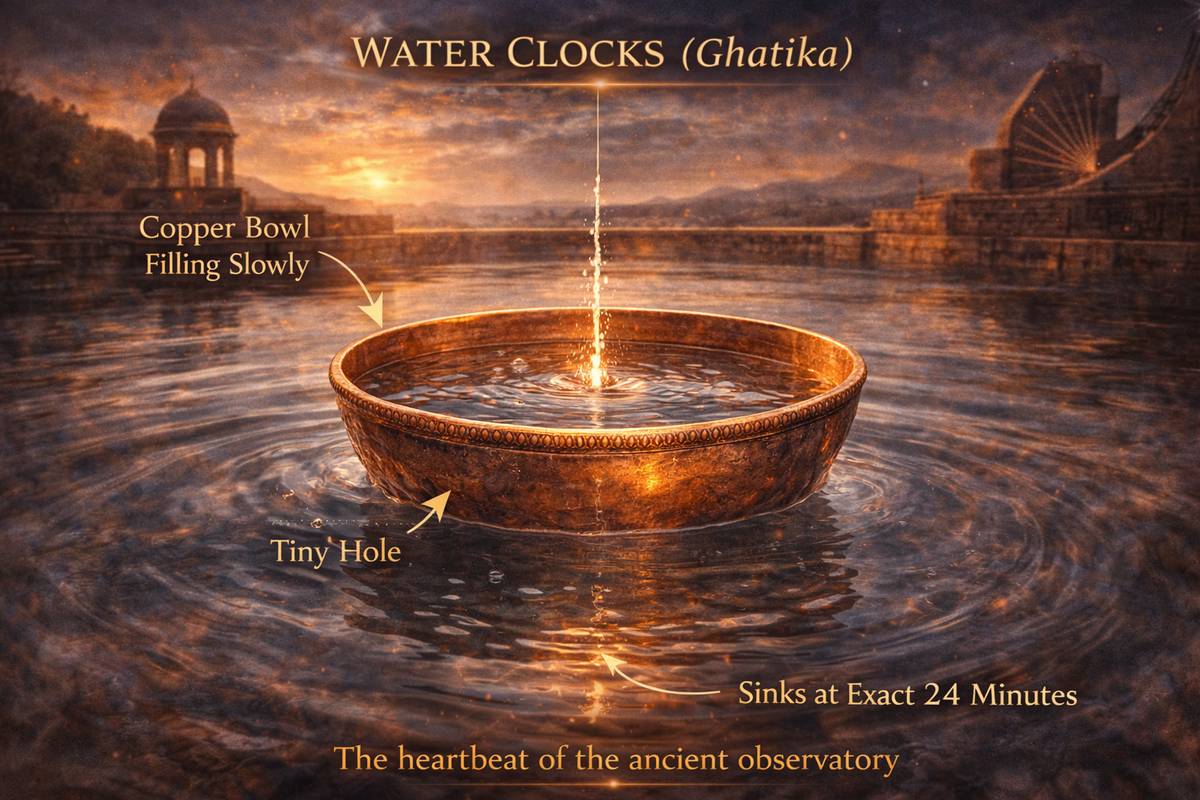
The Concept A water clock, for example, calculates time based [...]
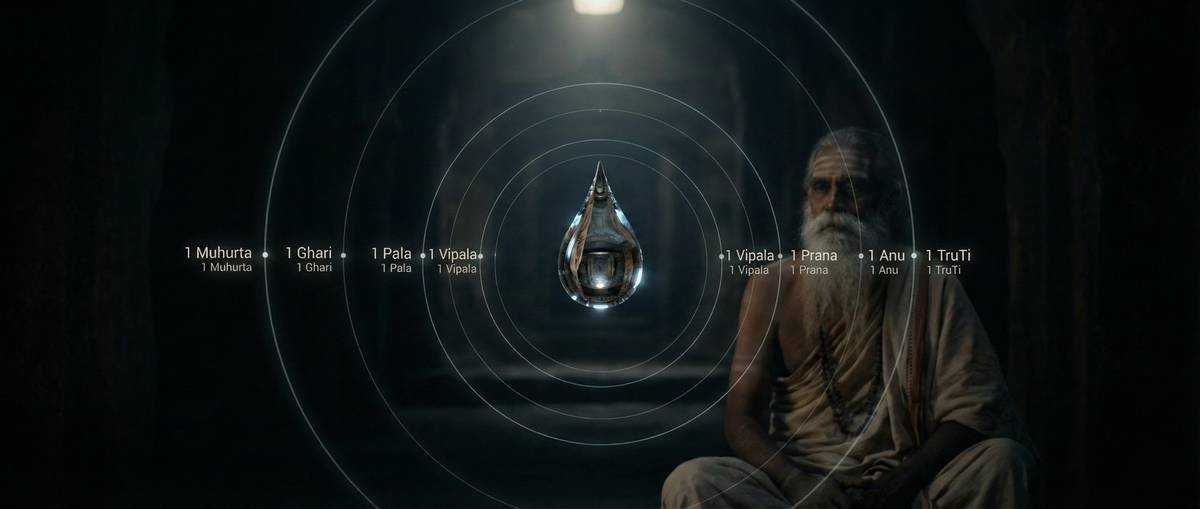
The Concept You may break time down into smaller and [...]