
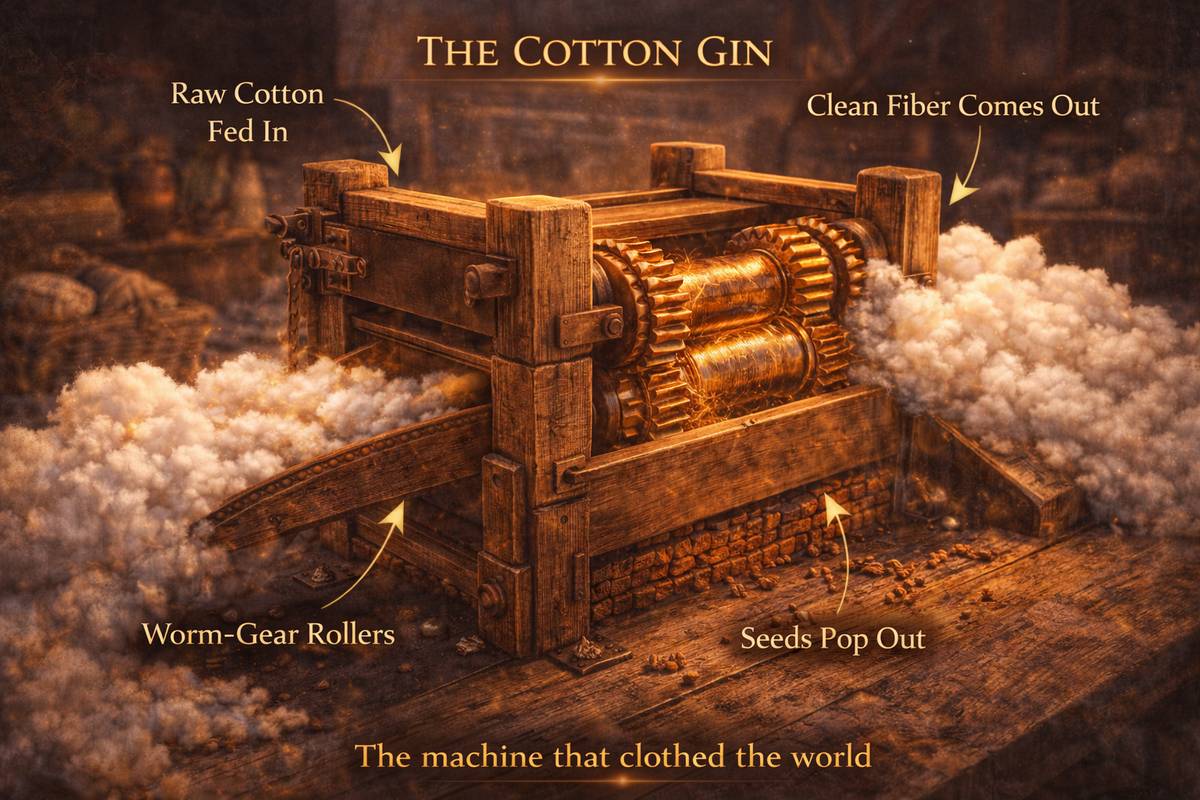
The Concept
Cotton seeds are slow to separate by hand; thus, a machine with two rollers (worm gear) pulls the fibre through while keeping the seeds out.
The Story
For two thousand years, India was the textile factory of the planet, and the secret weapon was a small, two-roller machine called the Charkhi. While the rest of the world was painfully separating cotton seeds by hand, Indian engineers in the 5th century CE had already developed the “worm gear” cotton gin. This machine used two rollers moving at different speeds to pull the fiber through while leaving the seeds behind. This innovation was so efficient that it triggered a global demand for Indian muslin, causing the Roman historian Pliny to complain that his empire was being drained of gold just to buy Indian cloth.
The Timeline
| Milestone | Details |
| Western Ref. | 1793 CE (Eli Whitney’s Cotton Gin) |
| Indian Source | Prior to 500 CE (Ajanta Paintings / Classical texts) |
| Chron. Gap | Over 1,200 Years |
The Original Text
Sanskrit Shloka: अथ कर्पासः… ततूलं स्यात् । तर्कुः कर्त्तनसाधनम् । Transliteration: Atha karpāsaḥ… tatūlaṃ syāt | Tarkuḥ karttanasādhanam || Kamasutra (Lists spinning/weaving as one of the 64 arts) . Meaning: “Now Cotton (Karpasa)… from it comes the fibre (Tula). The Spindle/Wheel (Tarku) is the instrument for spinning/cutting.”
Related Innovations
The Crank Handle – The use of a crank handle to create rotary motion, which eventually led to the spinning wheel (Futuh-us-Salatin, 1350 CE; early cotton gins, c. 6th-11th centuries CE). Mordant Dyeing – The industrial process of fixing dyes to mass-produced cotton textiles (Mohenjo-daro Excavations, c. 2500 BCE; Brihat Samhita, 6th century CE).
Fun Fact
Did you know that India clothed the world for 2,000 years? According to the Roman historian Pliny, Rome lost wealth to pay for Indian muslin .
The Modern Legacy
This is the grandfather of automation and industrial manufacturing equipment.
Recent Post

The Concept A bridge that swings from cables rather than [...]
The Concept Engineers face difficulties when building a dam on [...]