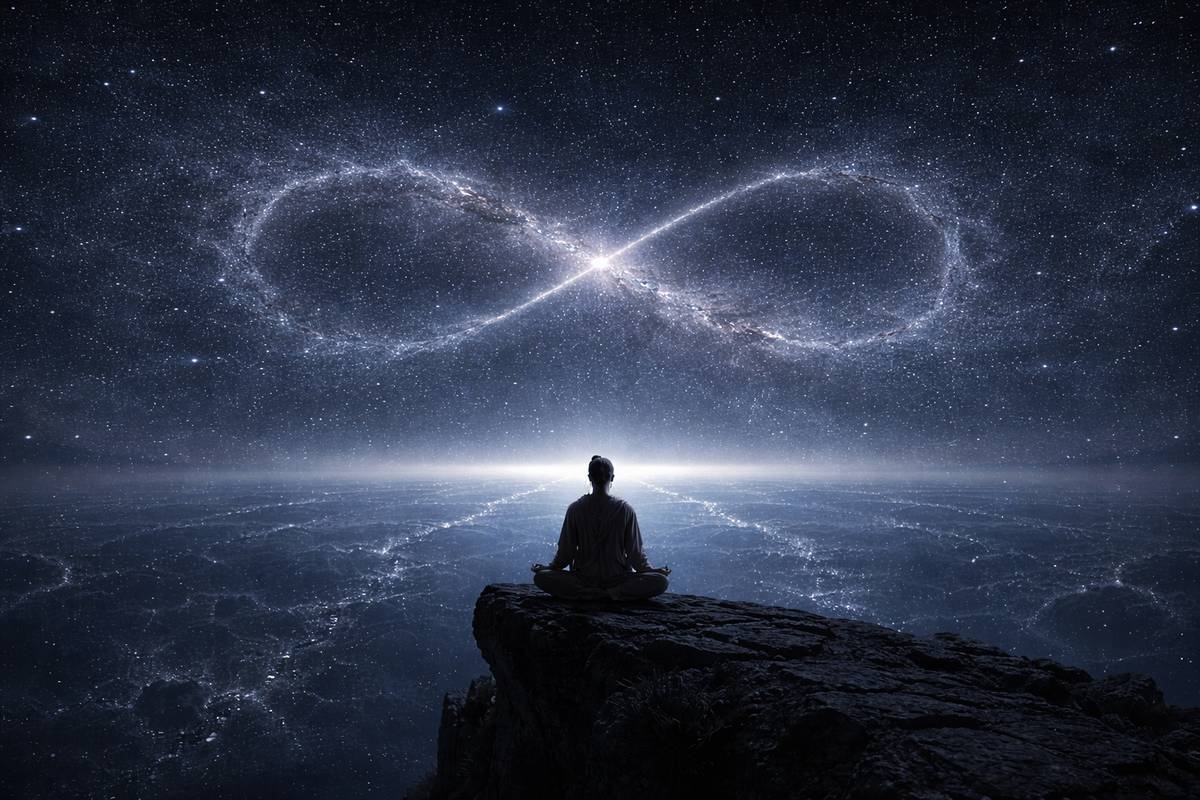
The Concept Infinity indicates that a number has no end. It is a means to understand the limitations of mathematics and the larger picture of philosophy.
The Story For hundreds of years, the Western world suffered from “Horror Infiniti”—a genuine religious terror of the infinite. They viewed infinity as a chaotic, dangerous concept that challenged the order of God. But in India, the Rishis embraced the endless. The Isha Upanishad boldly chanted that if you take infinity from infinity, infinity still remains. By the time Bhaskara II defined infinity mathematically as Khahara (a number divided by zero), he wasn’t just doing math; he was describing the nature of the universe itself. While others looked at the endless and saw chaos, India looked at it and saw completion.
The Timeline
| Milestone | Details |
| Western Ref. |
1655 CE (John Wallis uses infinity symbol)
|
| Ind. Source |
Prior to 10,000 BCE (Vedas); 1114 CE (Bhaskara II)
|
| Shloka Reference |
Isha Upanishad (Invocation) ‘Purnamadah Purnamidam…’ (That is full, this is full…)
|
| Chron. Gap |
Over 11,000 Years (Math) / Millennia (Concept)
|
Related Innovations Bhaskara II defined division by zero as ‘infinite’ (Khahara), and the concept of Indra’s Net depicted a universe that is both recursive and holographic, where every part contains the whole.
The Modern Legacy Understanding infinity is critical for calculus, cosmology (the Big Bang theory), and quantum physics, all of which are branches of modern science.