
The Concept
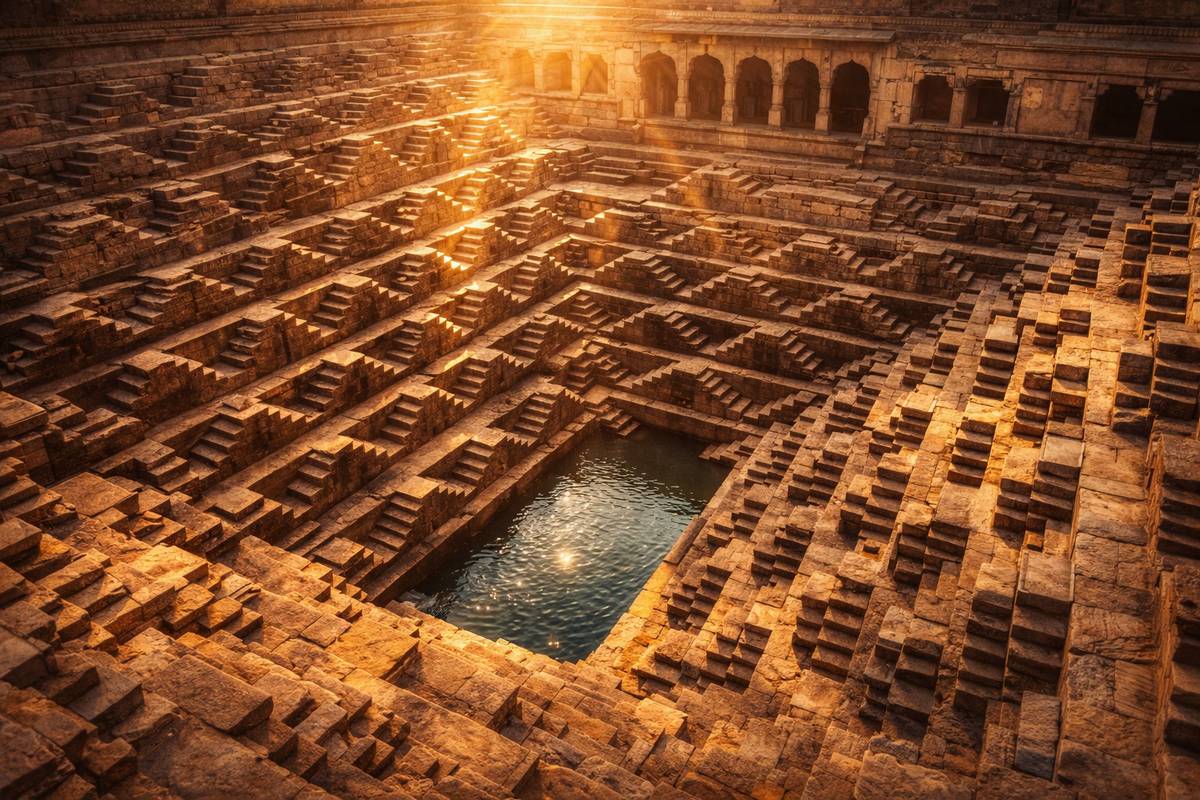
Water evaporates in hot climates. To save it, you must go deep underground. Stepwells (Baolis) are inverted pyramids of architecture that allow people to reach the water table while remaining cool.
The Story
In the scorching heat of India, water was more than a resource; it was a sacred trust. To protect it from evaporation, ancient engineers didn’t just build tanks—they built “inverted pyramids” that descended deep into the earth. These Baolis, or stepwells, were architectural marvels that used “Passive Cooling” to keep the air at the bottom 5-6 degrees cooler than the surface. Structures like the Chand Baori, with its 3,500 symmetrical steps, were built to withstand the immense pressure of the surrounding soil without a single drop of cement. They were the world’s first “natural air conditioners,” proving that green architecture is an ancient Indian heritage.
The Timeline
| Milestone | Details |
| Western Ref. |
1900s CE (Modern passive cooling designs) |
| Indian Source |
Prior to 600 CE (Earliest examples); 3000 BCE (Great Bath antecedents) |
| Chron. Gap |
Unique Indigenous Tech |
The Original Text
Sanskrit Shloka: चतुरस्रा वर्तृला वा दीर्घा वा वापिका शुभा । सोपानावलिर्युक्ता बद्धपाषाणकर्मणा ॥
Transliteration: Caturasrā vartṛlā vā dīrghā vā vāpikā śubhā | Sopānāvaliryuktā baddhapāṣāṇakarmaṇā || Silpa Shastra (Guidelines for reservoir construction) .
Meaning: “A Stepwell (Vapika) is auspicious if square, circular, or rectangular. It should be equipped with rows of stairs (Sopana) and constructed with bound stone masonry.”
Related Innovations
Water Filtration – Some designs incorporated sedimentation tanks where mud settled before the water flowed into drinking wells (Dholavira Reservoirs, c. 3500 BCE). Thermal Mass: Thick stone walls that absorb heat during the day and release it at night (Indus Valley Architecture, around 3000 BCE).
Fun Fact
Did you know that the Chand Baori in Rajasthan has 3,500 thin, perfectly symmetrical steps that descend 13 floors into the ground?.
The Modern Legacy
Modern ‘green architecture’ relies on thermal mass and evaporative cooling to save energy costs.
Recent Post
The Concept A bridge that swings from cables rather than [...]
The Concept Engineers face difficulties when building a dam on [...]