
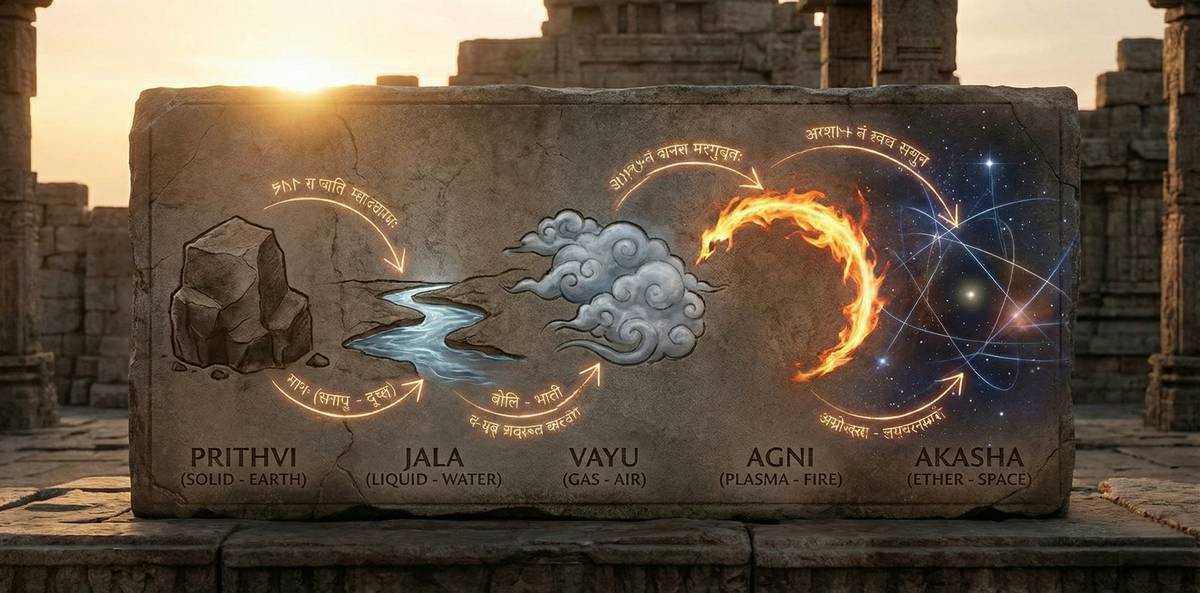
The Concept The five states of matter are solid, liquid, gas, plasma, and vacuum/ether.
The Story Until recently, Western science only recognized three states of matter: solid, liquid, and gas. But the ancient Pancha Bhuta system had already identified five. Beyond Prithvi (Solid), Jala (Liquid), and Vayu (Gas), they recognized Agni (Fire/Energy)—which matches what we now call Plasma, the state of matter in stars. Most impressively, they identified Akasha (Ether/Space), the medium that holds everything together. While 19th-century scientists were mocked for believing in an “ether,” modern quantum physics has returned to this idea, realizing that space itself is a “field” filled with energy.
The Timeline
| Milestone | Details |
| Western Ref. |
1800s CE (Formal states of matter) |
| Indian Source |
Prior to 10,000 BCE (Taittiriya Upanishad) |
| Chron. Gap |
Over 11,000 Years |
The Original Text
The Taittiriya Upanishad (2.1.1) states: ‘Tasmad va etasmadatmana akashah sambhutah…’ (From the Self, Space was born…).
Related Innovations The Vaisheshika Sutras classify Tejas (fire/light) as a distinct substance from Vayu (gas). They also said that Akasha (ether) is the subtle medium that transmits sound, analogous to the ‘field’ in modern physics.
Fun Fact Agni (Fire) is the same as plasma, which is the fourth state of matter, accounting for 99% of the visible universe and found in stars and neon signs.
The Modern Legacy Understanding thermodynamics and how to generate energy requires knowledge of phase changes.
Recent Post
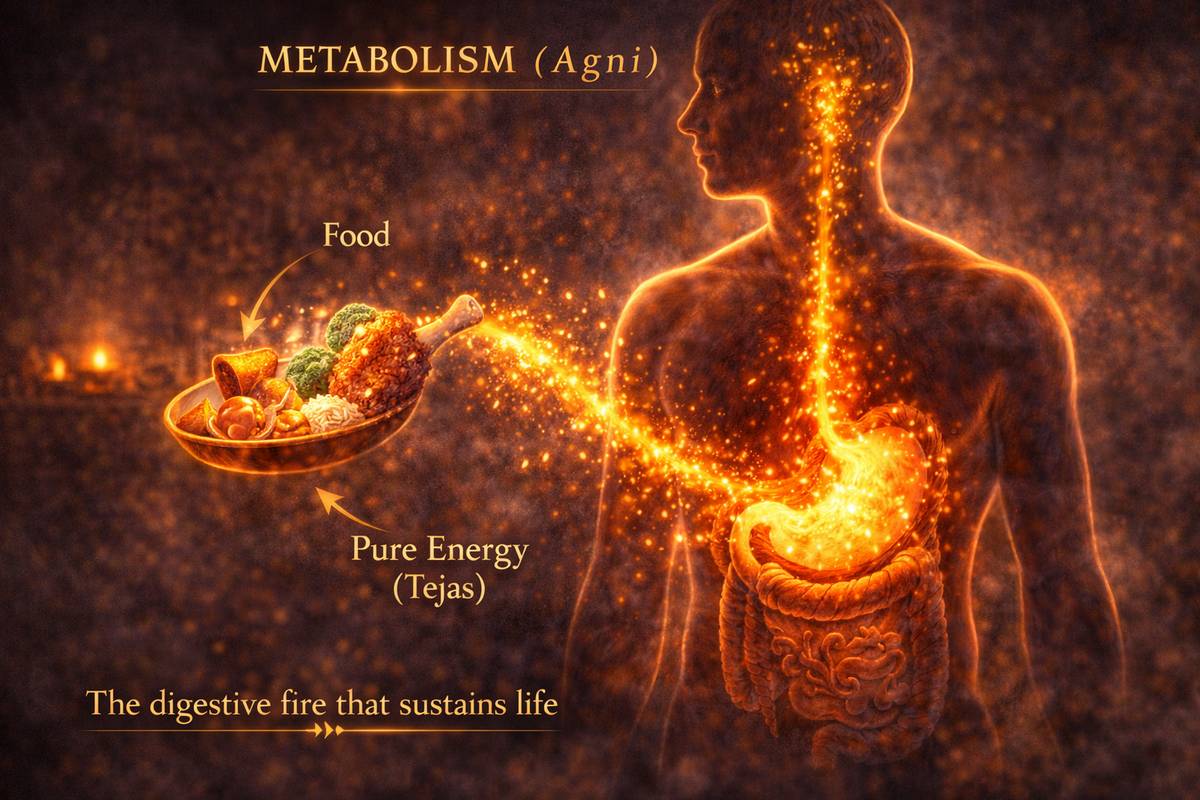
The Concept The body functions as an engine, burning fuel [...]
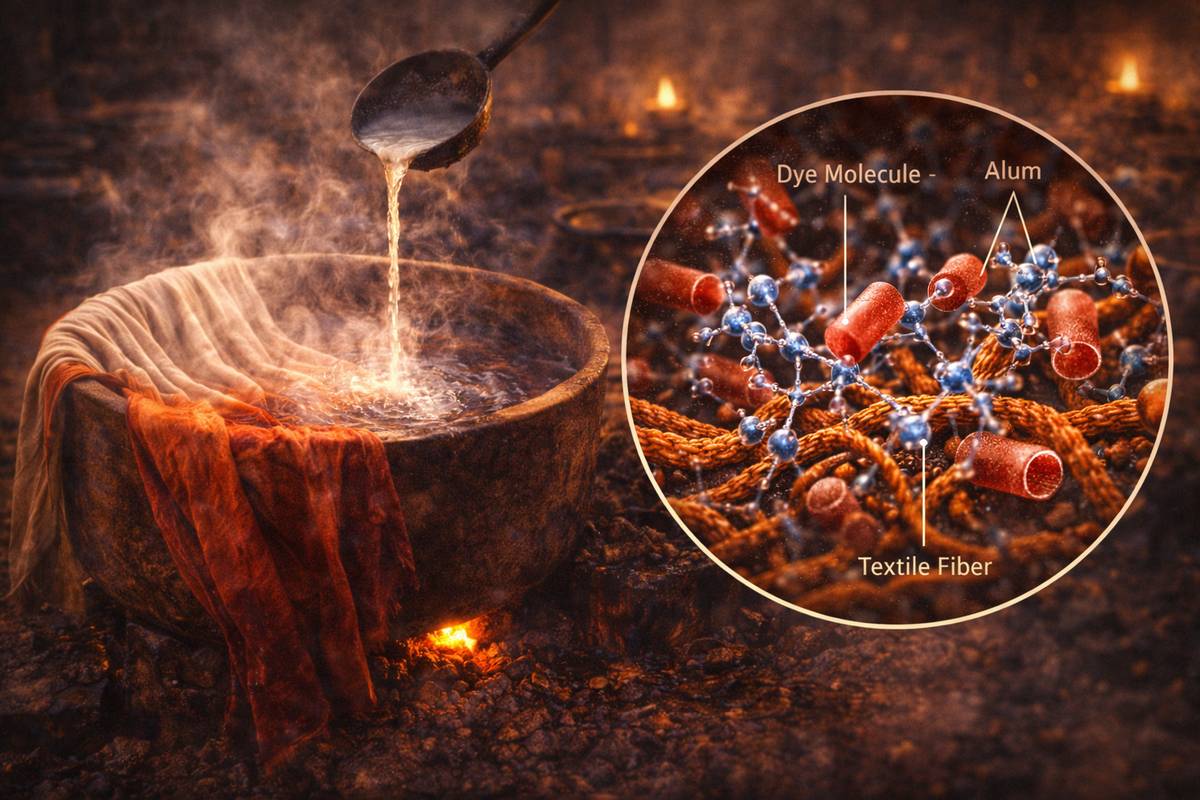
The Concept Dipping clothing in dye will cause it to [...]