
The Concept
A ship must be able to float, remain steady, and move easily across water.
The Story
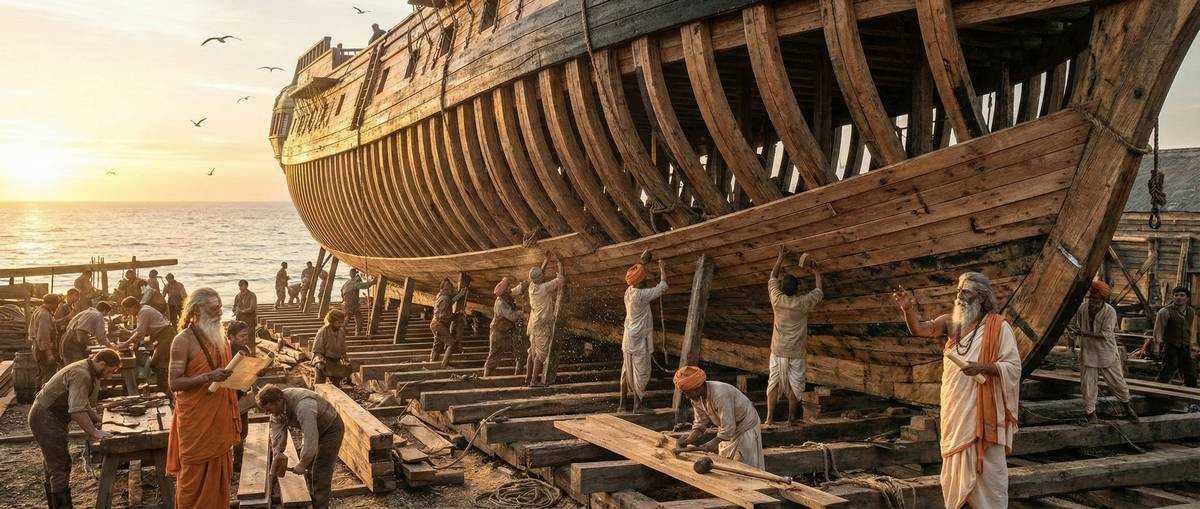
Long before the Portuguese “discovered” the route to India, Indian shipwrights were building vessels that made European boats look like toys. The Yuktikalpataru divided ships into two elite classes: those for rivers and those for the terrifying “Great Ocean”. These ships were built with “sewn-plank” technology—using coconut fibers to stitch planks together—creating a flexible hull that could absorb the impact of coral reefs or storm waves without shattering. When the British East India Company finally saw these ships, they were so intimidated by their durability that they attempted to ban them to protect their own inferior oak-built fleet.
The Timeline
| Milestone | Details |
| Western Ref. | 1500s CE (Age of Exploration) |
| Indian Source | Prior to 3000 BCE (Harappan Docks); 1000 CE (Bhoja’s text) |
| Chron. Gap | Over 4,000 Years |
The Original Text
Sanskrit Shloka: दीर्घा चोर्ध्वा च विक्षेपा त्रिविधा नौः प्रकीर्तिता । राजयानं भवेन्मध्या अन्त्या स्यात् कोशवाहिनी ॥
Transliteration: Dīrghā cordhvā ca vikṣepā trividhā nauḥ prakīrtitā | Rājayānaṃ bhavenmadhyā antyā syāt kośavāhinī || Yuktikalpataru (Classifies ships: Samanya, Visesa) .
Meaning: “Ships are proclaimed to be of three kinds by dimensions… The ‘Madhya’ type (cabin in middle) is for kings (Rajayana), the ‘Antya’ type is for carrying treasury/cargo.”
Related Innovations
Dry docks – The Lothal dockyard had a lock-gate system that kept the water level stable for ship repairs, which is the earliest known example of this type of system (Lothal Excavations, c. 2400 BCE). Ships had multiple masts and square sails to catch the winds that blew during the monsoon season (Ajanta Cave Paintings, c. 2nd Century BCE-480 CE).
Fun Fact
When the Indian shipping industry was at its peak, the British East India Company attempted to outlaw Indian ships since they lasted decades longer than British oak ships.
The Modern Legacy
Marine engineering and hydrodynamics constitute the foundation of modern science.
Recent Post
The Concept A bridge that swings from cables rather than [...]
The Concept Engineers face difficulties when building a dam on [...]