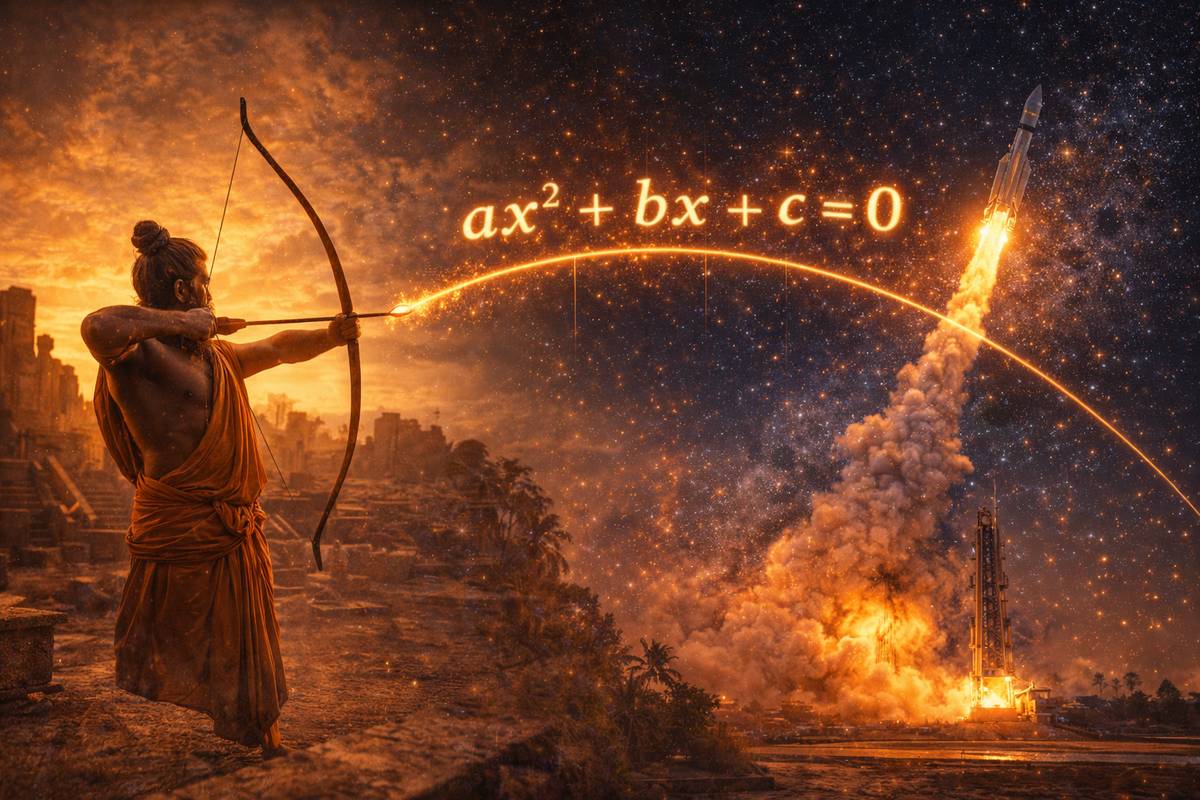
The Concept Solving a quadratic equation ($ax^2 + bx + c = 0$) is necessary for determining the trajectory of an object, such as a ball or rocket. It helps find unknown variables based on squares.
The Story Solving for “X” is the classic struggle of every school child, but for the ancient world, it was the key to understanding the trajectory of a flying arrow. While the Greeks were trying to solve these problems by drawing geometric shapes, the Indian master Brahmagupta decided to use pure logic. In 628 CE, he became the first person to provide a clear algebraic solution for quadratic equations. He wasn’t afraid of “invisible” numbers or negative roots—concepts that terrified Western mathematicians for centuries. He even used colors, calling his variables Kalaka (Black) or Nilaka (Blue), creating the world’s first “color-coded” math system.
The Timeline
| Milestone | Details |
| Western Ref. |
1600s CE (Standardized in Europe)
|
| Indian Source |
628 CE (Brahmagupta’s Brahmasphutasiddhanta)
|
| Shloka Reference |
Brahmasphutasiddhanta (18.44) (Gives the rule for solving quadratics)
|
| Chron. Gap |
Over 900 Years
|
Related Innovations Brahmagupta realised that quadratic equations could have two valid solutions: one positive and one negative.
The Modern Legacy Quadratic equations are the foundation of modern science. They allowed us to calculate speed, area, and projectile motion.