The Concept
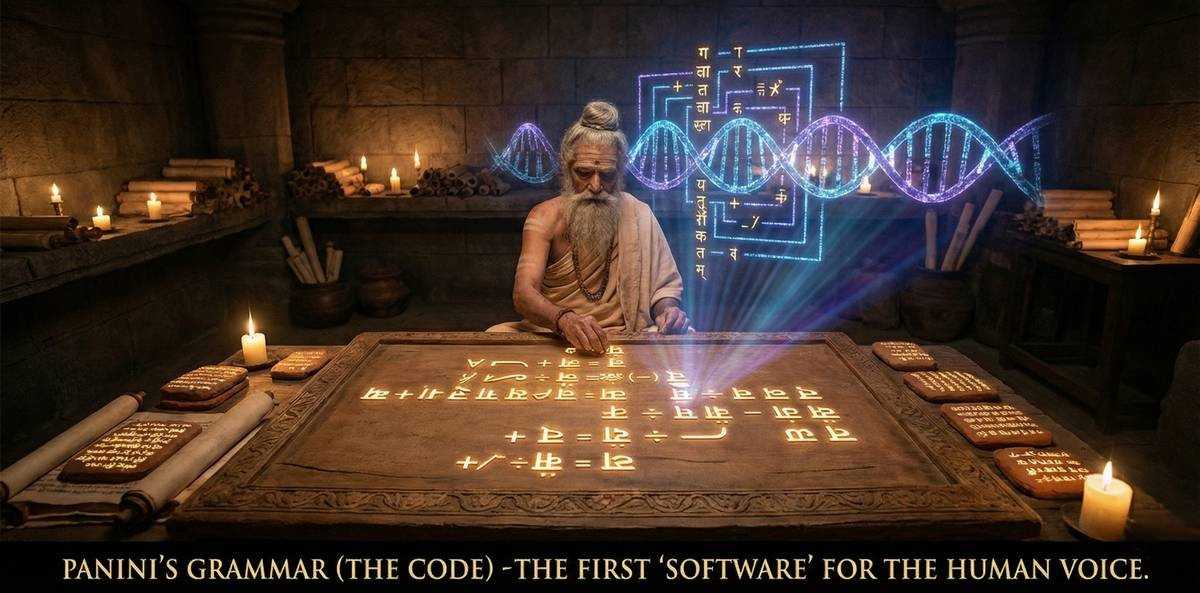
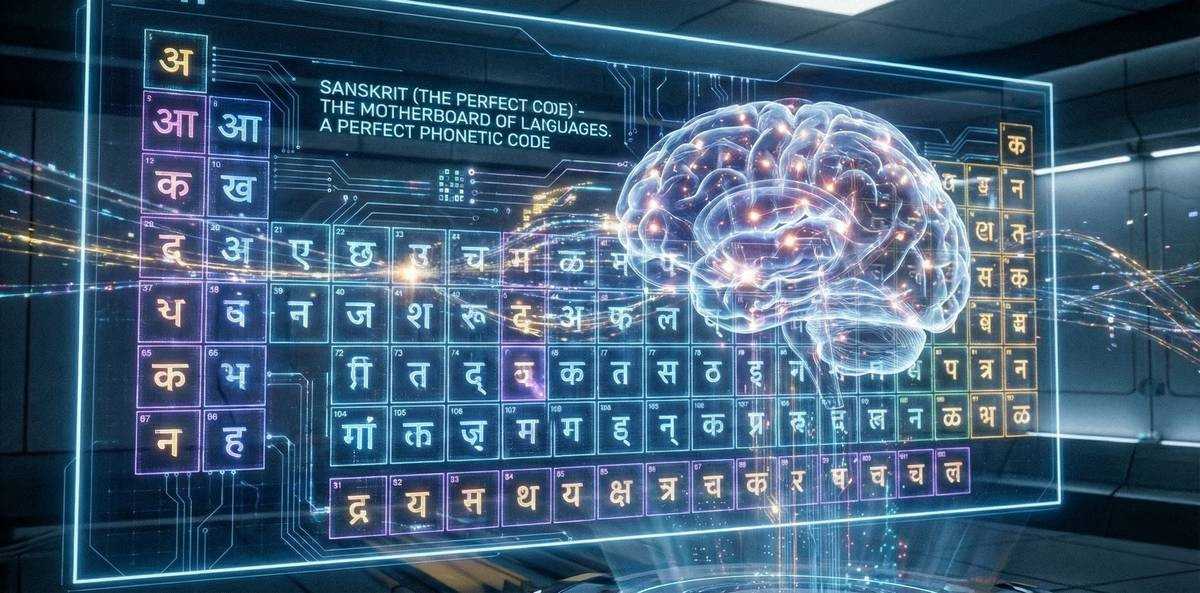
Language normally evolves in a chaotic manner. However, Sanskrit was ‘refined’ (Samskrita) into an ideal algebraic system. It follows tight principles in which base words and suffixes provide specified meanings, with no exceptions.
The Story
Normal languages evolve like wild forests—messy, chaotic, and full of exceptions. But 2,500 years ago, a genius named Panini decided to turn Sanskrit into a mathematical machine. In his Ashtadhyayi, he wrote a “Meta-Language” consisting of 4,000 algebraic rules and recursive logic. He treated words like variables, allowing an infinite number of sentences to be generated from a finite set of roots. When 20th-century computer scientists like Backus and Naur were looking for a way to define programming languages, they were stunned to find that Panini had already written the perfect code. It is the “Motherboard” of all coding—a bridge between human thought and machine logic.
The Timeline
| Milestone | Details |
| Western Ref. | 1950s CE (Noam Chomsky / Computer Linguistics) |
| Indian Source | Prior to 2,000 BCE (Panini) |
| Chron. Gap | Over 4,000 Years |
The Original Text
Sanskrit Shloka: वृद्धिरादैच् । अदेङ् गुणः । (1.1.2) Transliteration: Vṛddhir ādaic | Adeṅ guṇaḥ | Ashtadhyayi (1.1.1) ‘Vriddhiradaich…’ (Defining the growth of vowels). Meaning: “The term Vriddhi denotes the vowels Ā, Ai, and Au. (Rule 1.1.2): The term Guna denotes the vowels A, E, and O.” (These are definitions for the algorithmic processing of sound) .
Related Innovations
The Shiva Sutras, a series of 14 different phonemes that operate as the ‘alphabet code’ for the complete grammar system (Ashtadhyayi), and recursion, a logic established millennia before computer science defined it, are related innovations.
Fun Fact
The Algebra Code – Panini came up with the first ‘Meta-Language’ in the world. Panini’s Sutras were like E=mc^2 in that they turned the whole Sanskrit language into a dense, mathematical code.
The Modern Legacy
Natural Language Processing (NLP), Artificial Intelligence, and Coding Theory are foundations of modern science.
Recent Post
The Concept Sanskrit (Samskrita) translates as ‘refined’ or ‘perfected.’ Sanskrit, [...]