
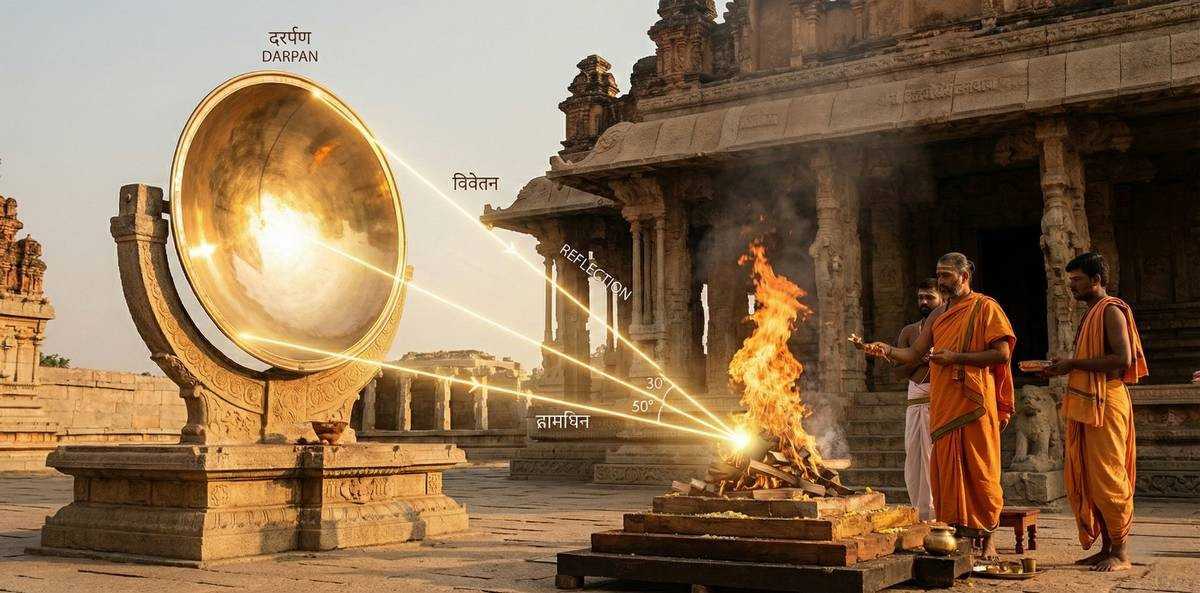
The Concept Smooth surfaces reflect light. Bending the surface (concave or convex) allows you to focus light or expand your field of view.
The Story While the West was still using polished stones, the Harappan civilization was already looking into the future through highly polished copper and bronze mirrors. By the time of the Vaisheshika Sutras, Indian scientists were studying Vakra-Gati—the “crooked motion” of light as it bends through different materials. They didn’t just use mirrors for vanity; they used concave mirrors to focus sunlight into intense heat, creating sacred “solar fires”. This ancient mastery of reflection and refraction laid the groundwork for the telescopes that would eventually unlock the stars and the microscopes that would reveal the hidden world of cells.
The Timeline
| Milestone | Details |
| Western Ref. |
300 BCE (Euclid) |
| Indian Source |
Prior to 2500 BCE (Harappan Artifacts); 10,000 BCE (Rig Veda metaphors) |
| Chron. Gap |
Over 9,000 Years |
The Original Text
The Katha Upanishad (2.3.5) references mirrors philosophically: ‘Yathadarshe…’ (As in a mirror, so in the soul…).
Related Innovations The Vaisheshika Sutras (about 5,000 BCE) discussed how light bends through various materials, a phenomenon known as Vakra-Gati (‘crooked motion’). The Shilpa Shastras, on the other hand, described how to use concave mirrors to direct Sunlight into extremely intense heat, so starting sacred fires (Agni-Kunda).
Fun Fact Did you know? Ancient Indian mirrors were made of highly polished bronze or copper, rather than glass. They survived for thousands of years without breaking.
The Modern Legacy Optics is the foundation of modern science. It leads to telescopes, microscopes, and lasers.
Recent Post
The Concept To drill a hole in a stone, you [...]

The Concept A city should not be a maze. A [...]