
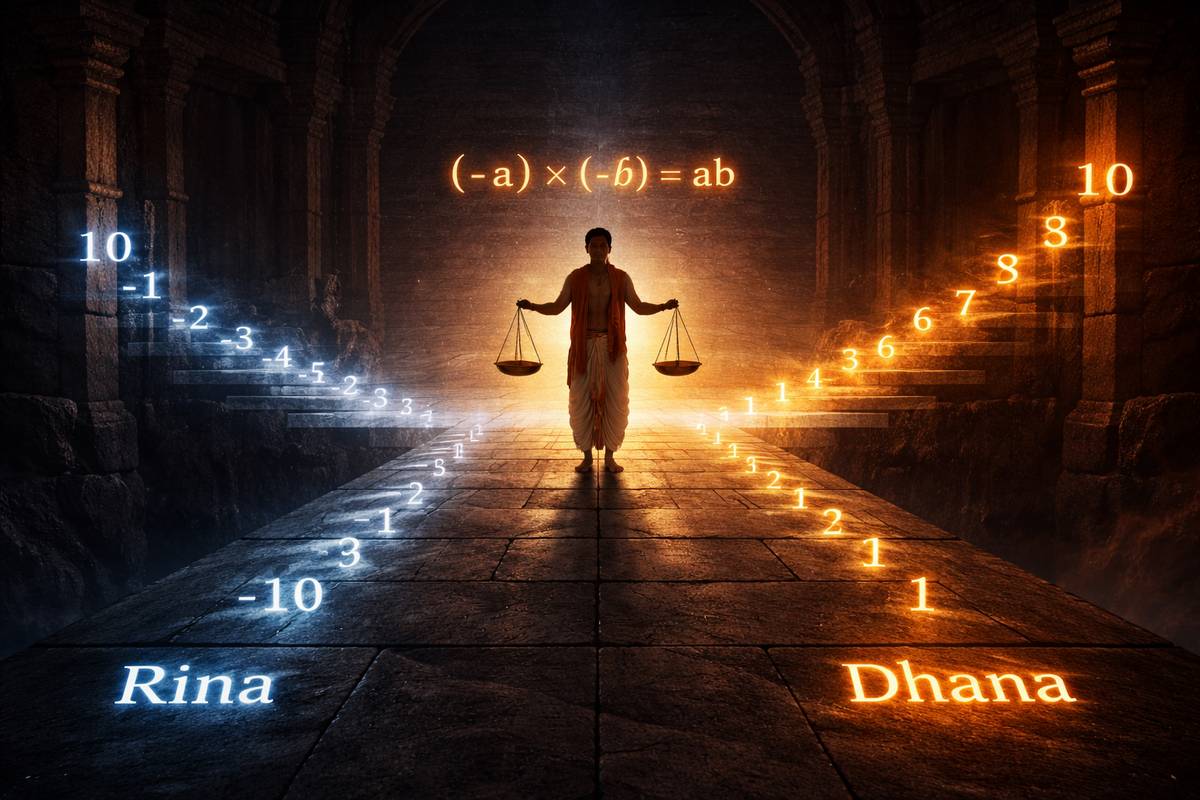
The Concept Negative numbers (-1, -5, and -10) are less than zero. They are useful for demonstrating debt, temperatures below freezing, and opposing directions.
The Story To the mathematicians of the Renaissance, the idea of a “negative” number was absurd—how could you have less than nothing?. They called these results “false” or “fictitious”. But the Indian mindset was more practical. Using the simple logic of Dhana (Wealth) and Rina (Debt), Brahmagupta realized that math worked exactly like a ledger. He was the first to write down the rule we all learn in grade school: “The product of two debts is a fortune” (Negative x Negative = Positive). By treating debt as a mathematical reality, India gave the world the foundation for modern finance and electrical engineering.
The Timeline
| Milestone | Details |
| Western Ref. |
1600s CE (Accepted reluctantly in Europe)
|
| Indian Source |
628 CE (Brahmagupta); Prior to 200 BCE (Bakhshali Manuscript)
|
| Chron. Gap |
Over 1,000 Years
|
The Evidence
Sanskrit Shloka: ऋणमृणेन धनं स्याद् धनं धनेन धनं भवेत् । ऋणधनयोर्ऋणं स्यात् ऋणं च धनमृणयोश्च ॥ Transliteration: Ṛṇamṛṇena dhanaṃ syād dhanaṃ dhanena dhanaṃ bhavet | Ṛṇadhanayorṛṇaṃ syāt ṛṇaṃ ca dhanamṛṇayośca || Brahmasphutasiddhanta (18.30) (Rules for signs). Meaning: “A debt multiplied by a debt becomes wealth (negative × negative = positive). Wealth multiplied by wealth is wealth. A debt multiplied by wealth is a debt.”
Related Innovations The Bakhshali Manuscript used a dot to represent negative integers and stated that zero was the sum of a positive number and its negative (X + (-X) = 0).
The Modern Legacy Negative numbers are essential to modern finance, vector physics, and electrical engineering (both positive and negative charges).