
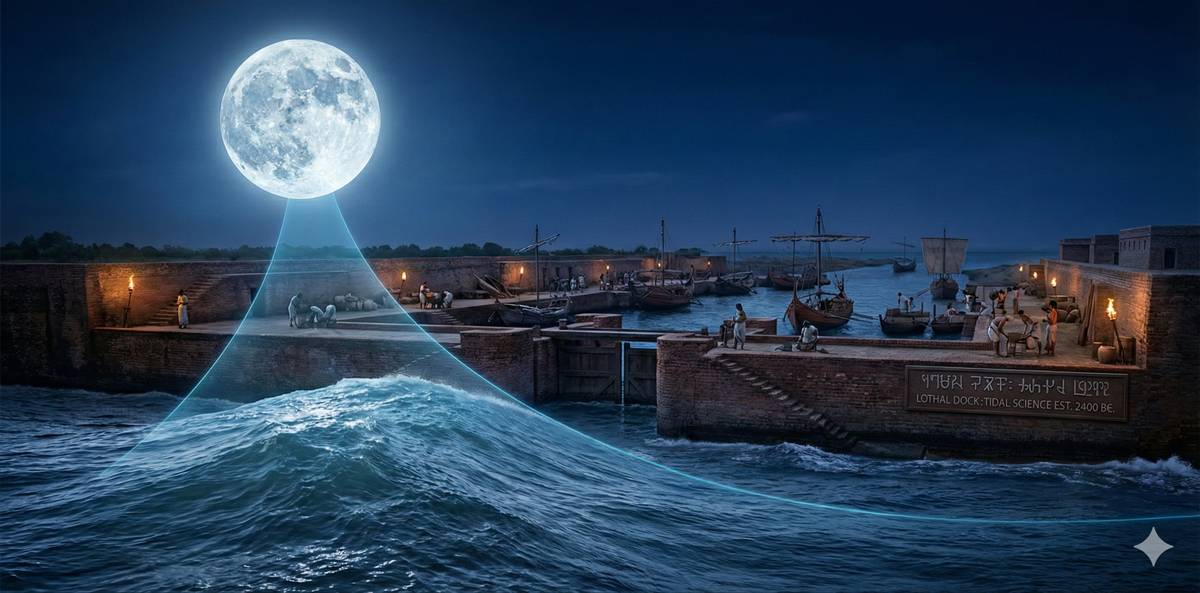
The Concept The Moon’s gravity pulls on Earth’s oceans, causing tides to rise and fall.
The Story For centuries, Western scientists like Galileo mocked the idea that the Moon could move the Earth’s oceans. But Indian sailors and scholars had long lived by the pulse of the Jwara-Bhata (Tides). The Vishnu Purana explicitly stated that the waters of the ocean swell and sink in direct rhythm with the rising and setting of the Moon. This wasn’t just theory—it was industrial reality. At Lothal, in 2400 BCE, Indian engineers built the world’s oldest tidal dock, using a “lock-gate” system that used the Moon’s gravity to float massive ships into harbor, a feat of hydraulic engineering that was thousands of years ahead of its time.
The Timeline
| Milestone | Details |
| Western Ref. |
1687 CE (Newton explains tidal forces) |
| Indian Source |
Prior to 5000 BCE (Vishnu Purana) |
| Chron. Gap |
Over 6,000 Years |
The Original Text
The Vishnu Purana (2.2.24) describes the rise of waters with the Moon using the term ‘Jala-vriddhi…’.
Related Innovations Archaeological excavation at Lothal (about 2400 BCE) discovered the world’s oldest known tidal dock. It was designed with an ingenious lock-gate mechanism to maintain steady water levels during tides.
Fun Fact The engineers at Lothal actually harnessed the Moon’s gravity to operate their lock-gate system, floating massive ships safely into harbor.
The Modern Legacy Tidal charts are extremely useful for shipping, fishing, and naval activities.
Recent Post

The Concept The zodiac consists of a 360-degree circle rather [...]

The Concept The Pole Star is a stationary point in [...]