
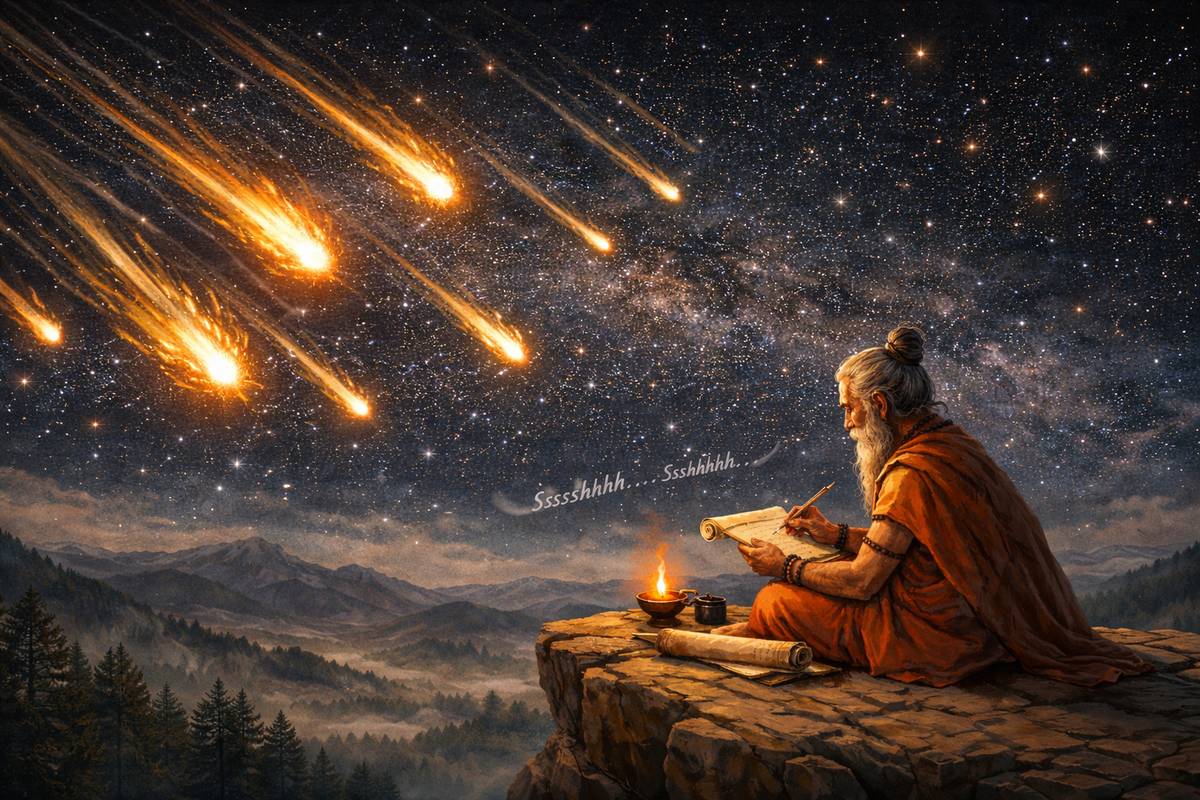
The Concept Stars are Suns that are located far away. Meteors, sometimes known as ‘shooting stars’, are rocks that burn up in the atmosphere. They have fundamentally different characteristics.
The Story While Aristotle believed meteors were just “hot gas” in the atmosphere, the Indian sage Varahamihira recognized them as physical objects falling from space. In the Brihat Samhita, he distinguished these Ulka (Meteors) from the fixed stars and moving planets. He even recorded the “hissing sound” they make as they burn up—a rare phenomenon now known as “electrophonic meteor sounds” that Western science only recently validated. By observing the friction and heat (Tejas) generated as these stones struck the air, ancient India had pioneered the study of atmospheric physics 1,300 years before the first meteorite was “officially” recognized by Europe.
The Timeline
| Milestone | Details |
| Western Ref. |
1803 CE (Jean-Baptiste Biot proves meteors fall from space) |
| Indian Source |
500 CE (Varahamihira) |
| Chron. Gap |
Over 1,200 Years |
The Original Text
The Brihat Samhita (Chapter 33) explicitly describes the physical falling of Ulkas.
Related Innovations The Vaisheshika Sutras (c. 5,000 BCE) stated that friction in the atmosphere causes meteors to burn (Tejas), while the Brihat Samhita (c. 550 CE) stated that different Nakshatras (constellations) are associated with specific meteor showers.
Fun Fact Varahamihira wrote that meteors make a ‘hissing sound’ when they fall. This is an unusual sound, now known as ‘electrophonic meteor sounds’.
The Modern Legacy Planetary defence (monitoring asteroids) and understanding the chemical delivery of elements to Earth.
Recent Post
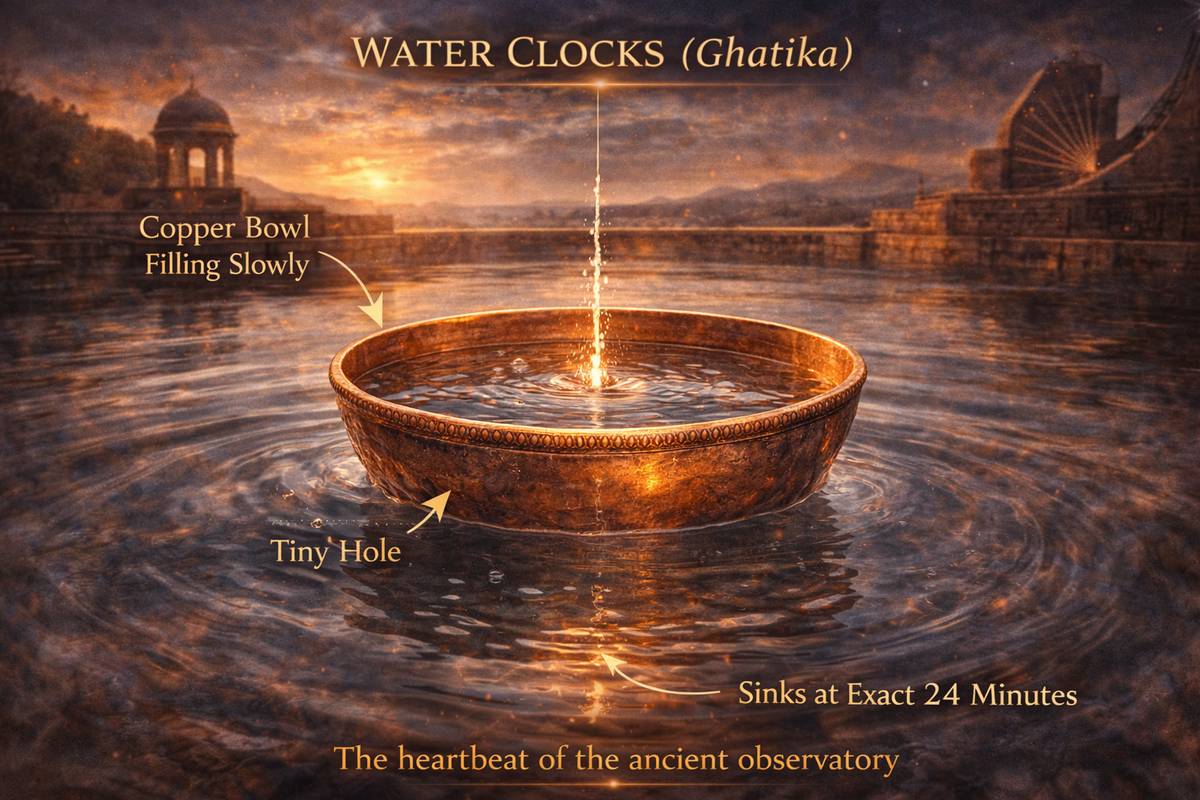
The Concept A water clock, for example, calculates time based [...]

The Concept Steel is iron with a small amount of [...]