
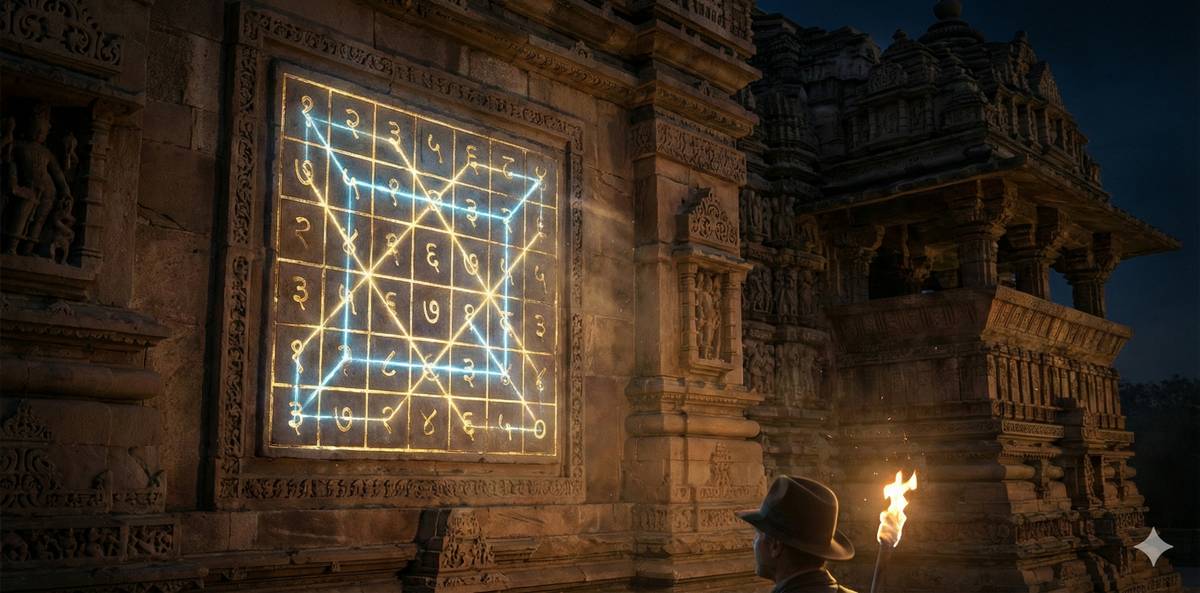
The Concept A Magic Square is a grid of numbers in which the sum of each row, column, and diagonal is equal. It’s an excellent demonstration of how to blend numbers and patterns.
The Story In the 6th century, the polymath Varahamihira wasn’t just doing math for the sake of numbers; he was using it to make the perfect scent. He created a 4×4 “Magic Square” where every row, column, and diagonal added up to the same number to help blenders mix perfumes in exact, harmonious proportions. By the 10th century, these “Yantras” were carved into temple walls like the Parshvanatha temple at Khajuraho—perfectly “pandiagonal” grids that were far more complex than anything Europe would produce for another 500 years. These weren’t just puzzles; they were the first steps toward modern matrix algebra and encryption.
The Timeline
| Milestone | Details |
| Western Ref. |
1514 CE (Albrecht Dürer’s Melencolia I)
|
| Indian Source |
550 CE (Varahamihira); 1st Century CE (Nagarjuna)
|
| Chron. Gap |
Over 1,400 Years
|
The Original Text
The Brihat Samhita (Chapter 76) vividly describes a mathematical method for creating a magic square specifically formulated for blending perfumes.
Related Innovations Cryptographers employed magic squares to hide secret messages and organise mystical yantras.
Fun Fact The Khajuraho square is ‘pandiagonal’, which means that even the broken diagonals sum to 34. This is more difficult to figure out mathematically than Dürer’s square.
The Modern Legacy Magic squares play an important role in modern encryption and matrix algebra.