
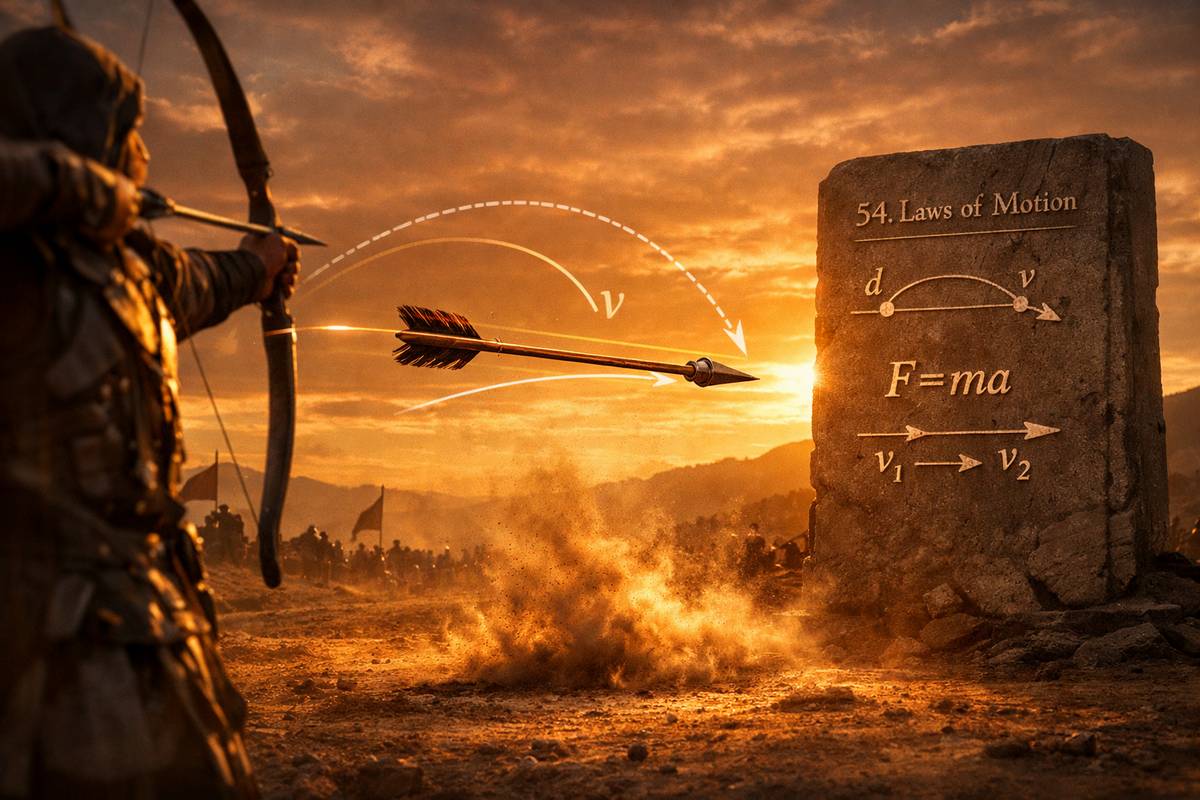
The Concept Things follow certain rules about speed, force, and direction. This includes the concept of inertia, which states that an object continues to move unless it is stopped and that every action has a reaction.
The Story We are taught that Isaac Newton “invented” the laws of motion in 1687, but the Vaisheshika Sutras had already mapped the rules of the road 6,000 years earlier. Rishi Kanada described Vega (Velocity) as a force with a specific direction—what we now call a vector. He explained Sanskara (Momentum), the “impressed force” that keeps an arrow flying long after it has left the bow. Most strikingly, he noted that “Action is opposed by an equivalent opposite action,” predating Newton’s Third Law by millennia. In the ancient Indian mind, the universe wasn’t a mystery; it was a machine governed by logical laws of force.
The Timeline
| Milestone | Details |
| Western Ref. |
1687 CE (Isaac Newton) |
| Indian Source |
Prior to 5,000 BCE (Kanada) |
| Chron. Gap |
Over 6,000 Years |
The Original Text
Sanskrit Shloka: नोदनादाद्यमिषोः कर्म तत्कर्मकारिताच्च संस्कारात् । उत्तरं तथोत्तरमुत्तरं च ॥ Transliteration: Nodanādādyamiṣoḥ karma tatkarmakāritācca saṃskārāt | Uttaraṃ tathottaramuttaraṃ ca || Vaisheshika Sutras (5.1.17) Meaning: “The first action of the arrow is from Impulse (Nodana); the next is from the Momentum (Sanskara) caused by that action; and similarly the next and the next.”
Related Innovations The Vaisheshika Sutras (about 5,000 BCE) distinguished between simple motion and Vega (velocity with direction). They also described Sanskara as the ‘impressed force’ (momentum) that keeps an object moving after the initial push has ended.
Fun Fact Kanada distinguished between Nodan (constant pressure, like pulling a cart) and Abhighata (impact, like hitting a ball).
The Modern Legacy These regulations govern everything from rocket launches to vehicle safety.
Recent Post
The Concept Old European science considered heat to be a [...]
The Concept When two different metals react with an acidic [...]