
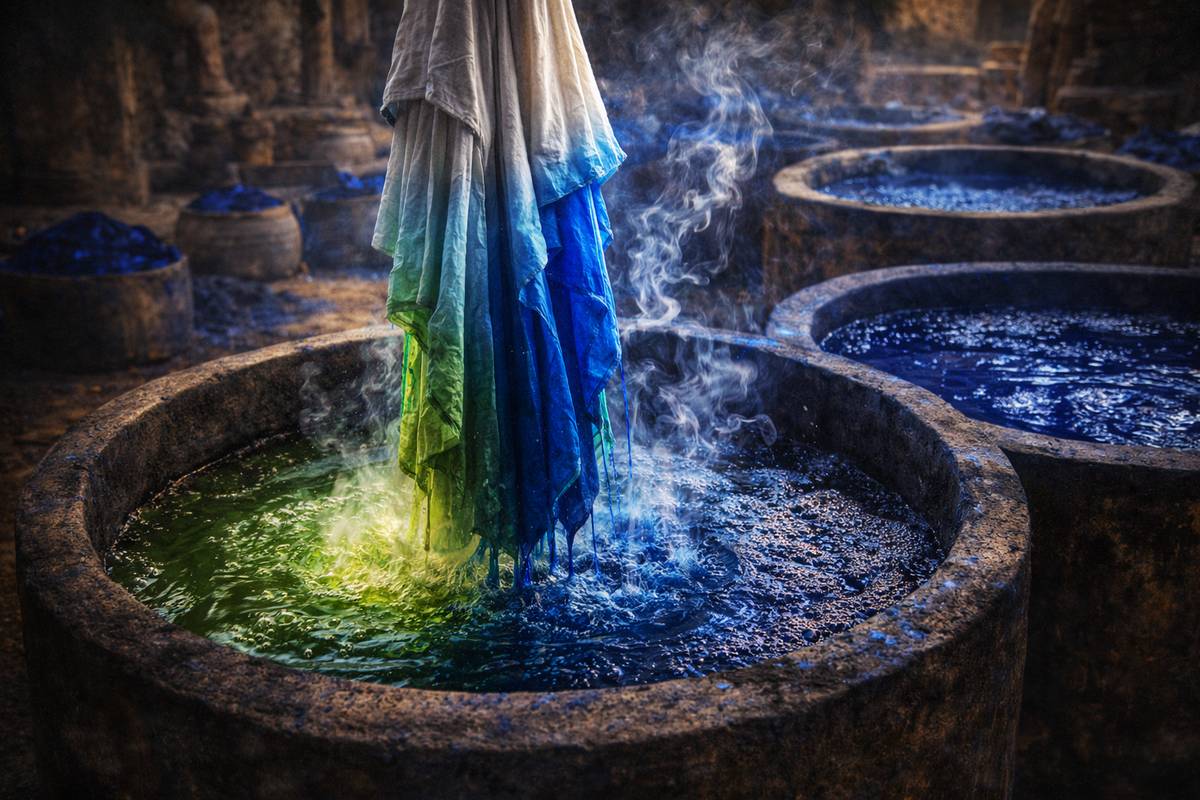
The Concept Natural dyes usually fade or wash off. Indigo (Neela) is a unique organic compound that requires a complex chemical fermentation process to transform green leaves into a vivid, long-lasting blue dye.
The Story To the Romans, there was one color that represented the height of luxury: Indicum, the blue dye that came only from India. But turning a green leaf into a brilliant blue dye required a complex, multi-stage chemical fermentation process that was a closely guarded Indian secret. It was so valuable it was called “Blue Gold”. This ancient chemical mastery was so perfect that it survived the ages—today, every time you put on a pair of blue jeans, you are wearing the legacy of an Indian chemical tradition that is over 5,000 years old.
The Timeline
| Milestone | Details |
| Western Ref. |
1880 CE (Synthetic Indigo by Baeyer) |
| Indian Source |
Prior to 3000 BCE (Harappan remnants); 400 BCE (Arthashastra) |
| Chron. Gap |
Over 10,000 Years |
The Original Text
Sanskrit Shloka: नक्तं जातास्योषधे रामे कृष्णे असिक्नि च । इदं रजनि रजय किलासं पलितं च यत् ॥ Transliteration: Naktaṃ jātāsyoṣadhe rāme kṛṣṇe asikni ca | Idaṃ rajani rajaya kilāsaṃ palitaṃ ca yat || Atharva Veda (1.23) (Mentions the use of dark plants for colouring) Meaning: “Born in the night are you, O Herb, dark, black, and dusky (Asikni). O Dyeing Plant (Rajani), color this leprosy and the gray spots.”
Related Innovations The Vishnudharmottara Purana outlines how to produce pigments using fermentation vats to process Indigo in alkaline solutions. This is a biological reduction approach that allows the dye to adhere to the fibre without needing a metallic mordant.
Fun Fact Did you know that Levi’s jeans are now blue because of an old Indian chemical heritage?.
The Modern Legacy The search for Indigo sparked the creation of organic chemistry and the synthetic dye industry, which gave rise to modern pharmaceuticals.
Recent Post
The Concept Cotton seeds are slow to separate by hand; [...]
The Concept Bacteria, viruses, and parasites are small, invisible organisms [...]