
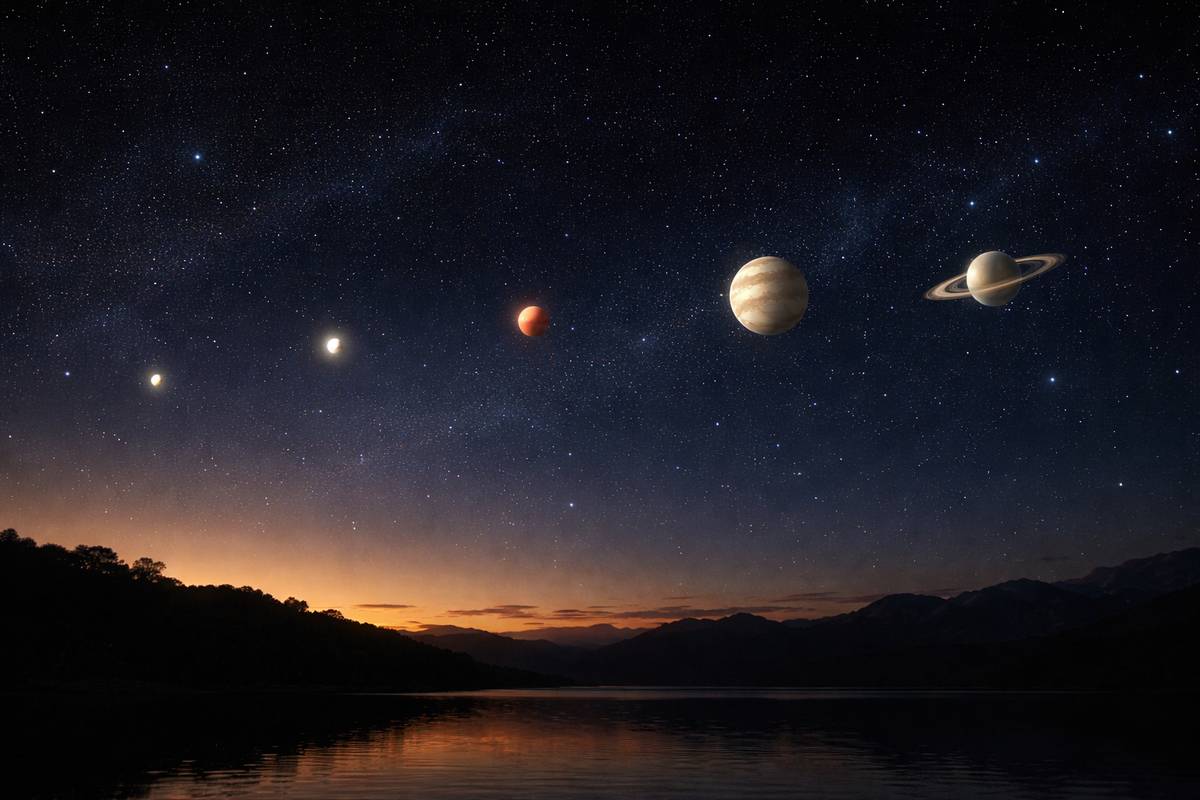
The Concept Distinguishing planets from stars: Planets move around, whilst stars stay in one location.
The Story To the ancient world, everything in the sky looked like a point of light. But the Rig Veda distinguished the “Wanderers” (Grahas) from the fixed stars. They didn’t just see lights; they saw characteristics. They called Mars “The Red One” and Jupiter “The Heavy One” (Guru), correctly identifying their physical natures through observation alone. They even realized that the dazzling “Morning Star” and “Evening Star” were both the same planet, Venus, long before Western astronomers solved the identity of the twin lights.
The Timeline
| Milestone | Details |
| Western Ref. |
Ancient Babylon (1800 BCE) / Greece (c 500 BCE) |
| Indian Source |
Prior to 10,000 BCE (Rig Veda) |
| Chron. Gap |
Over 8,000 Years |
The Original Text
The Rig Veda (10.55.3) makes specific references to the 34 lights—the Sun, Moon, 5 Planets, and 27 Nakshatras.
Related Innovations The Surya Siddhanta accurately characterised the planets, calling Mars red and Venus dazzling white, and classified the speeds of the planets’ orbits from the Moon (fastest) to Saturn (slowest) based on their geocentric angular velocity.
Fun Fact They realised that Venus resembled both the Morning and Evening Stars and realised that they were the same thing long before anyone else did.
The Modern Legacy The study of planets and how they are organised in the solar system.
Recent Post
The Concept Science pursues Truth, regardless of discomfort, and requires [...]
The Concept A water clock, for example, calculates time based [...]