
The Concept
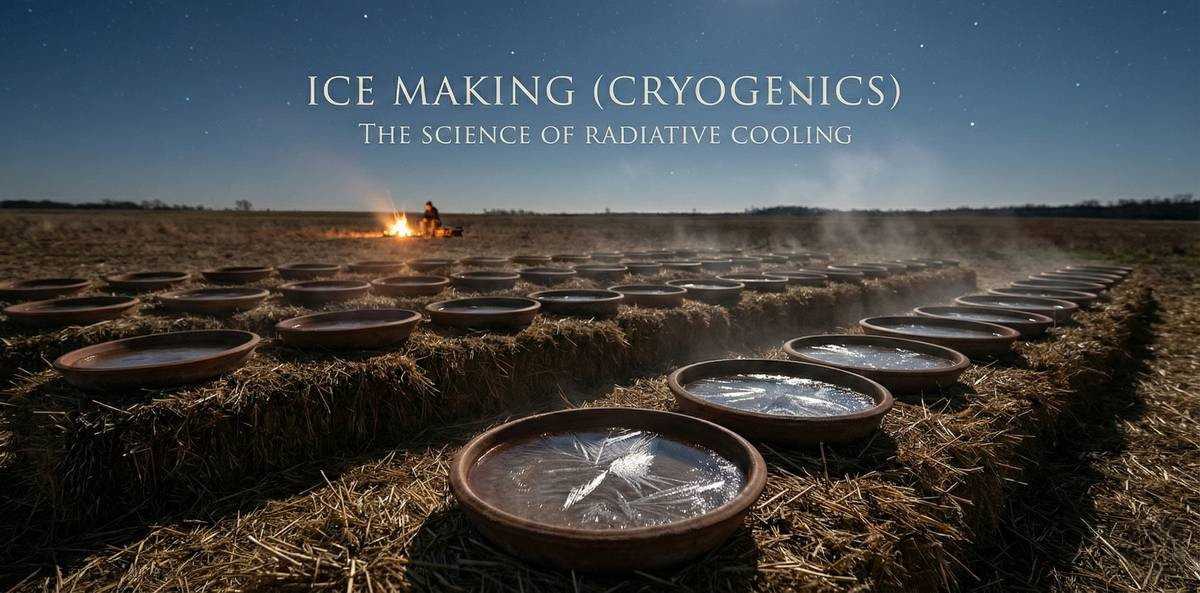
By applying ‘Radiative Cooling’ to the dark night sky, you can create ice even when the ambient temperature is higher than freezing.
The Story
In 1775, a British officer in Allahabad, Sir Robert Barker, witnessed something that seemed to defy the laws of nature: Indians making ice in the middle of a 41°F summer night. By placing shallow ceramic pans of water on beds of straw in open fields, they utilized “Radiative Cooling”. The water sent its heat out into the cold, dark night sky while the straw insulated it from the warm ground. By morning, the pans were filled with ice. This ancient mastery of thermodynamics provided “refrigeration” to Indian cities thousands of years before the first mechanical compressor was ever built.
The Timeline
| Milestone | Details |
| Western Ref | 1800s CE (Mechanical refrigeration) |
| Indian Source | Ancient Oral Tradition (Documented 1775 CE) |
| Chron. Gap | Precedence in Technique |
The Original Text
The Ain-i-Akbari mentions the elaborate transport and storage systems developed for ice.
Related Innovations
Evaporative Cooling (Matkas): The clay pot’s porosity uses thermodynamics to keep water cool, a technology discovered during excavations of the Indus Valley Civilisation (Mohenjo-daro, c. 2600 BCE).
The Modern Legacy
Thermodynamics and heat transfer systems (such as refrigerators and air conditioners) form the foundation of modern science.
Recent Post

The Concept A bridge that swings from cables rather than [...]
The Concept Engineers face difficulties when building a dam on [...]