
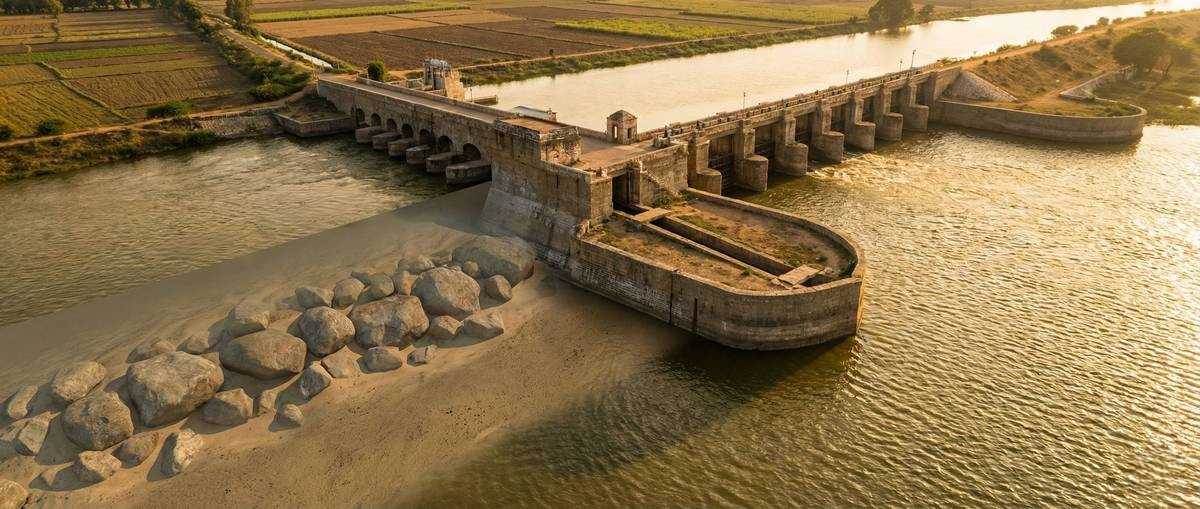
The Concept
Engineers face difficulties when building a dam on a sandy riverbank because the sand drifts and damages the foundation. However, dams hold floods at bay and provide water for crops.
The Story
Around 150 CE, a Chola king named Karikalan faced a “suicidal” engineering challenge: building a massive dam on a moving riverbed of shifting sand. Instead of fighting the river, his engineers used it. They rolled massive boulders into the stream, allowing the force of the water to “drill” them deep into the sand until they hit a stable layer. This structure, the Kallanai or Grand Anicut, has stood for nearly 2,000 years and still irrigates a million acres today. British engineers who studied it in the 1800s were so impressed that they called it a “Masterpiece” and used its principles to build the modern dams of India.
The Timeline
| Milestone | Details |
| Western Ref. | 1800s CE (British engineers study Kallanai) |
| Indian Source | 150 CE (Karikalan Chola) |
| Chron. Gap | Over 1,600 Years |
The Original Text
Tamil: “Kaaviiri naadan, kazhal-todai mannavan, Punal-paayum pozhil-anaithu kaatha…”- Sangam Literature (Pattinappalai – praise of Karikalan’s works). Meaning: “The Lord of the Kaveri, the King wearing the anklet of victory, who protected all the groves where the floods flow (by building the banks/dam).”
Related Innovations
Sluice gates are advanced devices that control the flow of water into canals to prevent flooding (Junagadh Rock Inscription, c. 150 CE). Interlinking canals are a network of canals that move water to dry areas, and they were recorded as early as the Nanda dynasty in the Hatigumpha Inscription (c. 1st Century BCE).
Fun Fact
Sir Arthur Cotton, the British engineer who built modern dams in India, claimed that he learnt how to build on riverbeds by studying the Grand Anicut, which he dubbed the ‘Grand Masterpiece’.
The Modern Legacy
Civil engineering and water resource management are the foundations of modern science.
Recent Post

The Concept A bridge that swings from cables rather than [...]
The Concept A lathe rotates a workpiece while a stationary [...]