
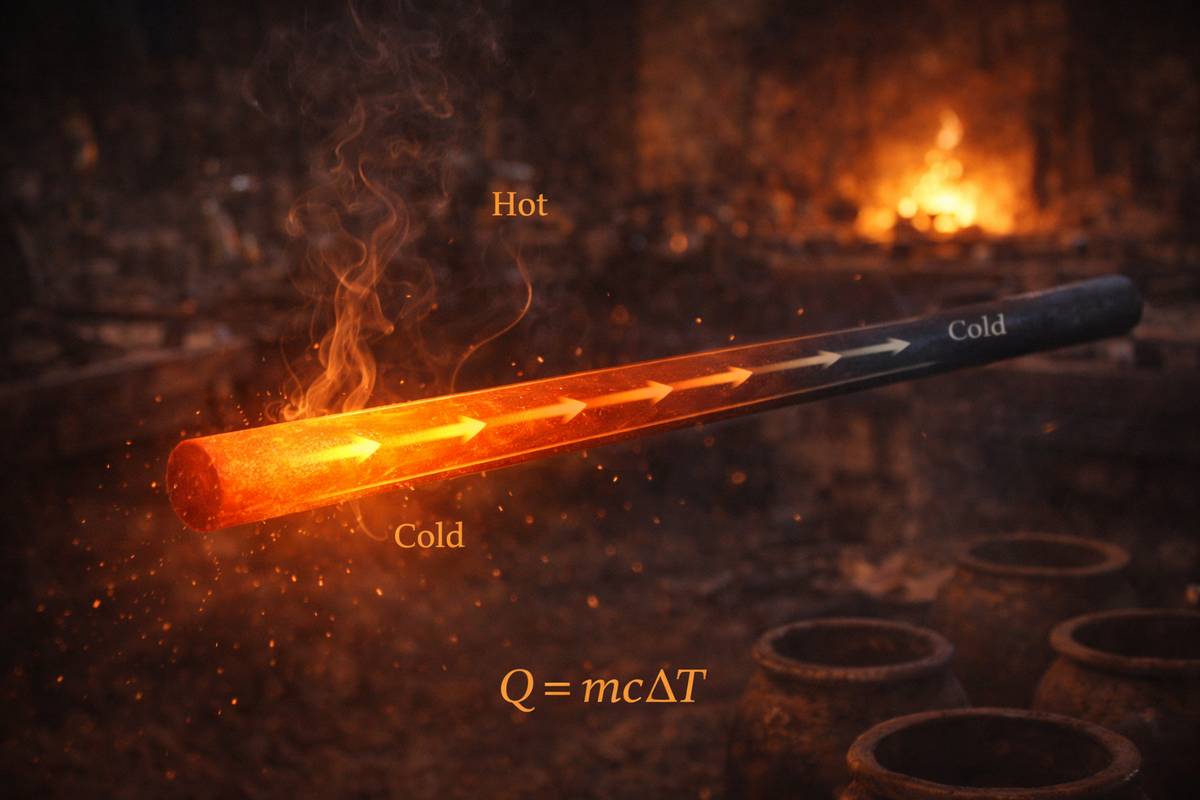
The Concept Old European science considered heat to be a fluid, but it is actually a form of energy that excites particles.
The Story Until the mid-1800s, Europe believed heat was an invisible fluid called “caloric” that flowed into objects. But Indian philosophers of the Nyaya-Vaisesika school had a much more modern view. They realized that Tejas (Heat) was a form of kinetic energy that penetrated substances to break down atomic bonds. They used the example of a green mango turning yellow as it ripens—a process they called Paka—to explain how heat triggers chemical and molecular transformations. They had mastered thermodynamics while others were still chasing fluids.
The Timeline
| Milestone | Details |
| Western Ref. |
1850s CE (Thermodynamics established) |
| Indian Source |
Prior to 5,000 BCE (Nyaya-Vaisesika); Kiranavali by Udayanacharya 1,000 CE |
| Chron. Gap |
Over 6,000 Years |
The Original Text
Sanskrit Shloka: उष्णस्पर्शवत् तेजः । तच्च द्विविधं नित्यमनित्यं च । नित्यं परमाणुरूपम् । अनित्यं कार्यरूपम् ॥ Transliteration: Uṣṇasparśavat tejaḥ | Tacca dvividhaṃ nityamanityaṃ ca | Nityaṃ paramāṇurūpam | Anityaṃ kāryarūpam || Kiranavali (Udayana) (Discusses the process of Paka/heating) Meaning: “Tejas is that which has the quality of hot touch. It is of two kinds: Eternal and Non-eternal. The eternal form exists as Atoms (Paramanu); the non-eternal form is the product (visible fire).”
Related Innovations The Nyaya-Vaisheshika school investigated Paka to learn how heat is absorbed during phase transitions without immediately raising the temperature (Latent Heat). They also discussed Ushna Samkrama as the passage of heat through solid things like metal rods (conduction).
Fun Fact They discovered several types of Tejas, including ‘stomach fire’ (digestion) and ‘solar fire’ (radiation).
The Modern Legacy Thermodynamics is the foundation of modern science. It aids in the development of motors and refrigerators, as well as our understanding of climate change .
Recent Post
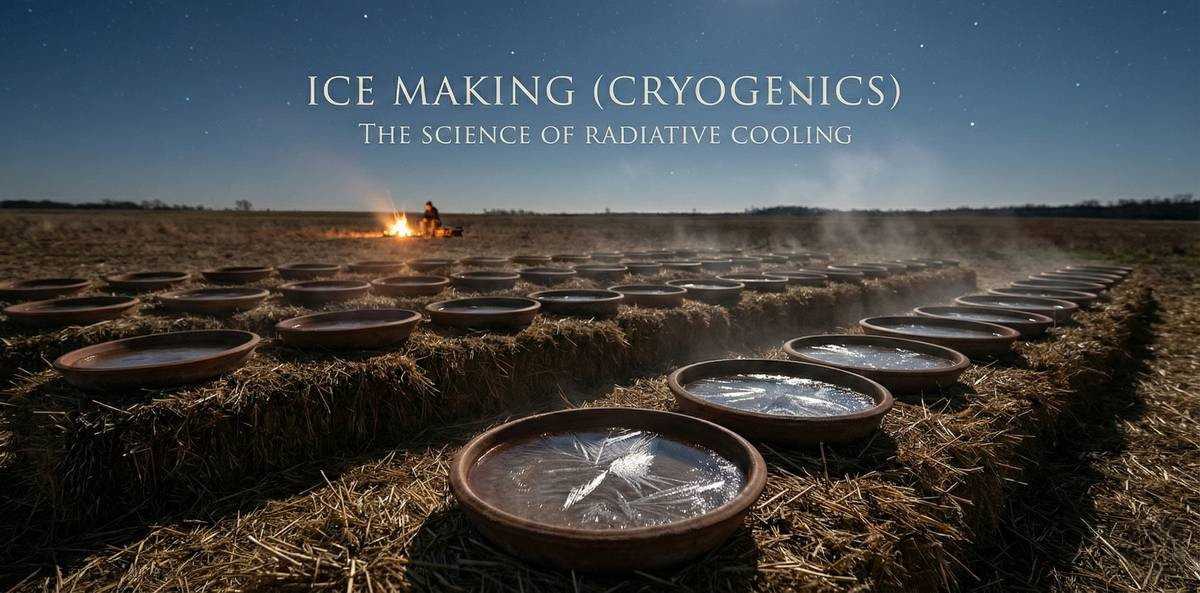
The Concept By applying ‘Radiative Cooling’ to the dark night [...]
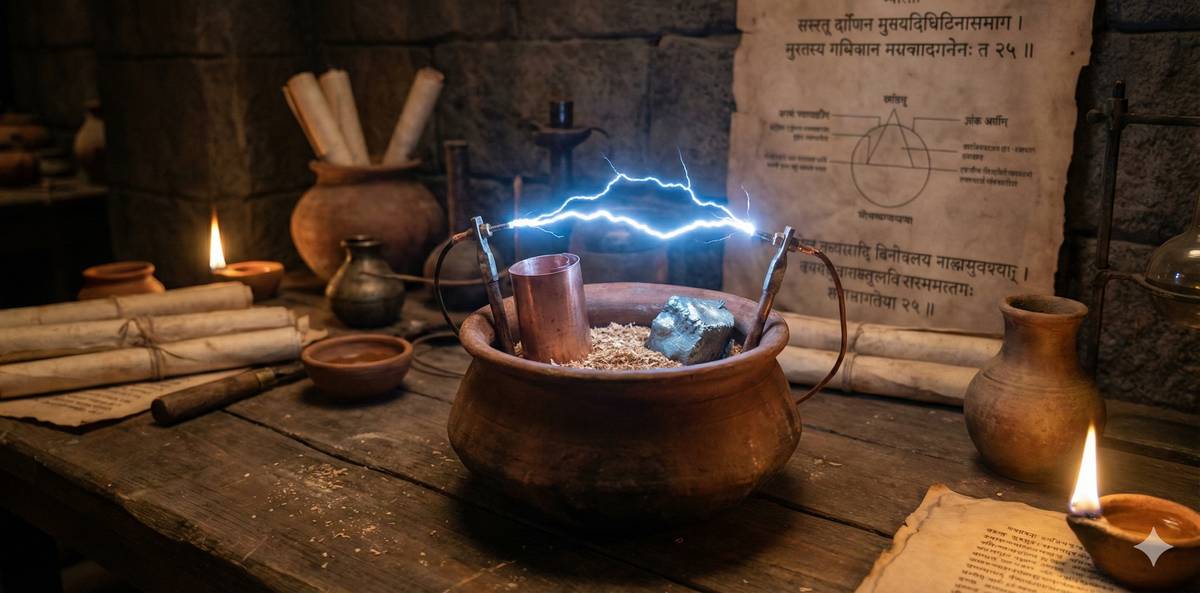
The Concept When two different metals react with an acidic [...]