
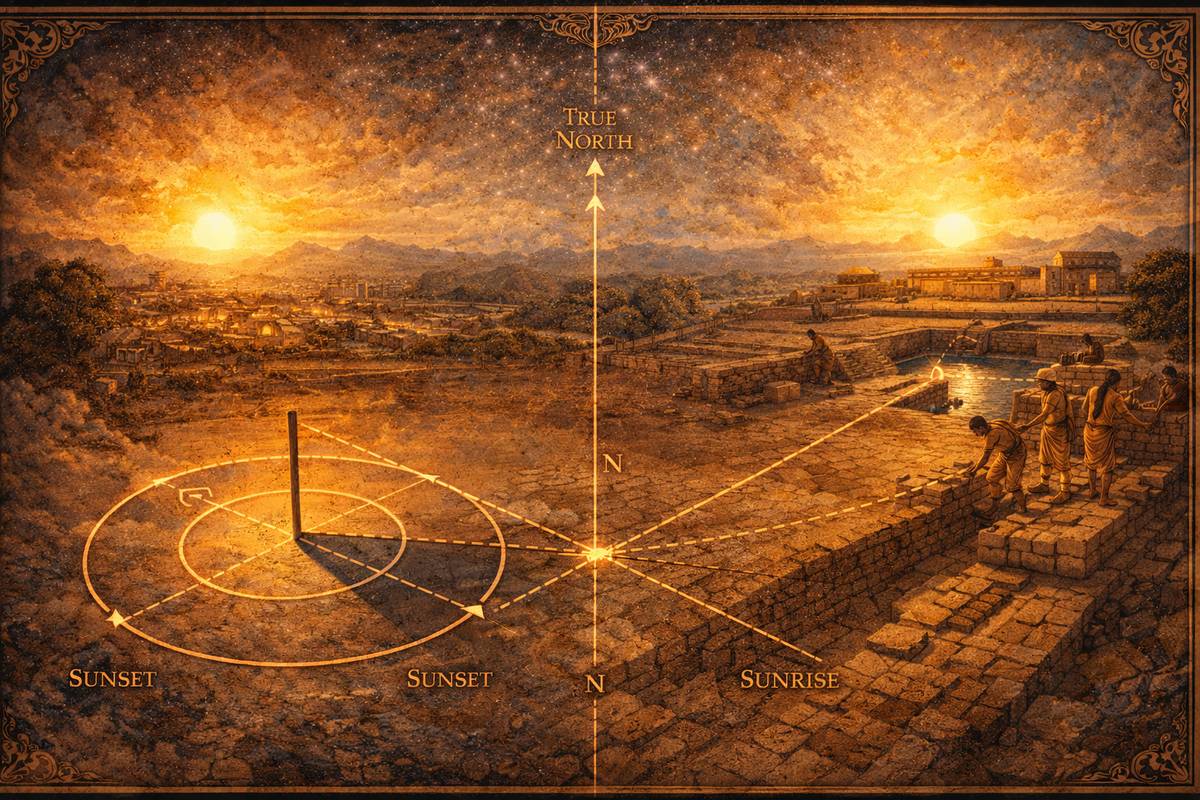
The Concept To orient a temple or observatory in the appropriate direction, use True North rather than Magnetic North. The ‘Shadow Circle’ technique is described in the Surya Siddhanta. A vertical stick (Shanku) is positioned in the centre of a circle. To create a flawless East-West axis, mark where the shadow touches the circle at dawn and Sunset, and then draw a line between those points. A perpendicular bisector indicates precisely where North and South are.
The Story To build a temple that perfectly aligned with the cosmos, ancient Indian architects couldn’t rely on a magnetic compass, which points toward the shifting magnetic pole. Instead, they used the “Shadow Circle” method (Shanku). By placing a vertical stick in a circle and marking where the dawn and sunset shadows touched the edge, they created a flawless East-West axis. A perpendicular line gave them True North with a precision that modern GPS would envy. This simple, elegant geometry allowed the Indus Valley cities to be built on perfect grids 4,600 years ago, oriented to the cardinal directions with mathematical certainty.
The Timeline
| Milestone | Details |
| Western Ref. |
c. 600 BCE (Anaximander) |
| Indian Source |
Prior to 10,000 BCE (Surya Siddhanta) |
| Chron. Gap |
Over 9,000 Years |
The Original Text
The technique is outlined in the Surya Siddhanta (3.1-2): ‘Shilatale ambushuddhe…’.
Related Innovations Finding Latitude: Use the length of the shadow at noon on the equinox to determine your location. Source: Surya Siddhanta.
Fun Fact Did you know that the Sindhu civilisation (2600 BCE) created towns with street grids perfectly aligned with the cardinal directions? They most likely employed this method.
The Modern Legacy Surveying and Cartography refer to the ability to navigate the Earth’s surface.
Recent Post

The Concept A bridge that swings from cables rather than [...]
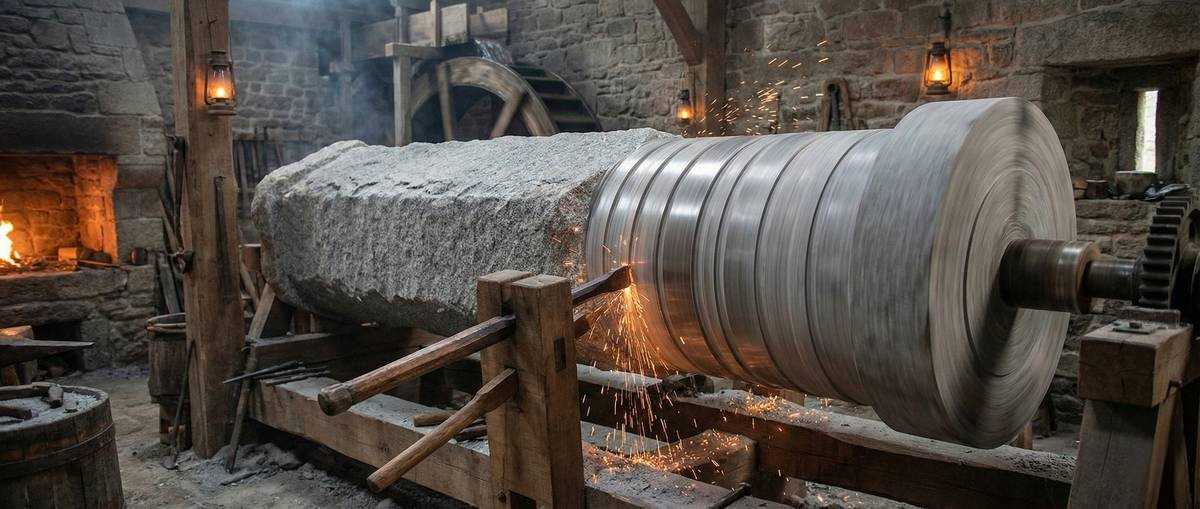
The Concept A lathe rotates a workpiece while a stationary [...]