
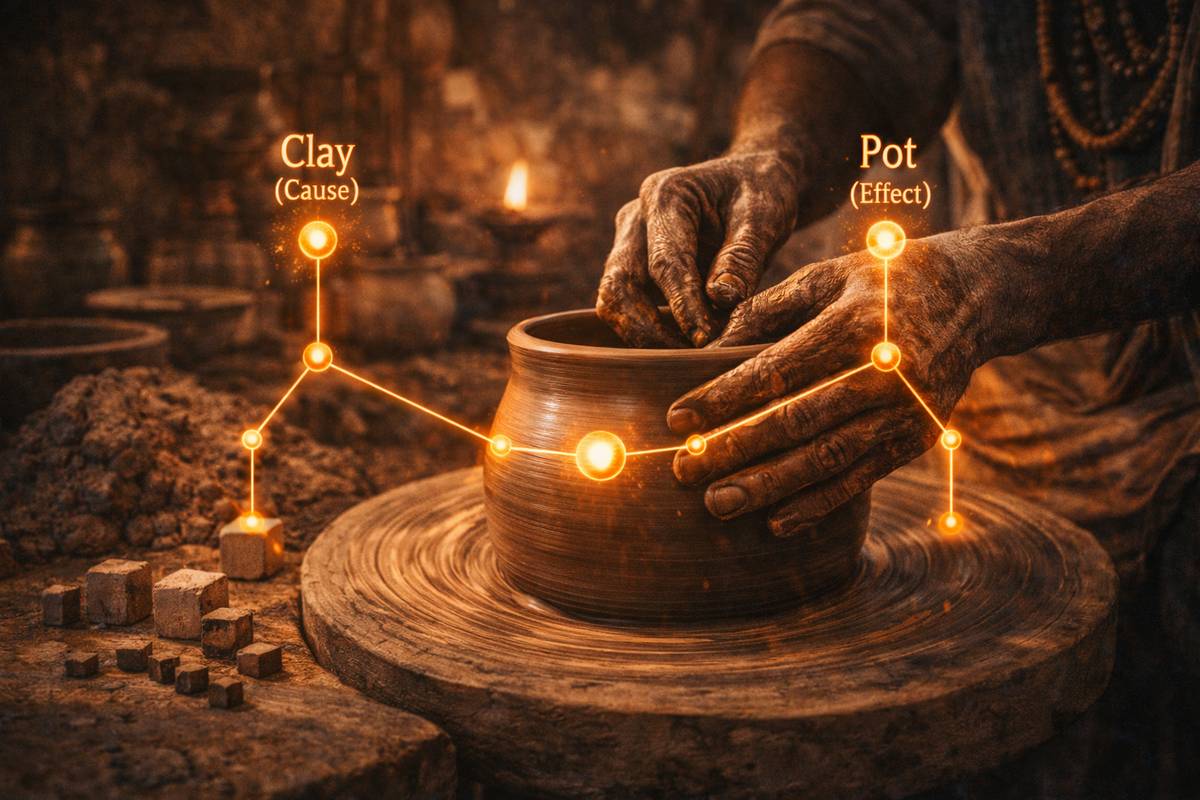
The Concept There is a cause for every outcome. Things do not happen by coincidence; there is a chain of events. This is the scientific method.
The Story While some cultures explained natural disasters as the “will of the gods,” Indian logic (Nyaya) demanded a natural explanation. They developed the Karya-Karana Bhava—the law of cause and effect. They famously taught: “Where there is smoke, there must be fire”. This wasn’t just a saying; it was the world’s first formal Scientific Method . They used Anumana (inference) and Tarka (logical questioning) to methodically dismiss false ideas, creating a culture of inquiry that allowed science to flourish for millennia.
The Timeline
| Milestone | Details |
| Western Ref. |
1600s CE (Baconian Method) |
| Indian Source |
Prior to 5,000 BCE (Gautama’s Nyaya Sutras) |
| Chron. Gap |
Over 6,000 Years |
The Original Text
The Nyaya Sutras (1.1.5) discuss inference and causality in great depth.
Related Innovations The Nyaya Sutras (c. 200 BCE) introduced the scientific method of Anumana (inference) to deduce unseen causes from observed results, while Tarka (falsification) was used to methodically dismiss erroneous hypotheses by demonstrating their contradictions.
Fun Fact This is why Indian astronomers sought mathematical explanations for eclipses rather than simply believing they were bad omens.
The Modern Legacy The Scientific Method (hypothesis -> experiment -> conclusion) is simply a more structured version of this traditional style of thinking.
Recent Post
The Concept Science pursues Truth, regardless of discomfort, and requires [...]