
The Concept
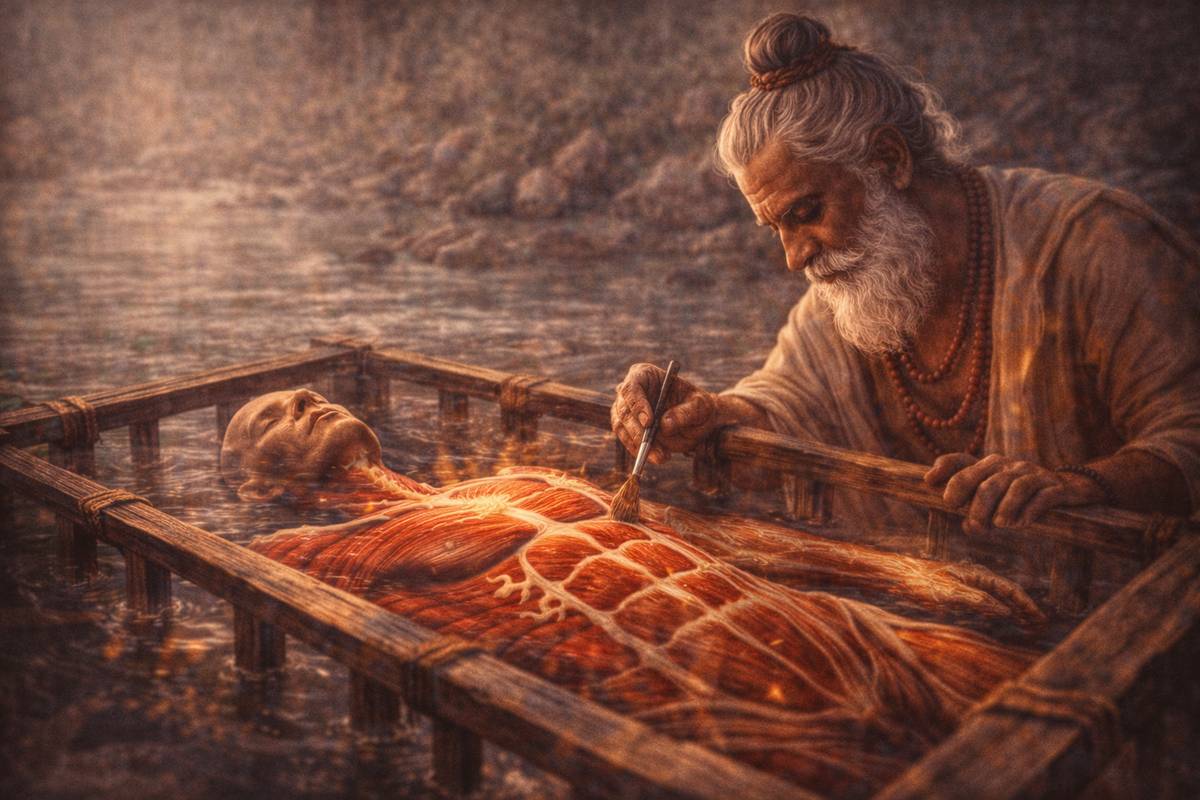
To repair a body, you must first understand what is within it . Dissection is the procedure of cutting open a dead body to examine its organs.
The Story
In medieval Europe, the Church’s ban on dissection kept the human body a mystery, but in ancient India, the surgeon Sushruta believed you couldn’t heal what you didn’t understand. To bypass religious taboos against cutting flesh, he devised a brilliant, non-invasive method of “dissection”. He would place a body in a cage and let it sit in a flowing river for seven days. As the skin softened through natural decay, he used a brush to gently scrape away layers, revealing the delicate network of nerves, muscles, and 300 bones without damaging them. This practice of Mrita Shodhana allowed Indian surgeons to map the body’s interior 6,000 years before the first modern anatomy textbooks were written.
The Timeline
| Milestone | Details |
| Western Ref. |
1543 CE (Vesalius – Father of Anatomy) |
| Indian Source |
Prior to 5,000 BCE (Sushruta Samhita) |
| Chron. Gap |
Over 6,000 Years |
The Original Text
The Sushruta Samhita (Sarira Sthana 5.49) provides the exact instructions on preparing the cadaver.
Related Innovations
The Sushruta Samhita pioneered osteology by accurately counting and classifying 300 bones, including teeth and cartilage, and layered anatomy by understanding the body as seven distinct layers of skin and tissue, providing precise surgical depth measurements.
The Modern Legacy
Every medical student today begins their career in the anatomy hall, a custom that Sushruta promoted .
Recent Post

The Concept Yoga demonstrates that the autonomic nervous system may [...]
The Concept The body functions as an engine, burning fuel [...]