
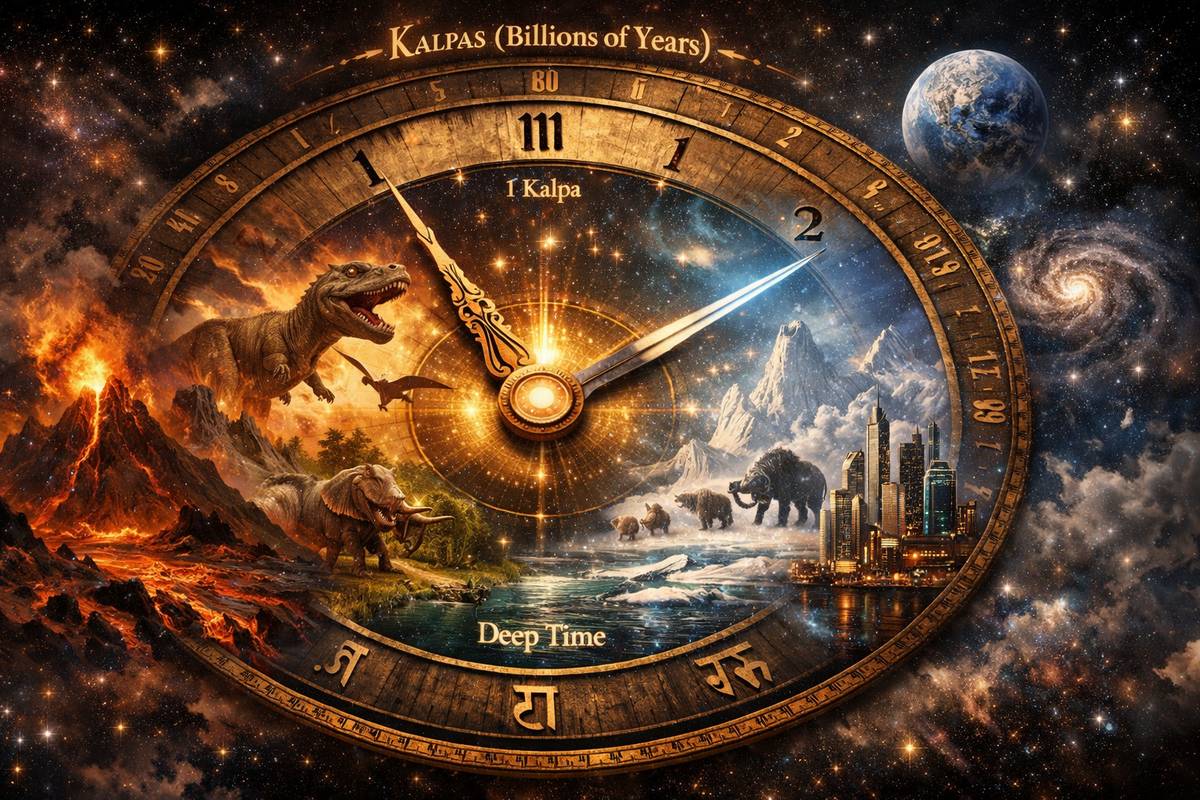
The Concept The universe has existed for billions of years. This is ‘Deep Time’.
The Story For over a millennium, Western thought was constrained by a strict biblical chronology, attempting to squeeze the entire history of the Earth into a meagre 6,000 years. Indian cosmology, however, was already thinking in billions. The Puranas described a Kalpa (a single day of the Creator) as 4.32 billion years—a number so vast it was dismissed as “myth” by colonial scholars. Yet, when modern radiometric dating finally revealed the Earth’s age to be roughly 4.5 billion years, the “myth” suddenly looked like a premonition. As Carl Sagan later noted, India was the only ancient culture whose time-scale matched the staggering “Deep Time” of modern science.
The Timeline
| Milestone | Details |
| Western Ref. |
1950s CE (Radiometric dating of Earth) |
| Indian Source |
Prior to 5000 BCE (Puranas / Surya Siddhanta) |
| Chron. Gap |
Over 7,000 Years |
The Original Text
Sanskrit Shloka: चतुर्युगसहस्रं तु ब्रह्मणो दिनमुच्यते । स तावतीं रात्रिमपि शेते स पुरुषोत्तमः ॥
Transliteration: Caturyugasahasraṃ tu brahmaṇo dinamucyate | Sa tāvatīṃ rātrimapi śete sa puruṣottamaḥ || Reference: Vishnu Purana (1.3) (Describes the Yugas and Kalpas totalling billions of years).
Meaning: “One thousand Chatur-Yugas are said to be one day of Brahma. That Supreme Person sleeps for a night of equal duration.”
Related Innovations Cosmic Breath: The belief that the universe expands and contracts (Pralaya). The Puranas serve as the source.
Fun Fact The ‘Day of Brahma’ lasts 4.32 billion years.
The Modern Legacy The Geological Time Scale is used to comprehend how the Earth and planets developed, and this concept is consistent with it.
Recent Post
The Concept There are other stars, such as our Sun. [...]
The Concept The Milky Way is our galaxy. It is [...]