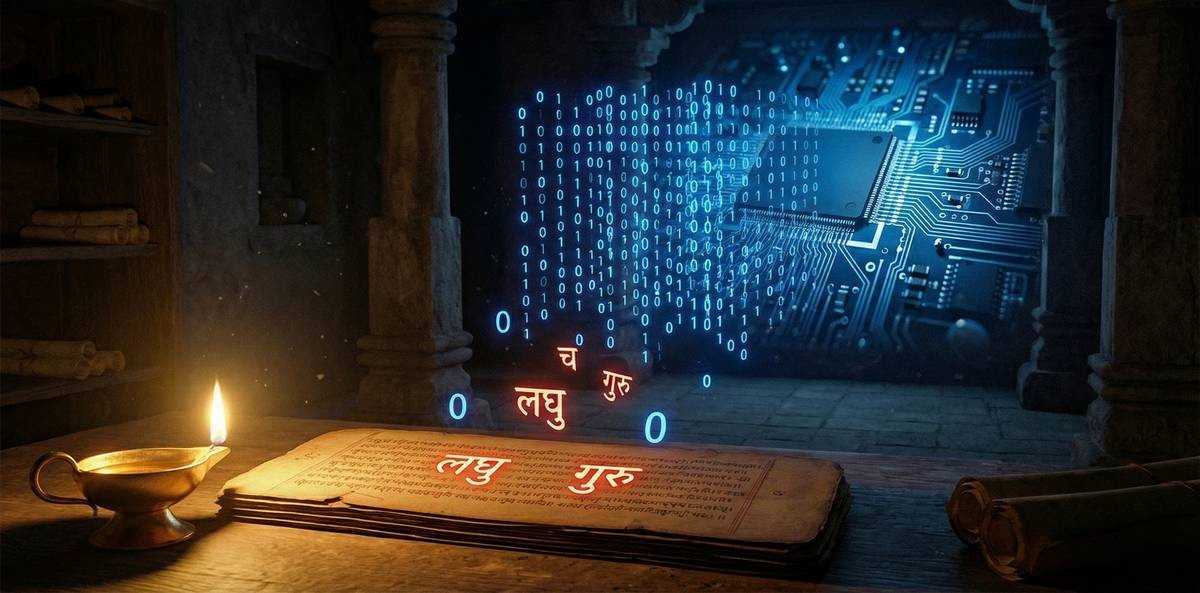
The Concept Binary has only two states: zero (off) and one (on). This is the ‘Machine Language’ that all computers, cell phones, and artificial intelligence systems use today. It converts all information into a series of yes/no choices.
The Story Long before the first computer chip was ever dreamed of, an Indian sage named Pingala was obsessed with the rhythm of poetry. He wasn’t looking for electricity; he was looking for the logic of music. By breaking every poetic meter into ‘Short’ (0) and ‘Long’ (1) syllables, he created the world’s first ‘Machine Language’. While history books often credit Leibniz with inventing binary in the 1600s, Pingala’s Chandas Shastra had already mapped out the doubling and halving algorithms that run your smartphone today. It is the ultimate irony: the code for Artificial Intelligence was first written to perfect the chanting of ancient verses.
The Timeline
| Milestone | Details |
| Western Ref. |
1679 CE (Gottfried Wilhelm Leibniz) |
| Indian Source |
Prior to 2,000 BCE (Pingala’s Chandas Shastra) |
| Chron. Gap |
Over 3,500 Years |
The Evidence
Sanskrit Shloka: द्विरर्धे तदन्तानाम् ग्लौ इति । Transliteration: Dvir ardhe tad antyānāṁ glau iti. Meaning: ‘When the number is halved (divisible by two), write a Guru (heavy syllable/1); when it is not divisible, subtract one and write a Laghu (light syllable/0).’ (This is effectively the logic of 1s and 0s). (Pingala Chhandas Sutra 8.23)
Related Innovations The Katapayadi system converted numbers into music, and Vedic chanting used binary code-like patterns to remedy errors and ensure that the syllables were correctly pronounced.
Fun Fact Pingala’s algorithms for calculating poetic combinations are identical to the code that operates your laptop.
The Modern Legacy Serving as the ‘Machine Language’ of the modern world, this logic underpins the entire Information Age. Digital computing is impossible without the binary framework first conceptualized by Pingala.