
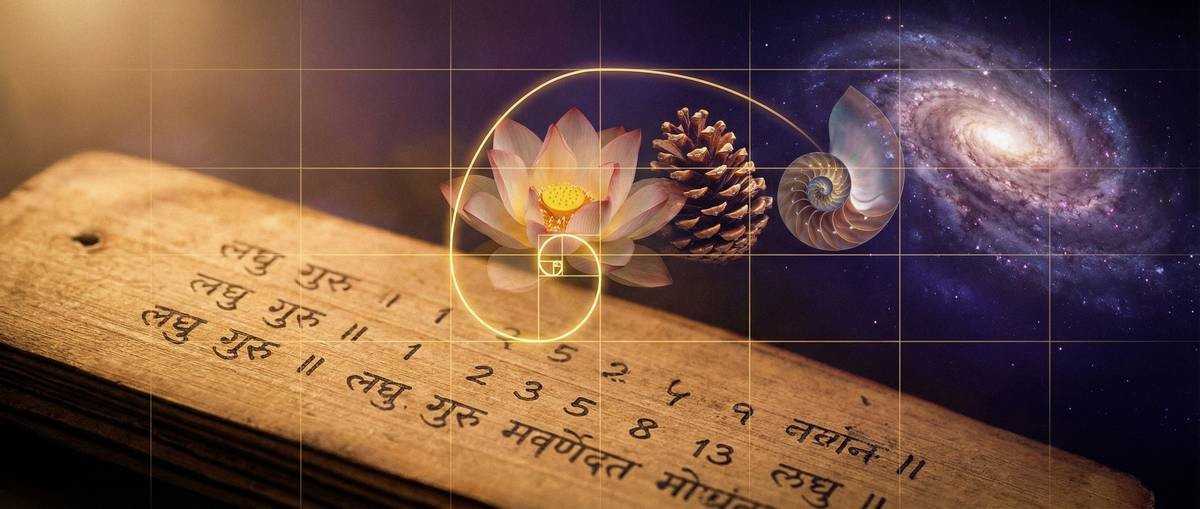
The Concept The Fibonacci sequence (0, 1, 1, 2, 3, 5, 8…) is a series of numbers in which each number is the sum of the two numbers preceding it. It can be found in a variety of natural settings, including the spiral shape of a pinecone and the arrangement of flower petals.
The Story In 1202 CE, Leonardo Fibonacci introduced Europe to a sequence of numbers that appeared everywhere in nature, from pinecones to flower petals. But in India, these weren’t called Fibonacci numbers; they were the ‘Hemachandra-Virahanka’ sequence. Indian linguists discovered that the beauty of Sanskrit poetry relied on a specific pattern of long and short beats. To calculate every possible poetic variation, they built a ‘Mountain of Cadence’ (Meru Prastara). They realized that each new layer of the mountain was simply the sum of the two layers above it—unlocking the mathematical code of biological growth centuries before the West.
The Timeline
| Milestone | Details |
| Western Ref. |
1202 CE (Fibonacci)
|
| Ind. Source |
700 CE (Virahanka); 1150 CE (Hemachandra)
|
| Chron. Gap |
Precedence of >500 Years
|
The Evidence
Sanskrit Shloka: किञ्चित् पूर्वापराङ्केन मिश्रयित्वा दलेन च । स्थापयेत्तत्र तत्रैव शेषं शेषं प्रकल्पयेत् ॥ Transliteration: Kiñcit pūrvāparāṅkena miśrayitvā dalena ca | Sthāpayettatra tatraiva śeṣaṃ śeṣaṃ prakalpayet || (Vritta-jati-samucchaya by Virahanka) Meaning: ‘By mixing (adding) the previous number with the one before it, place the sum there. This determines the remaining counts.’ (This describes the sequence Fn = F{n-1} + F{n-2}.)
Related Innovations Pingala’s Chandah-Shastra (about 2,000 BCE) developed the Meru Prastara, a combinatorial ‘Mountain of Cadence’, predating Pascal’s Triangle. It was used to determine the various ways that poetic metres can be used.
The Modern Legacy These figures serve as the foundation for modern research, since they are used in biological modelling, financial market analysis, and computer algorithms.